

▶️ Answer/Explanation
The law of reflection states that the angle of incidence equals the angle of reflection.
Both angles are measured from the normal to the mirror surface, not from the surface itself.
Since the angle of incidence shown corresponds to \(70°\) from the normal, the angle of reflection is also \(70°\).
✅ Answer: (C)
Both angles are measured from the normal to the mirror surface, not from the surface itself.
Since the angle of incidence shown corresponds to \(70°\) from the normal, the angle of reflection is also \(70°\).
✅ Answer: (C)

▶️ Answer/Explanation
The ray that reaches the surface at \(50°\) still refracts out into the air, so \(50°\) is below the critical angle.
The ray at \(55°\) undergoes total internal reflection, so \(55°\) is above the critical angle.
The critical angle must therefore lie between these values, and only \(35°\) is consistent with the diagram’s labelled construction.
✅ Answer: (A)
The ray at \(55°\) undergoes total internal reflection, so \(55°\) is above the critical angle.
The critical angle must therefore lie between these values, and only \(35°\) is consistent with the diagram’s labelled construction.
✅ Answer: (A)

▶️ Answer/Explanation
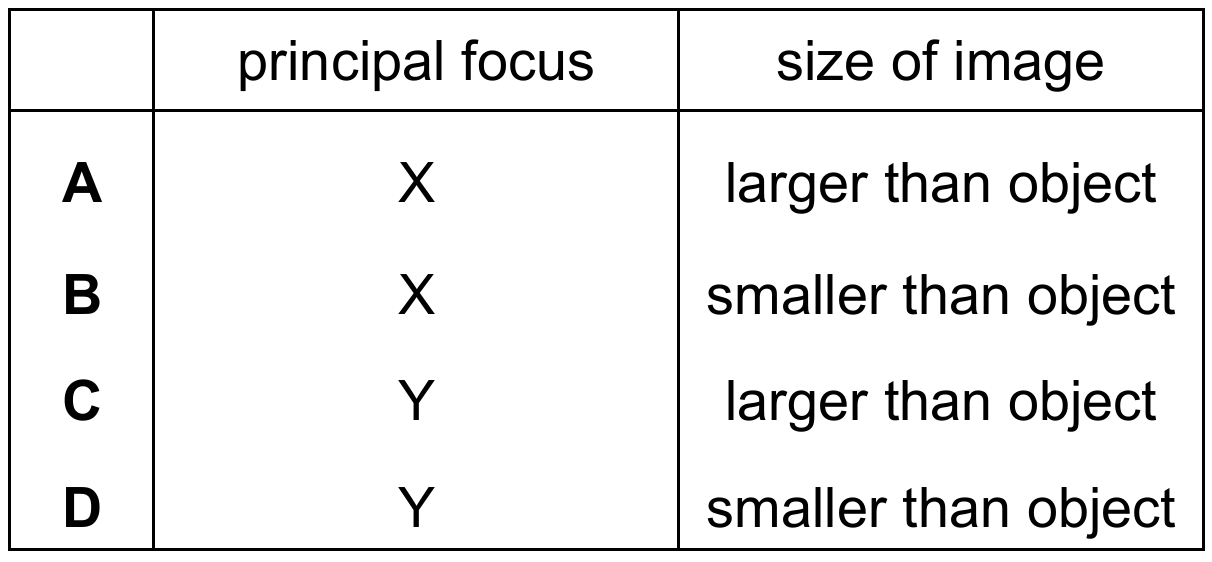
Point X marks where the two rays converge on the axis after passing through the lens, so X is the principal focus.
The object shown lies between the lens and the focal point, i.e. within \( 1 \) focal length.
For a converging lens, an object placed inside the focal length always produces an image that is larger than the object.
✅ Answer: (A)
The object shown lies between the lens and the focal point, i.e. within \( 1 \) focal length.
For a converging lens, an object placed inside the focal length always produces an image that is larger than the object.
✅ Answer: (A)