
CIE iGCSE Co-Ordinated Science P3.2.4 Dispersion of light Exam Style Questions Paper 4
Question
The speed of light is \(3.0 \times 10^8\) m/s.
Calculate the wavelength of the blue light waves.
Describe dispersion in terms of wave frequency.
You may wish to draw a diagram to illustrate your answer.
Most-appropriate topic codes (Cambridge IGCSE Co-ordinated Sciences 0654):
• Topic P3.1 — General properties of waves (Part (a))
• Topic P3.2.1 — Reflection of light (Part (b))
• Topic P3.1 — Wave equation (Part (c))
• Topic P3.2.4 — Dispersion of light (Part (d))
▶️ Answer/Explanation
(a)(i) Perpendicular / at right angles / at 90°
In a transverse wave, the direction of vibration is perpendicular to the direction of propagation (energy transfer).
(a)(ii) Transverse waves: ultraviolet, visible light, water wave
Seismic P-waves and sound waves are longitudinal waves.
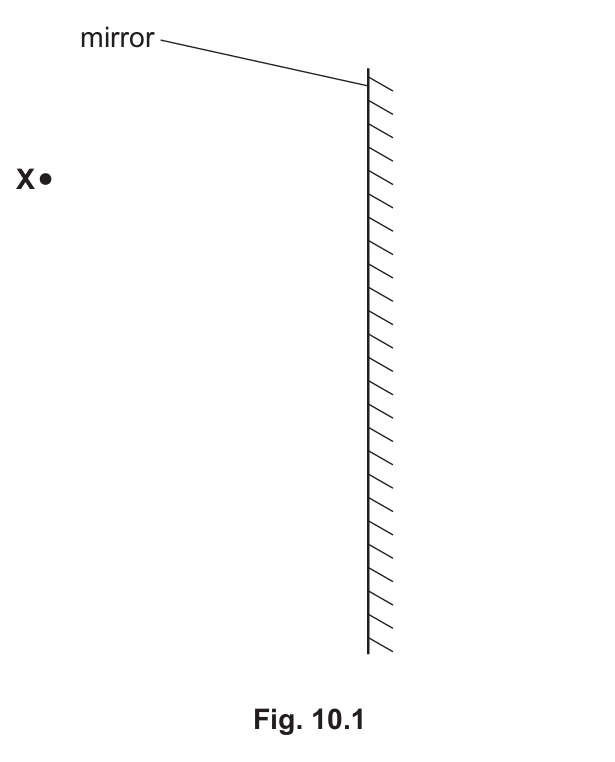
(b)(i) Ray diagram for plane mirror reflection:
1. Draw two rays from point X to the mirror.
2. At each point of incidence, draw the normal and apply the law of reflection (angle of incidence = angle of reflection).
3. Extend the reflected rays behind the mirror using dashed lines.
4. The point where the dashed lines meet is the virtual image (Y).
(b)(ii) Properties: upright, virtual
Plane mirror images are virtual (cannot be projected on a screen), upright (same orientation as object), same size as object, and laterally inverted.
(c) Wavelength calculation:
v = fλ
λ = v/f = (3.0 × 10⁸) / (6.6 × 10¹⁴) = 4.5 × 10⁻⁷ m
(d) Dispersion in terms of wave frequency:
• Different colours of light have different frequencies.
• As white light enters a prism, each colour refracts by a different amount.
• Higher frequency (violet) light is refracted more than lower frequency (red) light.
• This separates the colours, producing the visible spectrum.
Question
Give your answer to 3 significant figures.
Red light has a wavelength of \(7.0 \times 10^{-7} \, \text{m}\).
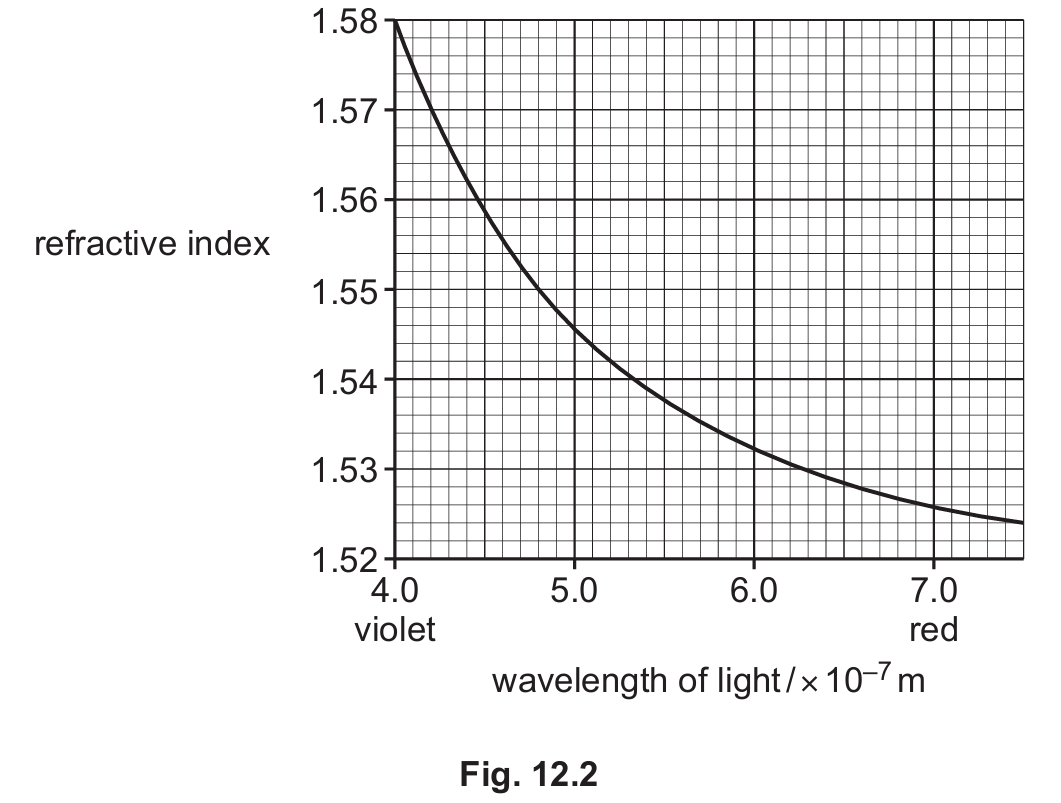
Describe how Fig. 12.2 shows that red light travels faster through glass than violet light.
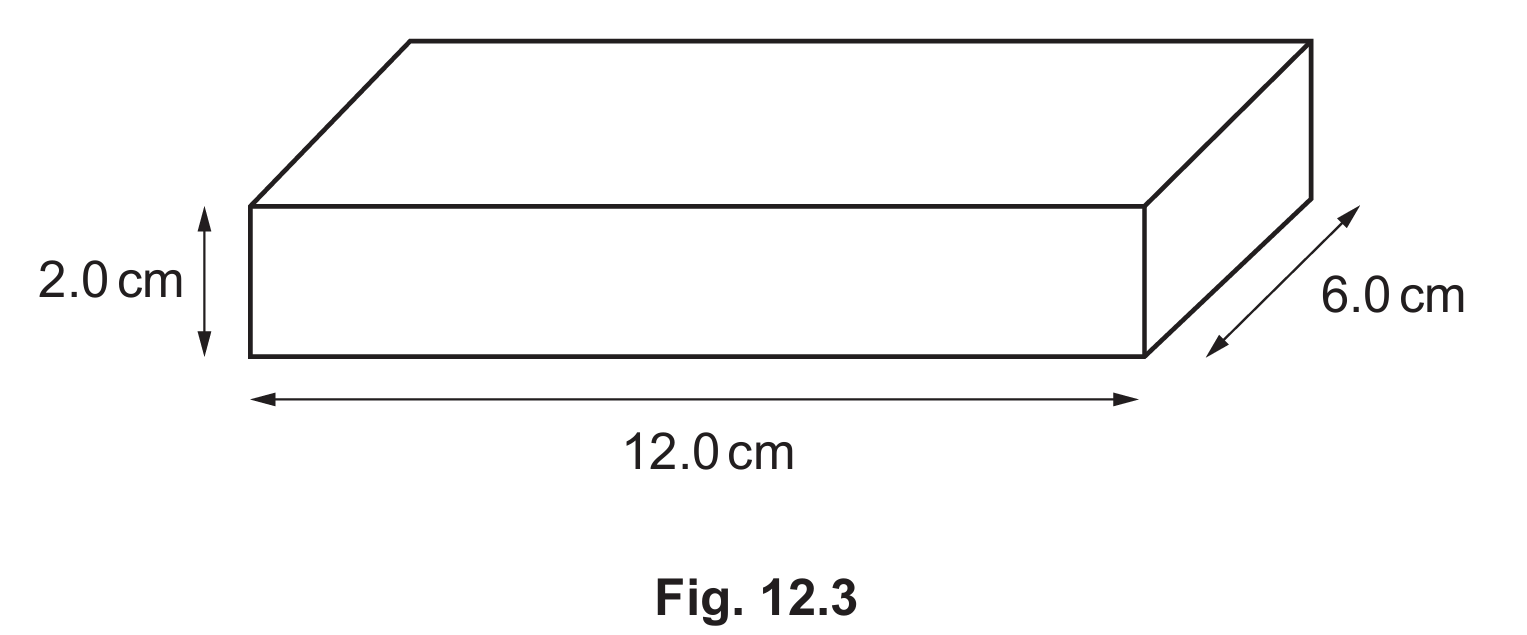
Use Fig. 12.3 to calculate the mass of the glass block.
Most-appropriate topic codes (Cambridge IGCSE Co-ordinated Sciences 0654):
• Topic P3.2.2 — Refraction of light (Parts (a), (b)(i))
• Topic P3.2.4 — Dispersion of light (Part (b)(ii))
• Topic P1.4 — Density (Part (c))
▶️ Answer/Explanation
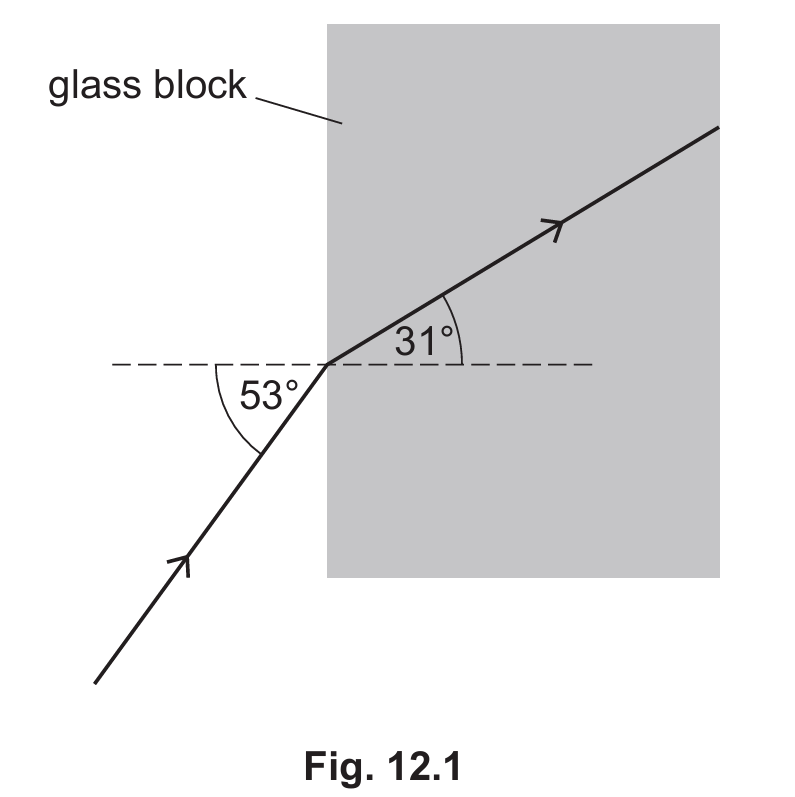
(a) 1.55
Refractive index is calculated using \(n = \dfrac{\sin i}{\sin r}\).
\(n = \dfrac{\sin 53°}{\sin 31°} \approx 1.55\).
(b)(i) \(4.8 \times 10^{-7} \, \text{m}\)
Using the refractive index of 1.55 found in part (a), this value is read off the graph in Fig. 12.2.
This corresponds to a wavelength of approximately \(4.8 \times 10^{-7} \, \text{m}\).
(b)(ii) Refractive index is inversely proportional to speed
Fig. 12.2 shows that red light (longer wavelength) has a lower refractive index than violet light.
Since refractive index is inversely related to the speed of light in the medium, a lower refractive index means red light travels faster through the glass than violet light.
(c) 403 g
Volume of the glass block \(= 12.0 \times 2.0 \times 6.0 = 144 \, \text{cm}^3\).
Mass is calculated using \(\text{mass} = \text{density} \times \text{volume} = 2.80 \times 144\).
This gives a mass of approximately \(403 \, \text{g}\).