
CIE iGCSE Co-Ordinated Science P3.3 Electromagnetic spectrum Exam Style Questions Paper 4
Question
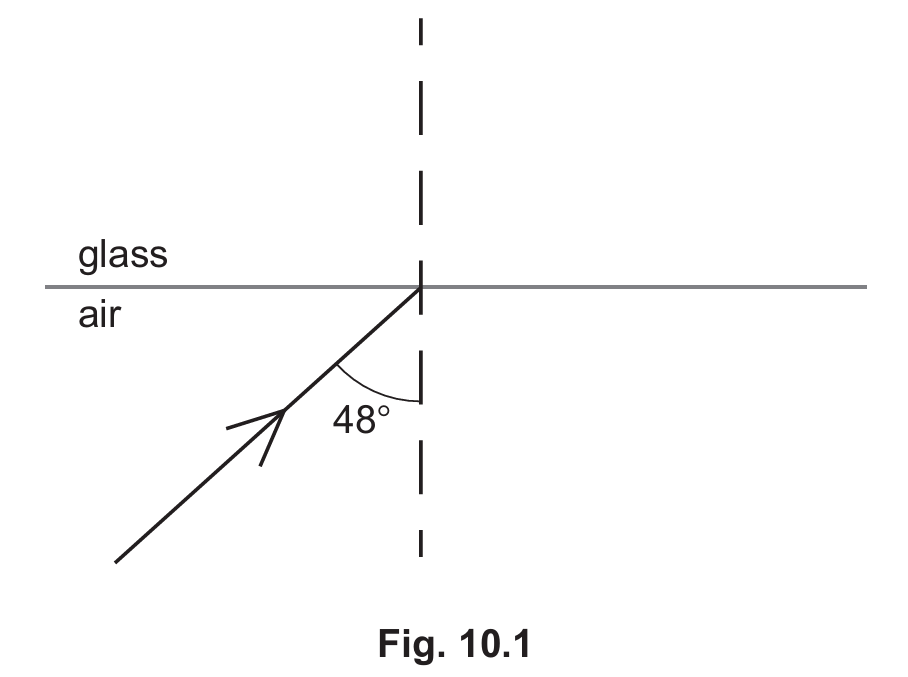
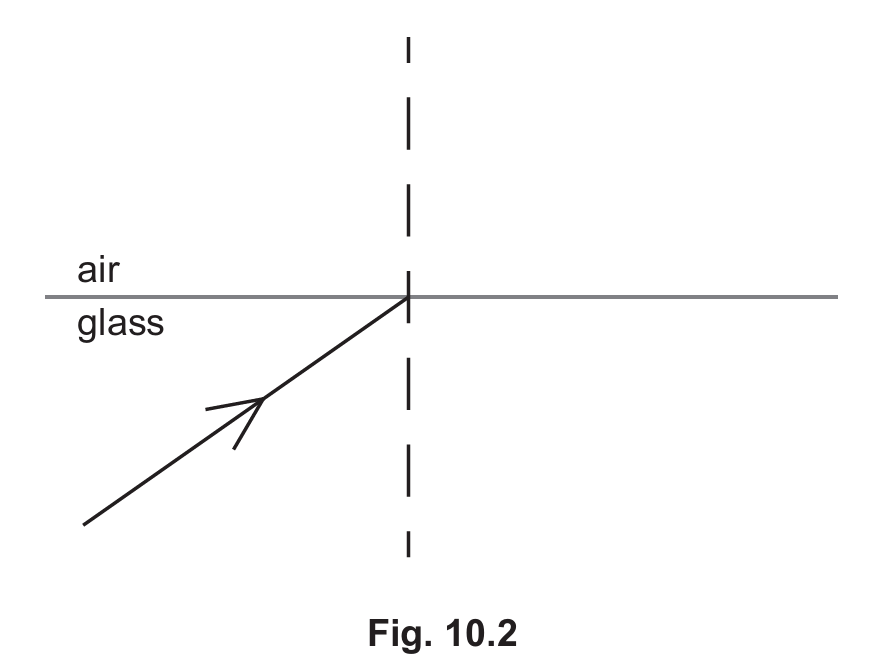
Most-appropriate topic codes (Cambridge IGCSE Co-ordinated Sciences 0654):
• Topic P3.3 — Electromagnetic spectrum (Part (a)(i))
• Topic P3.1 — General properties of waves (Part (a)(ii))
• Topic P3.2.2 — Refraction of light (Part (b)(i), (b)(ii))
• Topic P3.2.2 — Refraction of light / Total internal reflection (Part (c))
▶️ Answer/Explanation
(a)(i) Any one from:
- Satellite television transmissions.
- Mobile phones (cell phones).
- Microwave ovens.
Microwaves are a region of the electromagnetic spectrum with wavelengths ranging from about 1 mm to 1 m. They have several important applications: satellite television uses microwaves for communication as they can pass through the Earth’s atmosphere; mobile phones use microwaves for wireless communication; microwave ovens use microwaves to heat food by causing water molecules to vibrate.
(a)(ii) In a transverse wave, the vibrations / oscillations are perpendicular to the direction of propagation / direction of travel / direction of energy transfer.
Waves can be classified as transverse or longitudinal based on the direction of particle vibration relative to the direction of wave propagation. In a transverse wave, the particles of the medium vibrate at right angles (perpendicular) to the direction in which the wave travels. Examples include electromagnetic waves (including light, microwaves, X-rays), water waves, and seismic S-waves.
(b)(i) Angle of refraction = 36°.
The refractive index (\( n \)) is defined as the ratio of the sine of the angle of incidence (\( i \)) to the sine of the angle of refraction (\( r \)):
\( n = \frac{\sin i}{\sin r} \)
Given: \( n = 1.25 \), \( i = 48^\circ \)
Rearranging: \( \sin r = \frac{\sin 48^\circ}{1.25} \)
\( \sin 48^\circ \approx 0.7431 \)
\( \sin r = \frac{0.7431}{1.25} = 0.5945 \)
\( r = \sin^{-1}(0.5945) \approx 36.5^\circ \approx 36^\circ \)
(b)(ii) The ray should be drawn continuing as a straight line into the glass block in the top right region, refracted towards the normal.
When light travels from air (less dense medium) into glass (more dense medium), it slows down and bends towards the normal. The refracted ray should be drawn with a smaller angle to the normal than the incident ray (i.e., closer to the normal line), continuing in a straight line into the glass block.
(c) The ray should be drawn continuing as a straight line in the bottom right region (back into the glass), with the angle of incidence equal to the angle of reflection (total internal reflection).
When light travels from a denser medium (glass) to a less dense medium (air) at an angle of incidence greater than the critical angle, total internal reflection occurs. In total internal reflection:
- The light ray is reflected back into the glass (the denser medium).
- The angle of incidence equals the angle of reflection.
- No light is transmitted into the air.
The critical angle for the glass-air boundary can be calculated using \( \sin c = \frac{1}{n} \), where \( n \) is the refractive index of glass (approximately 1.5), giving a critical angle of about 42°. Since the incident angle in the question is greater than the critical angle, total internal reflection occurs, and the ray should be drawn reflecting back into the glass at an equal angle to the normal.
Question
Most-appropriate topic codes (Cambridge IGCSE Co-ordinated Sciences 0654):
• Topic P3.4 — Sound (Parts a(i), a(ii) & a(iii))
• Topic P3.3 — Electromagnetic spectrum (Parts b(i) & b(ii))
• Topic P3.1 — General properties of waves (Part c)
▶️ Answer/Explanation
(a)(i) Speed of sound in different states:
Slowest: Gases — particles are far apart with weak intermolecular forces, so vibrations are transmitted slowly.
Fastest: Solids — particles are closely packed with strong intermolecular forces, allowing vibrations to be transmitted rapidly.
(a)(ii) How sound travels through air:
Sound travels through air as a longitudinal wave. The vibrating source causes particles in the air to vibrate back and forth parallel to the direction of energy transfer. This creates a series of compressions (regions of higher pressure where particles are closer together) and rarefactions (regions of lower pressure where particles are spread further apart). These disturbances travel through the air as the energy is passed from one particle to the next.
(a)(iii) Frequency range of human hearing:
20 Hz to 20,000 Hz (20 kHz). Humans can hear sounds within this frequency range. Sounds below 20 Hz are infrasound and above 20 kHz are ultrasound.
(b)(i) Use of ultraviolet radiation:
• Detecting fake bank notes (UV light causes fluorescent markings on genuine notes to glow).
• Sterilising water and surfaces (UV radiation kills bacteria and viruses).
• In tanning lamps.
(b)(ii) Danger of ultraviolet radiation:
• Damage to skin cells — overexposure to UV radiation can cause sunburn, premature ageing of the skin, and skin cancer (melanoma).
• Damage to eyes — UV radiation can cause cataracts and other eye conditions.
• Cell mutations — UV radiation can cause DNA damage and mutations in skin cells.
(c) Calculate the wavelength of the infrared wave:
Using the wave equation: \(v = f\lambda\)
\(\lambda = \frac{v}{f} = \frac{3.0 \times 10^8}{2.2 \times 10^{12}}\)
\(\lambda = 1.36 \times 10^{-4} \, \text{m}\)
Wavelength ≈ \(1.4 \times 10^{-4} \, \text{m}\)