Home / iGCSE / Coordinated Sciences / P1.6.2 Work Paper 1 |IITIAN ACADEMY

CIE iGCSE Co-Ordinated Science P1.6.2 Work Exam Style Questions Paper 1

Question

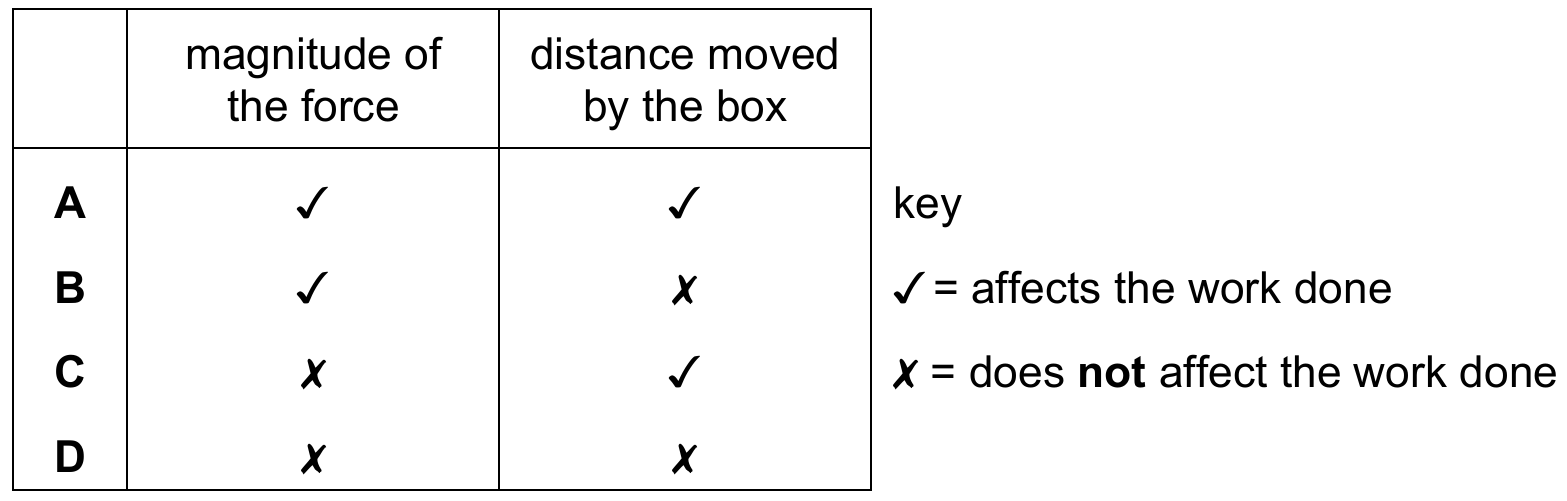
A worker exerts a force on a box to move it across a horizontal surface.

Which of the two quantities in the table affect the amount of work done by the force?

▶️ Answer/Explanation
Work done is calculated using \(W = F \times d\), where \(F\) is the force applied and \(d\) is the distance moved in the direction of the force.
Only quantities that appear in this equation — the size of the force and the distance moved — change the value of the work done.
Quantities such as time taken or the box’s mass do not appear in the work equation, so they do not directly affect work done.
Answer: (A)

Question

A horizontal force acts on a block.
The block moves in the direction of the force.
Which two quantities affect the work done by the force on the block?

A. magnitude of force and distance moved
B. magnitude of force and mass of block
C. magnitude of force and volume of block
D. magnitude of force and weight of block

▶️ Answer/Explanation
Work done is defined by the equation \(W = F \times d\), where \(F\) is force and \(d\) is the distance moved in the direction of the force.
Only the magnitude of the force and the distance moved determine the work done.
The mass, volume, or weight of the block do not appear in this equation and so do not directly affect work done.
Answer: (A)

Question

A student lifts a box vertically from the floor and places it on a table.

Which two quantities must be known in order to calculate the work done on the box by the student?

A. the force used to lift the box and the height of the table
B. the force used to lift the box and the time taken to lift the box
C. the volume of the box and the height of the table
D. the volume of the box and the time taken to lift the box

▶️ Answer/Explanation
Work done is calculated using \( W = F \times d \), where F is force and d is the distance moved in the direction of the force.
Volume and time are not part of this equation, so any option including them can be ruled out.
The distance moved vertically corresponds to the height of the table, so the force used to lift the box and the height of the table are the two quantities needed.
Answer: (A)

Question

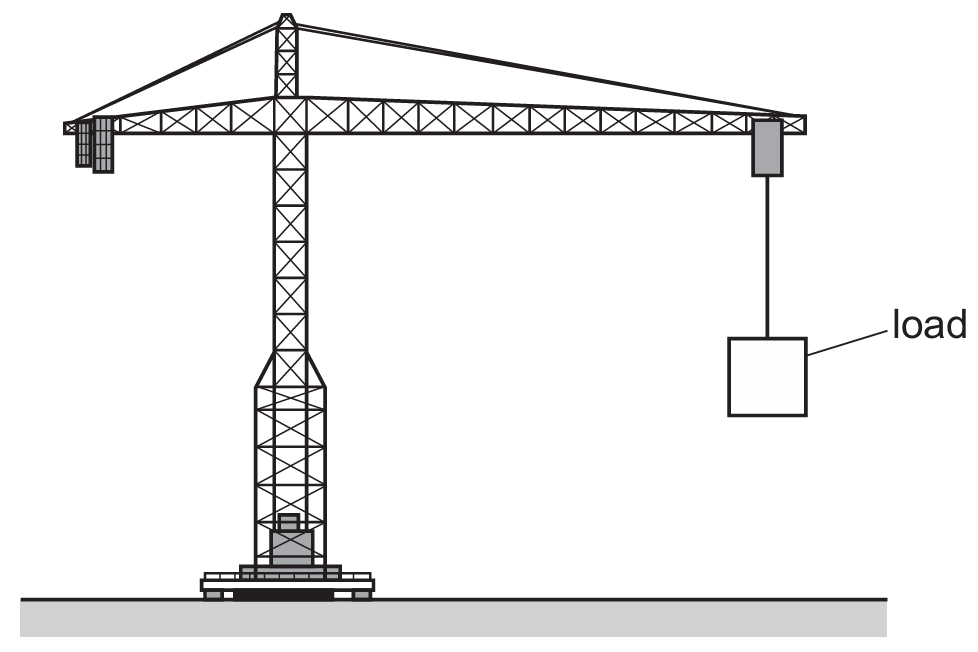
A crane does work on a load by lifting it vertically upwards.

Which action decreases the work done on the load?

A. lifting the load higher
B. lifting the load more slowly
C. reducing the mass of the load
D. using a more powerful crane

▶️ Answer/Explanation
Work done is calculated as \( \text{work} = \text{force} \times \text{distance moved} \), where the force needed equals the weight of the load.
Lifting the load higher increases distance (more work), and the speed of lifting or the power of the crane affects only how quickly work is done, not the total amount of work.
Reducing the mass of the load reduces its weight, and therefore reduces the force needed, decreasing the total work done.
Answer: (C)

Question

A student walks up some steps at constant speed.
Which two quantities provide enough information so that the useful power produced by the student can be calculated?
A the weight of the student and the time taken
B the weight of the student and the total height of the steps
C the work done by the student and the time taken
D the work done by the student and the total height of the steps

▶️Answer/Explanation

Ans : C

Scroll to Top