Home / iGCSE / Coordinated Sciences / P3.4 Sound Paper 2

CIE iGCSE Co-Ordinated Science P3.4 Sound Exam Style Questions Paper 2

Question

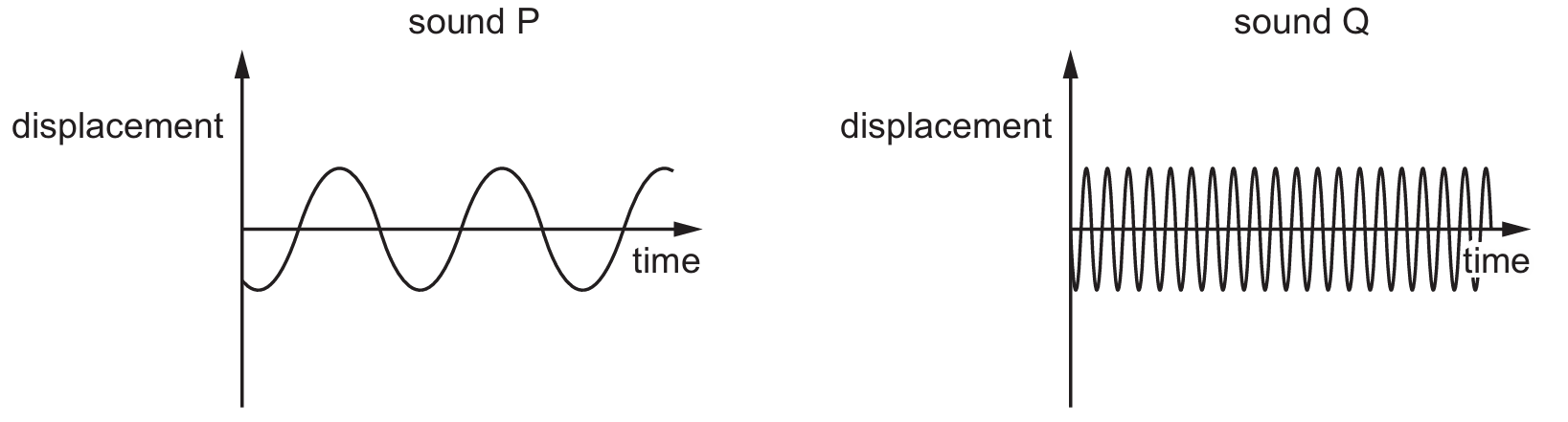
The graphs represent the sound waves of sounds P and Q. The graphs are drawn to the same scale.

Which statement is correct?

A. Sound P is higher pitched than sound Q.
B. Sound P is louder than sound Q.
C. Sound P is lower pitched than sound Q.
D. Sound P is quieter than sound Q.

▶️ Answer/Explanation
Pitch depends on frequency (wavelength). Sound P has a longer wavelength (lower frequency), so it is lower pitched than Q. Loudness depends on amplitude, which appears equal.
Answer: (C)

Question

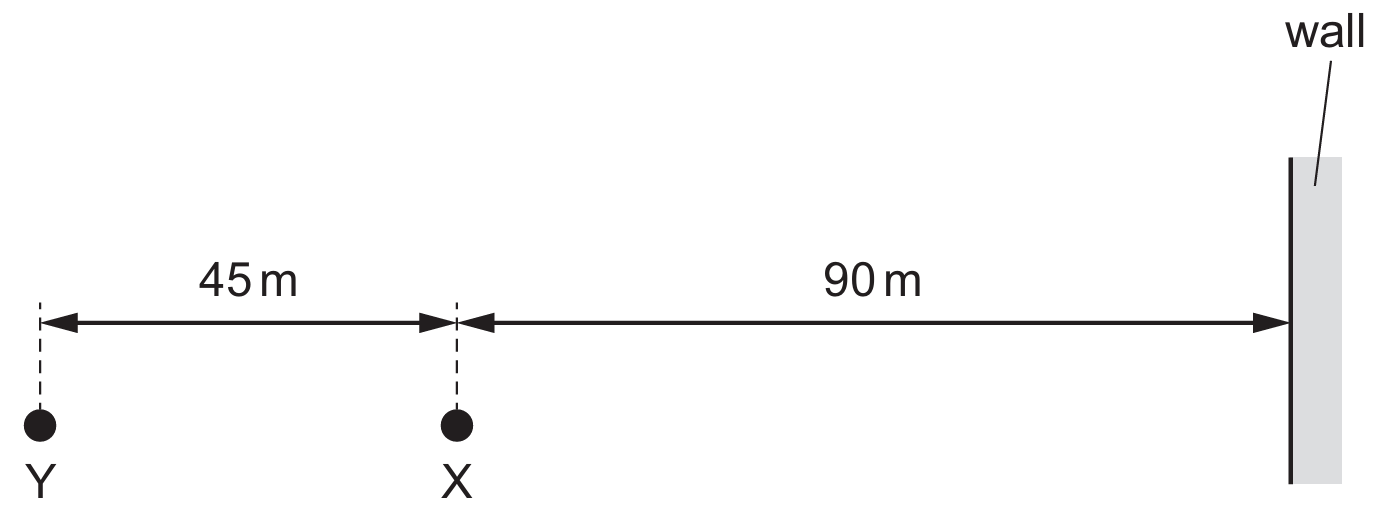
Person X stands facing a high wall that is 90 m away.

Person Y stands 45 m behind person X on a line perpendicular to the wall, as shown.

Person X claps loudly once.

Person Y hears the sound of this clap, then an echo of the sound from the wall.

The speed of sound in air is 330 m/s.

What is the time interval between person Y hearing the first sound and the echo?

A. 0.27 s
B. 0.41 s
C. 0.55 s
D. 0.68 s

▶️ Answer/Explanation
First sound travels directly from X to Y: distance \(= 45 \text{ m}\). Time for first sound \(t_1 = \frac{45}{330} = 0.136 \text{ s}\). Echo travels from X to the wall (90 m) and then from the wall to Y (90 + 45 = 135 m). Total distance for echo \(= 90 + 135 = 225 \text{ m}\). Time for echo \(t_2 = \frac{225}{330} = 0.682 \text{ s}\). Time interval \(= t_2 – t_1 = 0.682 – 0.136 = 0.546 \text{ s} \approx 0.55 \text{ s}\).
Answer: (C)

Question

A guitar produces a loud sound with a low pitch. Which description of the sound wave produced by the guitar is correct?

A. It has a large amplitude and a large frequency.
B. It has a large amplitude and a small frequency.
C. It has a small amplitude and a large frequency.
D. It has a small amplitude and a small frequency.

▶️ Answer/Explanation
Loudness is related to amplitude — larger amplitude means louder sound. Pitch is related to frequency — lower pitch means smaller frequency. Therefore, a loud, low-pitch sound has large amplitude and small frequency.
Answer: (B)

Question

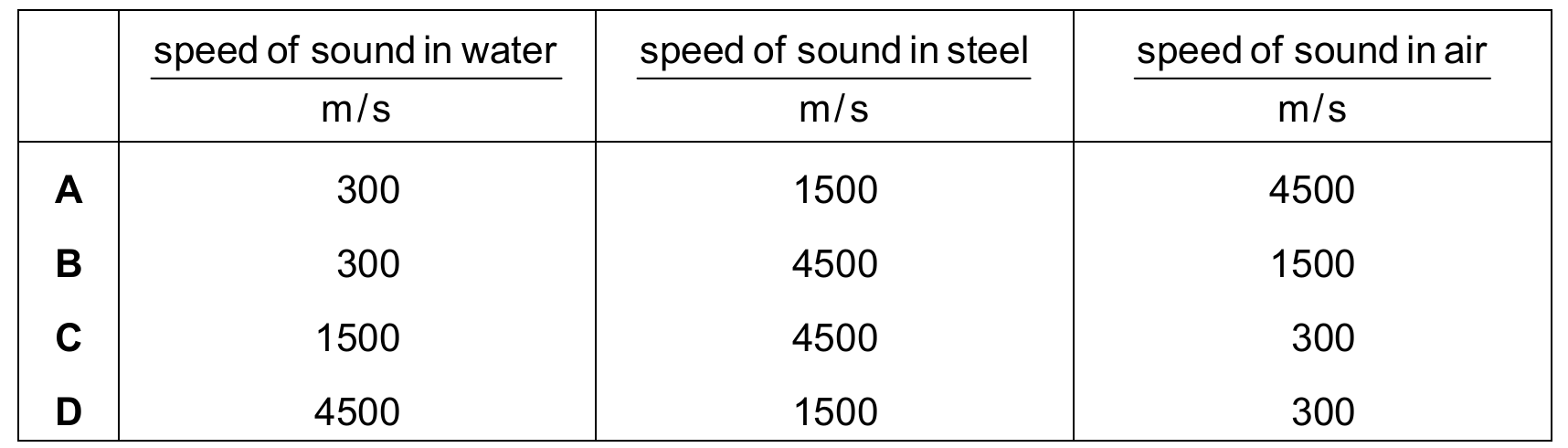
Sound travels at different speeds in water, in steel and in air.

Each row in the table gives the three speeds at room temperature.

Which row gives the correct speeds?

▶️ Answer/Explanation
Sound travels fastest in solids because particles are closely packed, allowing quicker energy transfer. In liquids, particles are less dense, so sound travels slower than in solids. In gases, particles are far apart, so sound travels slowest. The correct speeds are water ≈ 1500 m/s, steel ≈ 4500 m/s, and air ≈ 300 m/s.
Answer: (C)

Question

Which change to a sound wave makes the sound louder?

A. decreasing the amplitude
B. decreasing the wavelength
C. increasing the amplitude
D. increasing the wavelength

▶️ Answer/Explanation
The loudness of a sound is determined by the amplitude of the sound wave, not its wavelength or frequency.
A larger amplitude means the sound wave carries more energy, which is perceived as a louder sound.
Wavelength changes affect pitch, not loudness, so increasing amplitude is the correct change.
Answer: (C)
Scroll to Top