
▶️ Answer/Explanation
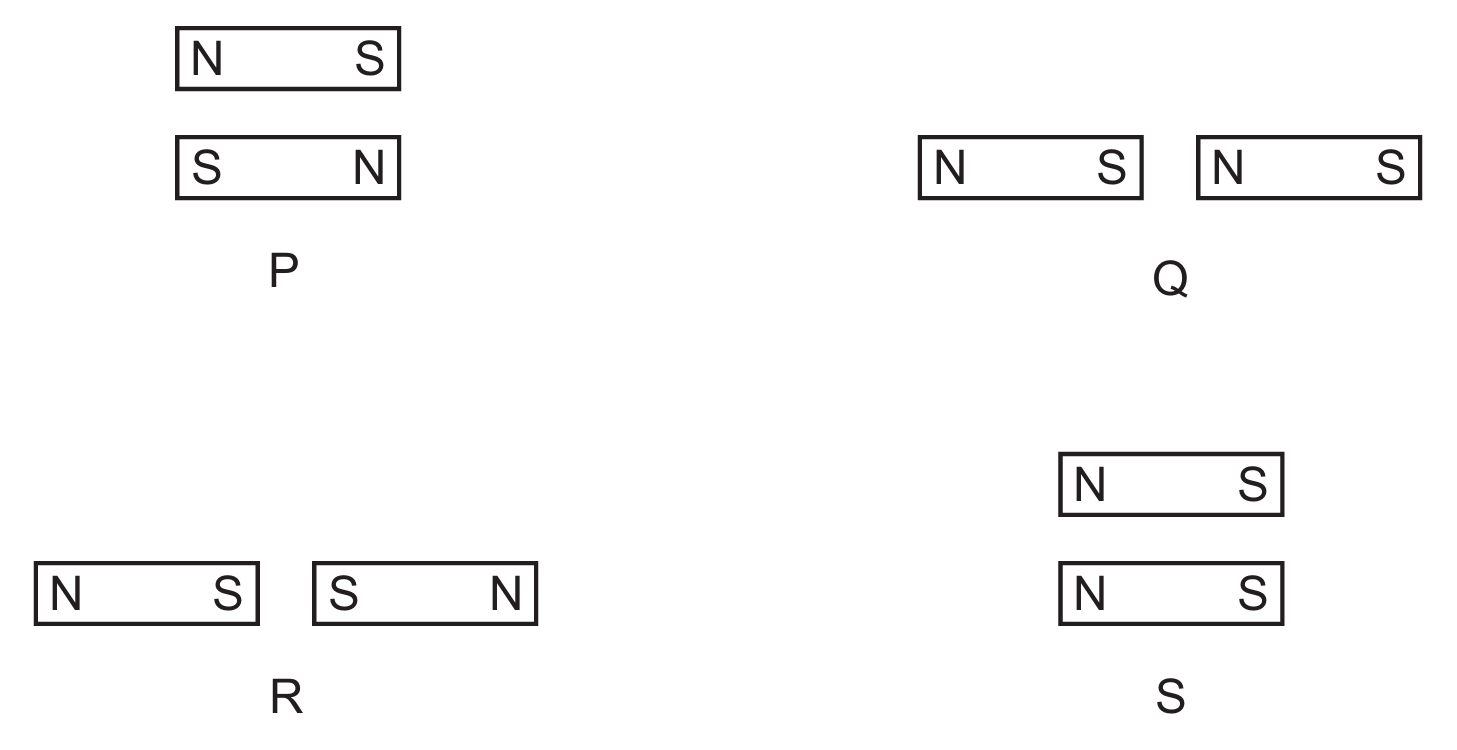
Attraction occurs between opposite poles (N–S). In pair P, the magnets have opposite poles facing each other (N–S). In pair Q, they also have opposite poles facing. In R and S, like poles face each other, causing repulsion. Therefore, the pairs with attraction are P and Q.
✅ Answer: (A)
✅ Answer: (A)

▶️ Answer/Explanation
The magnetic field around a straight current-carrying wire forms concentric circles centred on the wire; applying the right-hand rule with the current directed upward (as shown by the arrow) means the field lines circle anticlockwise when viewed from above.
Only diagram D shows concentric circular field lines in the correct anticlockwise direction consistent with the given current direction.
✅ Answer: (D)
Only diagram D shows concentric circular field lines in the correct anticlockwise direction consistent with the given current direction.
✅ Answer: (D)
▶️ Answer/Explanation
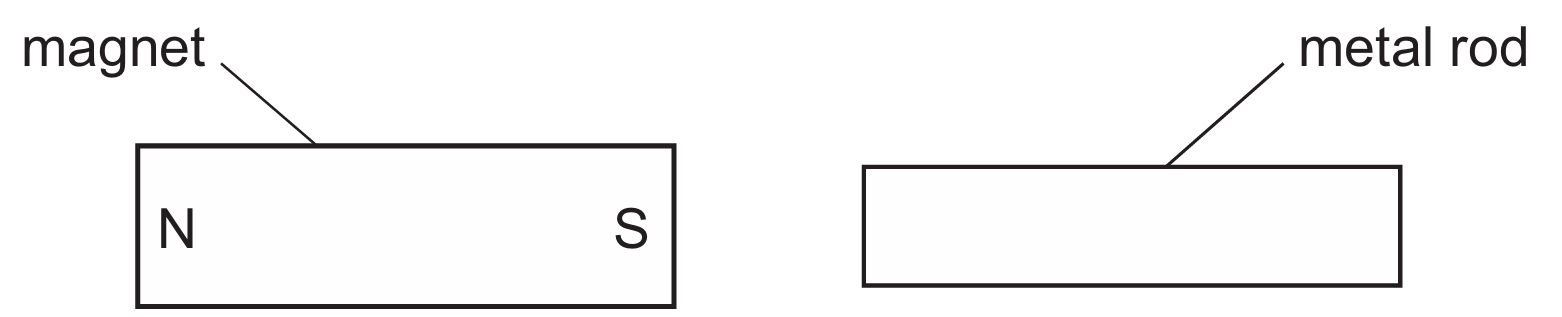
A magnetic material (unlike another magnet) is always attracted to either pole of a magnet, regardless of which way round it is turned.
Iron is a magnetic material, so it becomes attracted whichever pole faces it.
Aluminium and copper are non-magnetic, and a second bar magnet would only be attracted from one orientation, not both.
✅ Answer: (D)
Iron is a magnetic material, so it becomes attracted whichever pole faces it.
Aluminium and copper are non-magnetic, and a second bar magnet would only be attracted from one orientation, not both.
✅ Answer: (D)

▶️ Answer/Explanation
Magnetic field lines always point in the direction a free N pole would move if placed at that point, meaning they run from the N pole into the S pole outside the magnet.
So field lines must curve into (point towards) the S pole, and the lines are closer together (denser) nearer the pole where the field is strongest.
Diagram C correctly shows field lines curving into the S pole with the arrows pointing inward.
✅ Answer: (C)
So field lines must curve into (point towards) the S pole, and the lines are closer together (denser) nearer the pole where the field is strongest.
Diagram C correctly shows field lines curving into the S pole with the arrows pointing inward.
✅ Answer: (C)