Home / iGCSE / Coordinated Sciences / P4.1 Simple phenomena of magnetism Paper 2

CIE iGCSE Co-Ordinated Science P4.1 Simple phenomena of magnetism Exam Style Questions Paper 2

Question

A bar magnet is brought near to a metal rod. The metal rod is attracted to the magnet.

The magnet is then turned around so that the N-pole is on the right.

The magnet is again brought near to the metal rod and is again attracted to the magnet.

What could the metal rod be?

A. another bar magnet
B. a piece of aluminium
C. a piece of copper
D. a piece of iron

▶️ Answer/Explanation
The rod is attracted no matter which pole of the magnet faces it, so it cannot itself be a permanent magnet (a magnet would be repelled by one pole).
This rules out A, and it must instead be a magnetic material such as iron, which is always attracted to either pole.
Aluminium and copper are not magnetic materials, so they would not be attracted at all.
Answer: (D)

Question

Which type of magnet can be switched on and off many times per second?

A. an electromagnet only
B. a permanent magnet only
C. both electromagnets and permanent magnets
D. neither electromagnets or permanent magnets

▶️ Answer/Explanation
An electromagnet’s magnetic field is created by an electric current flowing through a coil of wire, so its magnetism can be turned on or off very rapidly simply by switching the current on or off.
A permanent magnet keeps its magnetism at all times and cannot be switched off, so it cannot be used in this way.
This makes an electromagnet the only type of magnet suitable for switching on and off many times per second.
Answer: (A)

Question

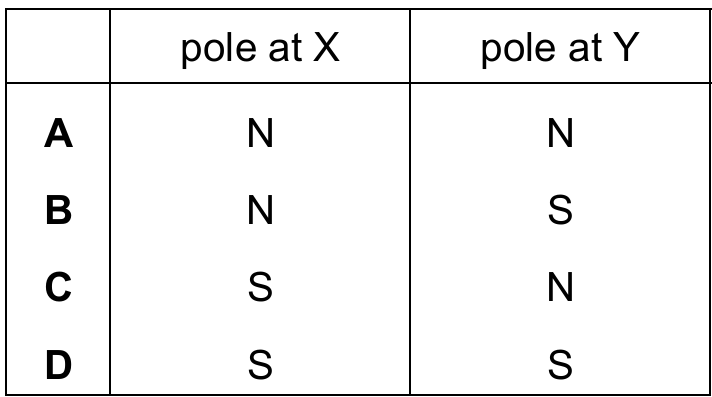
An iron bar XY is brought near to a magnet. Magnetic poles are induced in the iron bar.

What are the magnetic poles induced at X and Y?

▶️ Answer/Explanation
When an unmagnetised iron bar is brought near a magnet, it becomes magnetised by induction, with the nearer end always taking the opposite polarity to the pole facing it.
Since the magnet’s South pole faces end Y, end Y is induced to become a North pole, so that it is attracted to the magnet.
The opposite end, X, is then induced to become a South pole.
Answer: (C)

Question

A bar of soft iron and a bar of steel are held in contact with a strong magnet.

Both bars become magnetised.

The two bars are now moved away from the magnet.

Which statement about the bars is correct?

(A) Both bars lose their magnetism.
(B) Neither of the bars loses its magnetism.
(C) The soft iron bar loses its magnetism but the steel bar retains its magnetism.
(D) The steel bar loses its magnetism but the soft iron bar retains its magnetism.

▶️Answer/Explanation

Ans : C

Question

The diagram shows two soft-iron rods JK and LM placed between the poles of two magnets.


Which row shows the poles induced in the soft-iron rods?


▶️Answer/Explanation

Ans: D

Scroll to Top