
CIE iGCSE Co-Ordinated Science P4.1 Simple phenomena of magnetism Exam Style Questions Paper 3
Question
- travels through space
- slows down through the Earth’s atmosphere
- hits the Earth’s surface.
Isotopes are atoms of the same element which have the same …………………… number but a different …………………… number.
Most-appropriate topic codes (Cambridge IGCSE Co-ordinated Sciences 0654):
• Topic P1.2 — Motion (Part (a))
• Topic P1.3 — Mass and weight (Part (b)(i))
• Topic P1.4 — Density (Part (b)(ii))
• Topic P4.1 — Simple phenomena of magnetism (Part (c))
• Topic C2.3 — Isotopes (Part (d))
▶️ Answer/Explanation
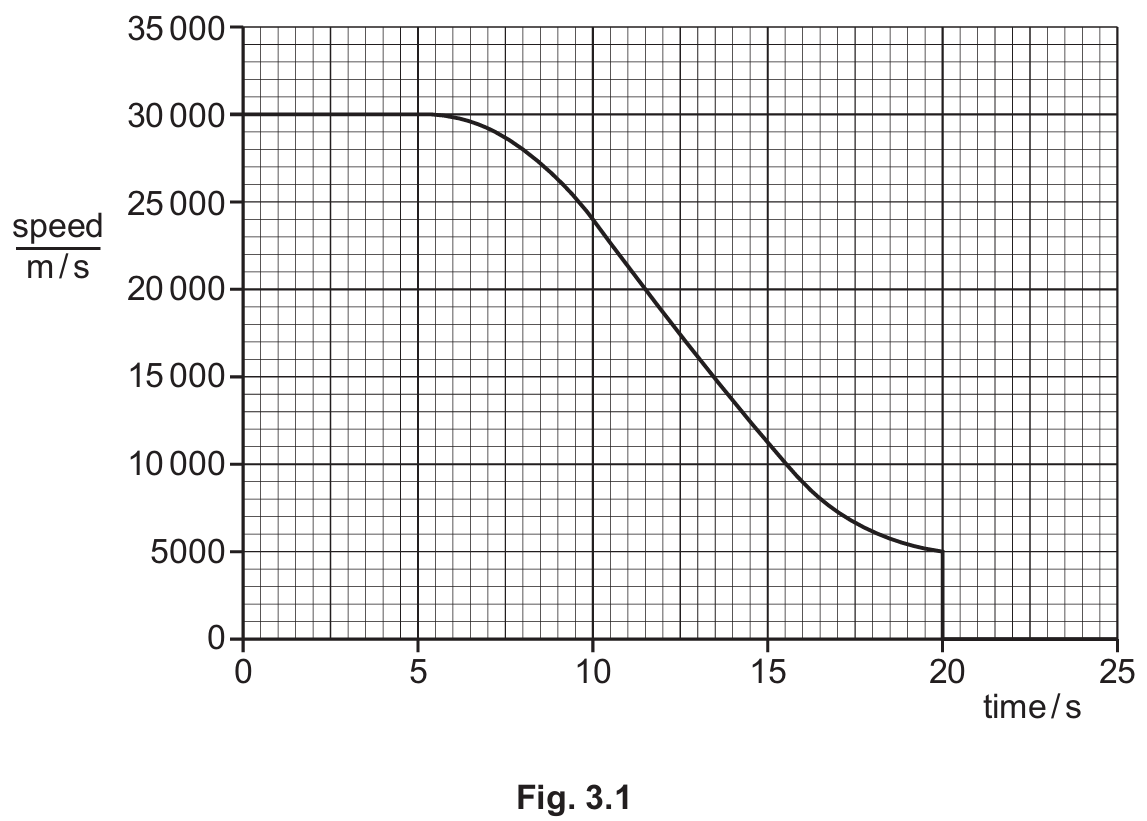
(a)(i) 30,000 m/s
Reading the graph at the flat (constant speed) section before the meteorite enters the atmosphere gives the maximum speed.
The speed remains constant at \(30{,}000 \, \text{m/s}\) while travelling through space where there is no air resistance.
(a)(ii) 20 s
The meteorite hits the surface when its speed reaches zero on the graph.
Reading from the graph, this occurs at \(t = 20 \, \text{s}\).
(a)(iii) Friction / air resistance
As the meteorite passes through the Earth’s atmosphere, air molecules collide with it.
This creates a resistive force (air resistance/friction) that acts opposite to the direction of motion, slowing it down.
(b)(i) \(3.3 \times 10^7 \, \text{kg}\)
Using the formula \(W = mg\), rearranged to: \(m = \dfrac{W}{g}\)
\(m = \dfrac{3.3 \times 10^8}{10} = 3.3 \times 10^7 \, \text{kg}\)
(b)(ii) 7900 kg/m³
Using \(\rho = \dfrac{m}{V}\):
\(\rho = \dfrac{3.3 \times 10^7}{4200} = 7857 \approx 7900 \, \text{kg/m}^3\)
Units: \(\text{kg/m}^3\)
(c) Place the iron in a solenoid (coil) and pass a direct current (d.c.) through the coil.
The magnetic field created by the current-carrying coil aligns the magnetic domains in the iron.
Alternatively, placing the iron in the direction of the Earth’s magnetic field and hammering it gently can also magnetise it.
(d)(i) proton (atomic) number … nucleon (mass) number
Isotopes are atoms of the same element with the same proton/atomic number but a different nucleon/mass number.
They differ only in the number of neutrons in the nucleus.
(d)(ii)
Neutrons = mass number − proton number
Isotope A: \(54 – 26 = \mathbf{28}\) neutrons
Isotope B: \(56 – 26 = \mathbf{30}\) neutrons
Question
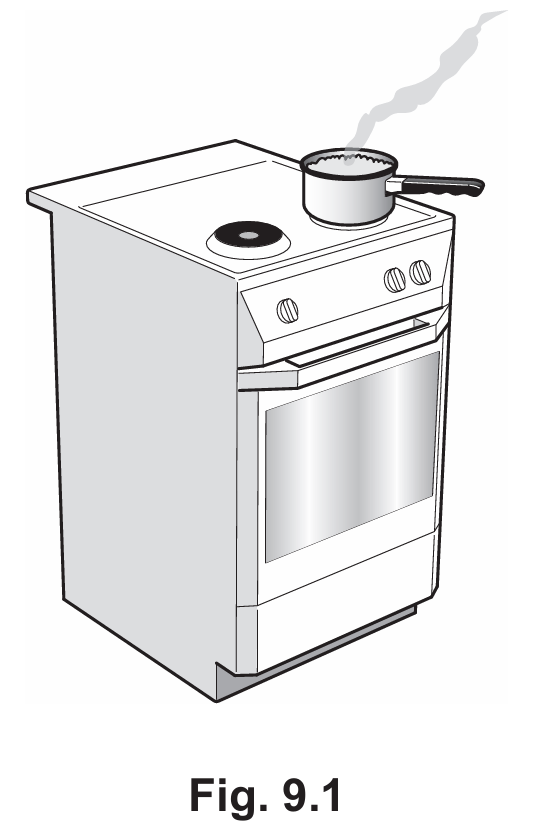
the water ……………………………..
the saucepan. …………………………
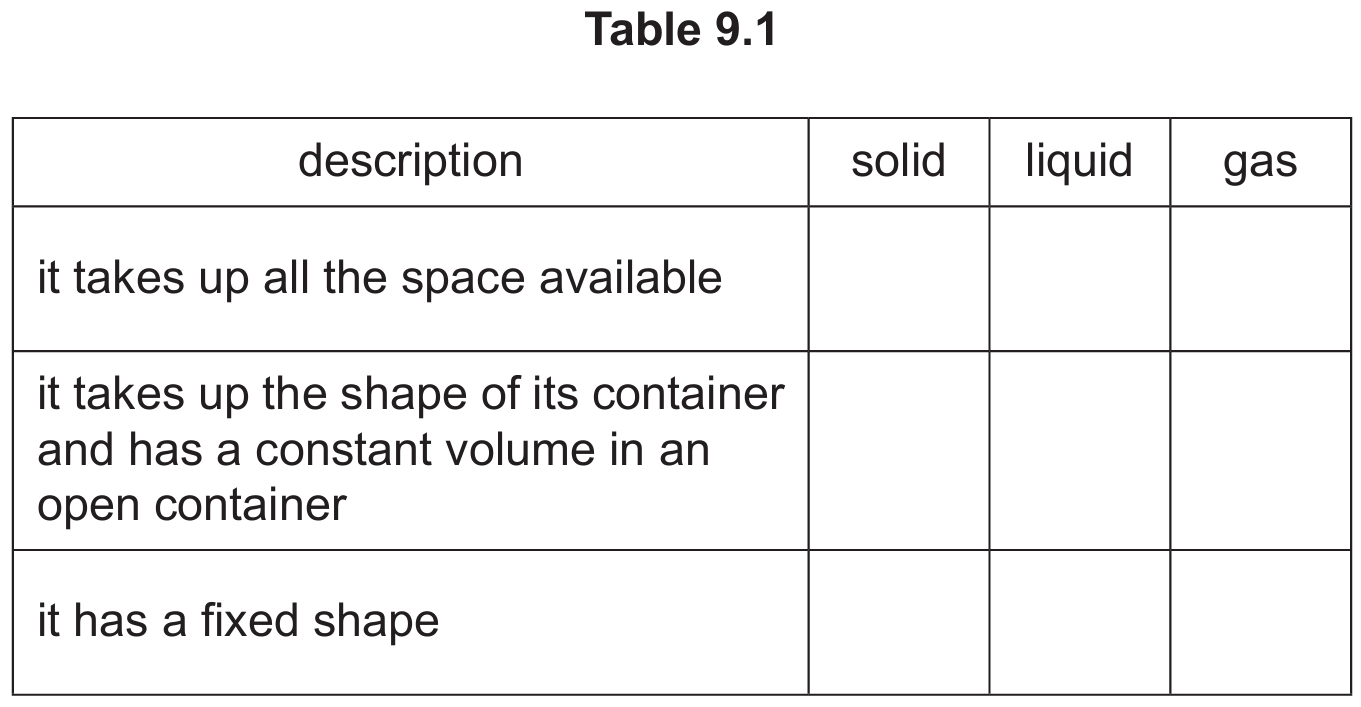
Complete Table 9.1 by placing ticks (✓) in the correct boxes to show which description describes a solid, a liquid and a gas.
Describe one difference between the magnetic properties of steel and the magnetic properties of soft iron.
Calculate the mass of the saucepan in grams.
The gravitational force on unit mass, \(g = 10 \, \text{N/kg}\).
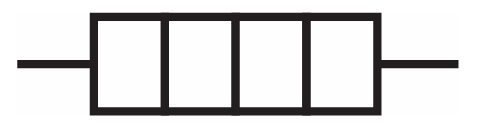 to represent the hotplates.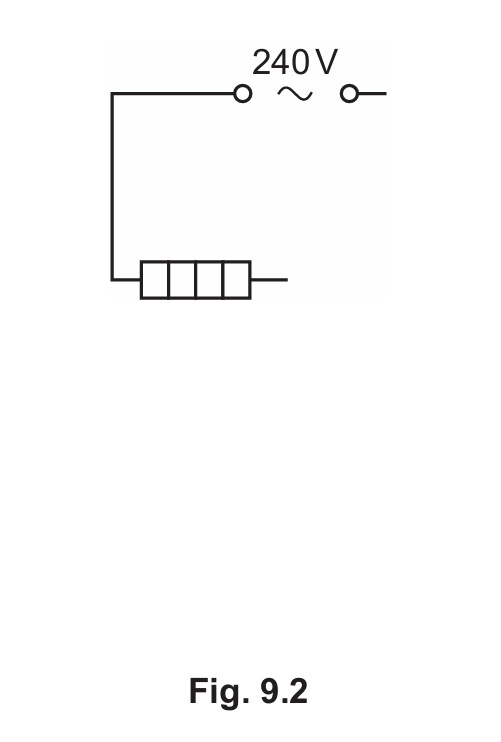
Most-appropriate topic codes (Cambridge IGCSE Co-ordinated Sciences 0654):
• Topic P2.3.4 — Consequences of thermal energy transfer (Parts (a)(i)–(a)(ii))
• Topic P2.2.2 — Melting, boiling and evaporation (Part (a)(iii))
• Topic P2.1.1 — States of matter (Part (a)(iv))
• Topic P4.1 — Simple phenomena of magnetism (Part (b))
• Topic P1.3 — Mass and weight (Part (c))
• Topic P4.3.2 — Series and parallel circuits (Part (d))
▶️ Answer/Explanation
(a)(i) through the water: convection; through the saucepan: conduction.
In liquids, thermal energy is transferred mainly by convection — heated water near the bottom becomes less dense, rises, and cooler water sinks to replace it.
In solids such as the steel saucepan, thermal energy is transferred by conduction — vibrating particles pass energy to neighbouring particles without bulk movement of material.
Radiation can also occur from the outer surface of the pan, but convection and conduction are the main methods here.
(a)(ii) The temperature remains constant / stays at 100 °C while the water is boiling.
During boiling, all the energy supplied is used to overcome the intermolecular forces and convert liquid water to steam.
No energy goes into increasing the kinetic energy of the particles, so the temperature does not rise.
This energy used during a change of state is called latent heat of vaporisation.
(a)(iii) 100 °C
The boiling point of pure water at standard atmospheric pressure (101 325 Pa) is exactly 100 °C.
At higher pressures, the boiling point is higher; at lower pressures (e.g. at altitude), the boiling point is lower.
This fixed boiling point is used as one of the calibration points on the Celsius temperature scale.
(a)(iv) 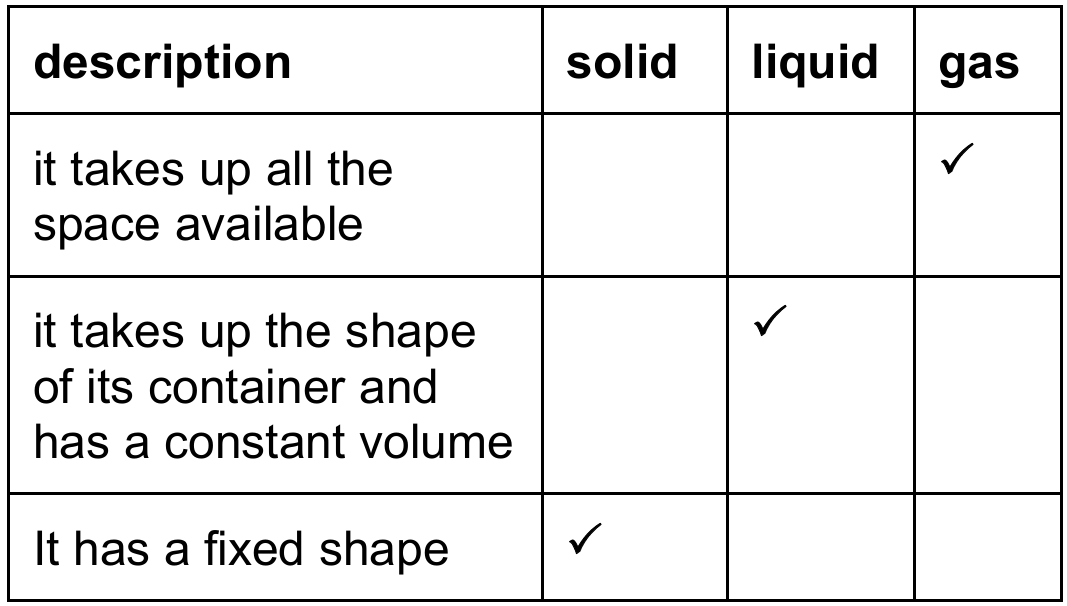
A gas expands to fill any container completely, so “takes up all the space available” describes a gas.
A liquid takes the shape of its container but has a definite volume, so the second description applies to a liquid.
A solid has a fixed shape and volume because its particles are held in fixed positions by strong intermolecular forces.
(b) Steel retains its magnetism better (is a permanent magnet); soft iron loses its magnetism more readily (is a temporary magnet).
Steel is a hard magnetic material — once magnetised it remains magnetised, making it suitable for permanent magnets.
Soft iron is an easy magnetic material — it is easily magnetised but loses its magnetism quickly when the external field is removed.
This makes soft iron suitable for electromagnet cores (e.g. in transformers and electric bells) where magnetism must be switched on and off.
(c) 1500 g
Using \(W = mg\), rearranged to \(m = \frac{W}{g} = \frac{15}{10} = 1.5 \, \text{kg}\).
Converting to grams: \(1.5 \, \text{kg} \times 1000 = 1500 \, \text{g}\).
The question specifically asks for the mass in grams, so the conversion from kg to g is essential for full marks.
(d) The completed circuit has: the 240 V supply connected to two branches in parallel, each branch containing a switch in series with a heater symbol. Correct symbol for switch; second heater connected in parallel; each heater controlled by a separate switch.
In a parallel circuit, each branch operates independently so each hotplate can be switched on or off without affecting the other.
A switch must be placed in series with each heater so that it can control that heater individually.
The circuit symbol for a heater is a rectangle with slanted lines inside (resembling a heating element).