Home / iGCSE / Coordinated Sciences / P4.2.1 Electrical charge Paper 2

CIE iGCSE Co-Ordinated Science P4.2.1 Electrical charge Exam Style Questions Paper 2

Question

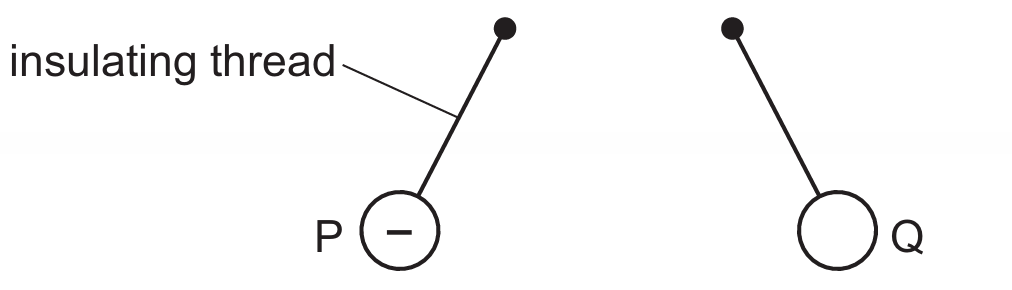
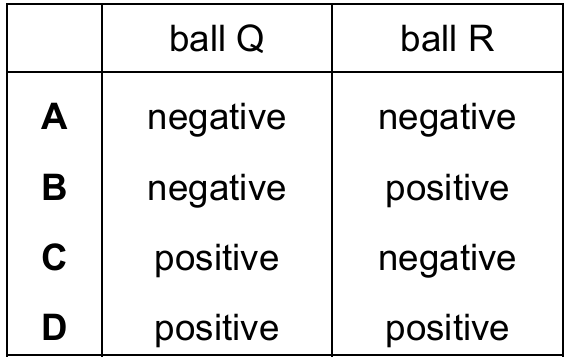
Three charged balls P, Q and R are suspended by insulating threads. Ball P is negatively charged.

Ball Q is brought close to ball P. The balls move away from each other.

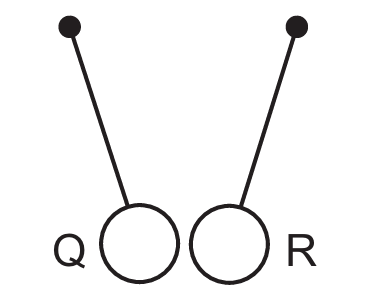
Ball Q is now brought close to ball R. The balls move closer to each other.

What are the signs of the charges on ball Q and ball R?

▶️ Answer/Explanation
Ball P is negative and repels ball Q, so Q must also be negatively charged (like charges repel).
Ball Q is negative and attracts ball R, so R must have the opposite (positive) charge (unlike charges attract).
This gives Q as negative and R as positive.
Answer: (B)

Question

A plastic rod is rubbed with a cloth. The rod becomes positively charged.

Which statement describes why this happens?

A. Electrons move from the cloth to the rod.
B. Electrons move from the rod to the cloth.
C. Protons move from the cloth to the rod.
D. Protons move from the rod to the cloth.

▶️ Answer/Explanation
Charging by friction always involves the transfer of electrons, never protons, since protons are fixed in the nucleus.
If the rod becomes positively charged, it must have lost electrons to the cloth, leaving an excess of positive charge on the rod.
Answer: (B)

Question

Two insulators are charged by rubbing them with a cloth.

After this, the charged insulators repel each other.

Which statement is a possible description of how the insulators become charged?

A. One gained electrons and the other gained protons.
B. One gained electrons and the other lost electrons.
C. They both lost electrons.
D. They both lost protons.

▶️ Answer/Explanation
Charging by friction only ever transfers \(e^-\); protons are fixed in the nucleus and cannot move between materials.
For repulsion, both objects need like charges — if both lose the same number of electrons to the cloth, both become equally \(+\)vely charged.
Answer: (C)

Question

A plastic rod is rubbed with a cloth and the rod becomes positively charged.

Why does this happen?

A. Electrons move from the cloth to the rod.
B. Electrons move from the rod to the cloth.
C. Protons move from the cloth to the rod.
D. Protons move from the rod to the cloth.

▶️ Answer/Explanation
Charging by friction always involves the transfer of electrons, since protons are held tightly within the nucleus and cannot move between materials.
If the rod ends up positively charged, it must have lost negative charge overall.
This happens because electrons move from the rod to the cloth, leaving the rod with an excess of positive charge.
Answer: (B)

Question

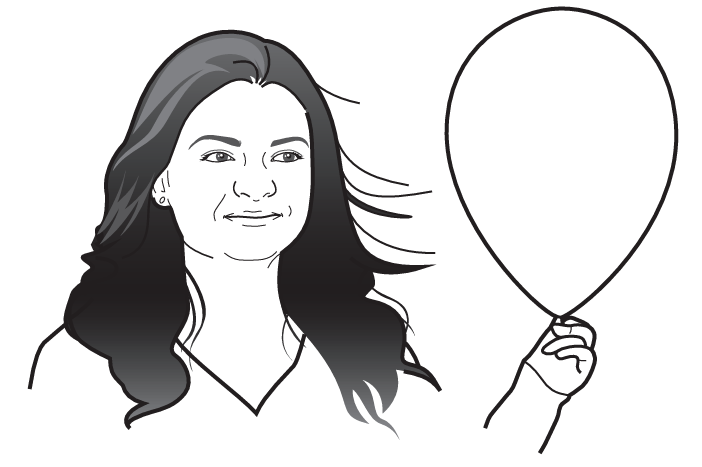
A student rubs a balloon against her hair. Electrons are transferred from the hair onto the balloon, and the hair and the balloon both become charged.

The hair is now attracted to the balloon.

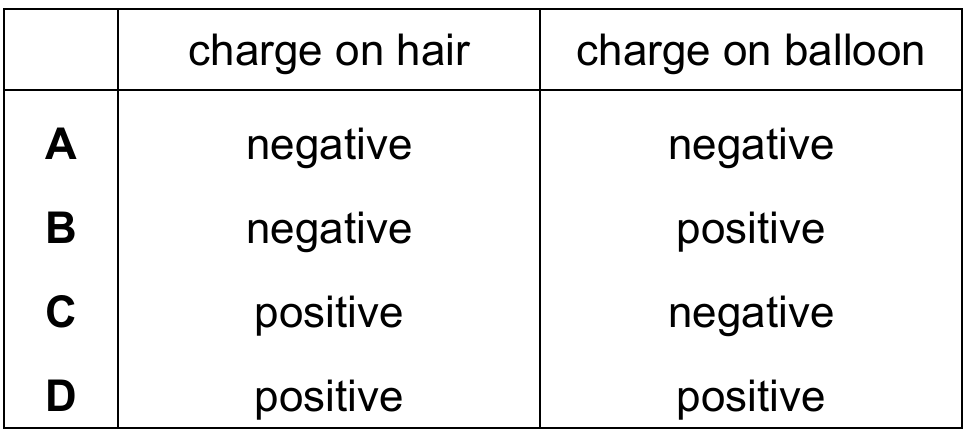
Which row shows the charges on the hair and on the balloon after rubbing?

▶️ Answer/Explanation
Electrons are transferred away from the hair and onto the balloon, so the hair loses negative charge and the balloon gains it.
Losing electrons leaves the hair with an overall positive charge, while gaining electrons leaves the balloon with an overall negative charge.
This gives hair positive and balloon negative, matching row C, consistent with the two becoming oppositely charged and therefore attracted to each other.
Answer: (C)
Scroll to Top