
CIE iGCSE Co-Ordinated Science P4.2.1 Electrical charge Exam Style Questions Paper 3
Question
Topic codes:
• Topic P1.2 — Motion (Part (a)(i) & (a)(ii))
• Topic P2.1.2 — Particle model (Part (b))
• Topic P1.5.2 — Turning effect of forces (Part (c))
• Topic P4.2.1 — Electrical charge (Part (d)(i), (d)(ii) & (d)(iii))
▶️ Answer/Explanation
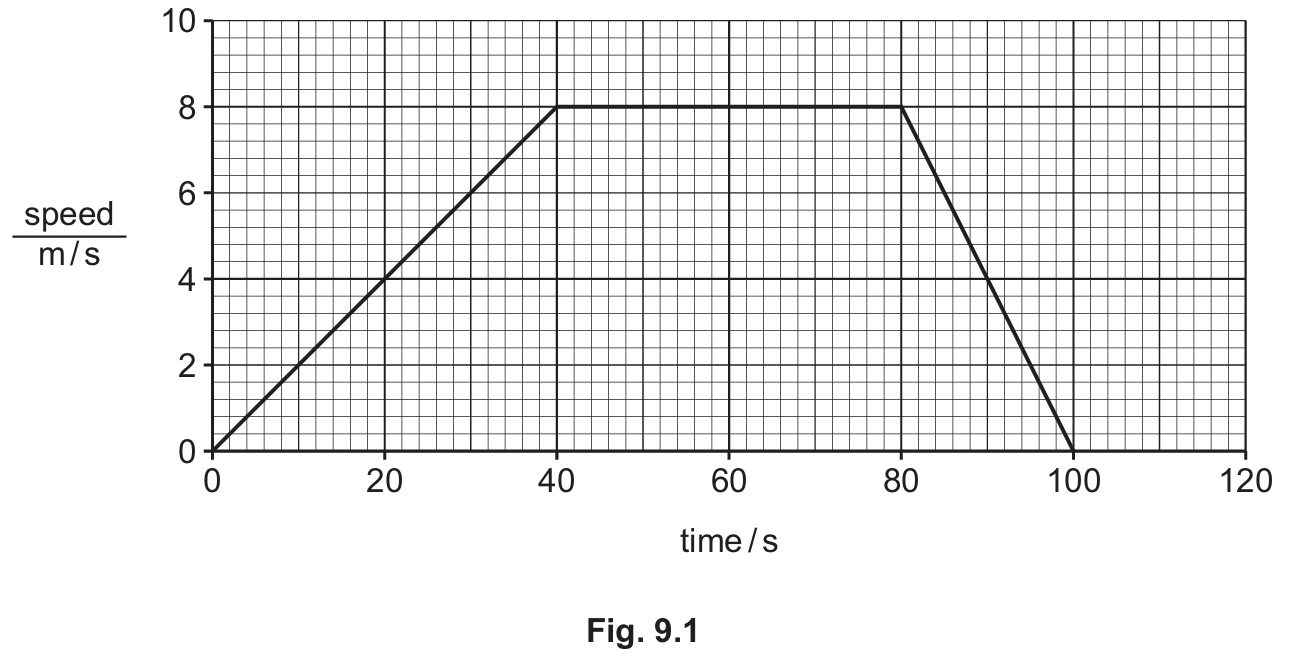
(a)(i) Any time between t = 0 to t = 40 s
The car is accelerating when the speed is increasing. From the graph, the speed increases from 0 to 8 m/s during the first 40 seconds (the line slopes upwards). Any time within this interval shows acceleration.
(a)(ii) 560 m
Total distance travelled = area under the speed-time graph.
The graph forms a trapezium split into three sections:
- Triangle 1 (0 to 40 s): \(\frac{1}{2} \times 40 \times 8 = 160\) m
- Rectangle (40 to 80 s): \(40 \times 8 = 320\) m
- Triangle 2 (80 to 100 s): \(\frac{1}{2} \times 20 \times 8 = 80\) m
Total distance = 160 + 320 + 80 = 560 m
(b) Particles move faster / have greater kinetic energy / \(E_k\)
As temperature increases, the air particles gain kinetic energy. They move more rapidly, colliding with each other and the tyre walls more frequently and with greater force. This increased motion causes the pressure in the tyre to rise.
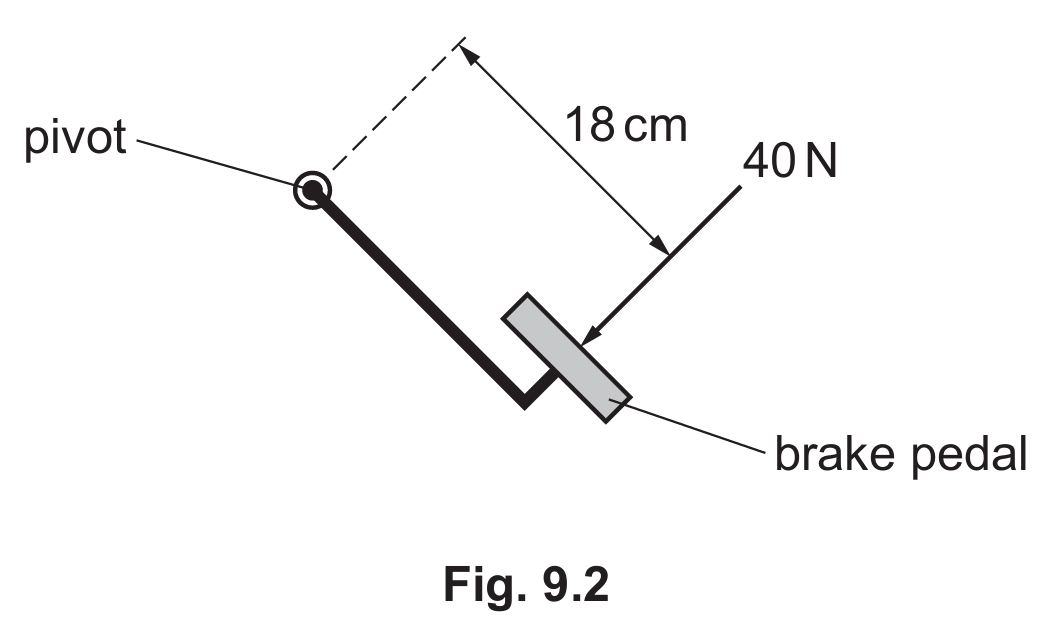
(c) Moment = 720 Ncm
Moment = force × perpendicular distance from the pivot.
Moment = 40 N × 18 cm = 720 Ncm
(Note: The perpendicular distance is measured from the pivot to the line of action of the force. Here it is given as 18 cm.)
(d)(i) Friction
As the car moves, friction between the car and the air, and between the tyres and the road, causes the transfer of electrostatic charges. This is similar to charging by friction where electrons are transferred from one surface to another.
(d)(ii) Electrons
The charged particles that move during the transfer of electrostatic charge are electrons. They are negatively charged and are transferred from one material to another during friction.
(d)(iii) \(-1\)
Electrons have a relative charge of \(-1\). This means they have a negative charge equal in magnitude to the positive charge of a proton (\(+1\)).
Question
As the gasoline flows into the fuel tank, the gasoline becomes charged.
The gasoline evaporates and the driver’s hand cools down.
Explain this cooling effect.
Use ideas about molecules in your answer.
State the work done on the car by the car engine.
State the unit of your answer.
Describe what happens to the motion of the air particles in the tyres as the air warms up.
The turning effect on the current-carrying coil in the electric motor can be increased by increasing the magnetic field strength.
Complete the sentence to describe how to calculate the moment of a force:
The moment of a force is calculated by multiplying the ……………………….. by the perpendicular distance from the ………………………… .
Most-appropriate topic codes (Cambridge IGCSE Co-ordinated Sciences 0654):
• Topic P4.2.1 — Electrical charge: charging by friction (Part (a))
• Topic P2.2.2 — Melting, boiling and evaporation (Part (b))
• Topic P1.6.2 — Work (Part (c)(i))
• Topic P2.1.2 — Particle model: motion and temperature (Part (c)(ii))
• Topic P4.5.5 — The d.c. motor (Part (d)(i))
• Topic P1.5.2 — Turning effect of forces / moments (Part (d)(ii))
▶️ Answer/Explanation
(a)(i) Friction
As the gasoline flows and rubs against the surfaces of the pipe and tank, charge is transferred between the surfaces.
This process of charging by rubbing together is called friction.
(a)(ii) Name: electrons; Charge: negative
Charging by friction always involves the transfer of negatively charged particles.
These particles are electrons, which move from one surface to another, leaving one surface positively charged and the other negatively charged.
(b) The most energetic molecules escape from the liquid surface during evaporation, leaving behind molecules with lower average kinetic energy
Evaporation removes the fastest-moving, most energetic molecules from the surface of the gasoline.
This lowers the average kinetic energy (and so the temperature) of the molecules left behind, which is felt as a cooling effect on the hand.
(c)(i) Work done = \(5.8 \times 10^7\) joules (J)
Work done is defined as being equal to the energy transferred.
Since the engine transfers \(5.8 \times 10^7\,\text{J}\) of useful energy, the work done on the car has this same value, measured in joules (J).
(c)(ii) The air particles move faster
As the air in the tyres warms up, the particles gain kinetic energy.
This increase in kinetic energy means the particles move faster (with greater average speed).
(d)(i) Increase the current, or increase the number of turns on the coil
The turning effect on a current-carrying coil depends on several factors.
Besides increasing the magnetic field strength, increasing the current through the coil or increasing the number of turns on the coil will also increase the turning effect.
(d)(ii) The moment of a force is calculated by multiplying the force by the perpendicular distance from the pivot
Moment is a measure of the turning effect of a force about a pivot.
It is calculated using \(\text{moment} = \text{force} \times \text{perpendicular distance from the pivot}\).