
CIE iGCSE Co-Ordinated Science P4.2.3 Voltage (electromotive force and potential difference) Exam Style Questions Paper 3
Question
Complete the sentence:
The e.m.f. of an electrical source of energy is measured in …………….. .
Most-appropriate topic codes (Cambridge IGCSE Co-ordinated Sciences 0654):
• Topic P4.3.1 — Circuit diagrams and circuit components (Parts (a)(i)–(ii))
• Topic P4.2.3 — Voltage (e.m.f. and p.d.) (Parts (a)(iii), (v))
• Topic P4.2.4 — Resistance (Part (a)(iv))
• Topic P3.2.1 — Reflection of light (Part (b))
▶️ Answer/Explanation
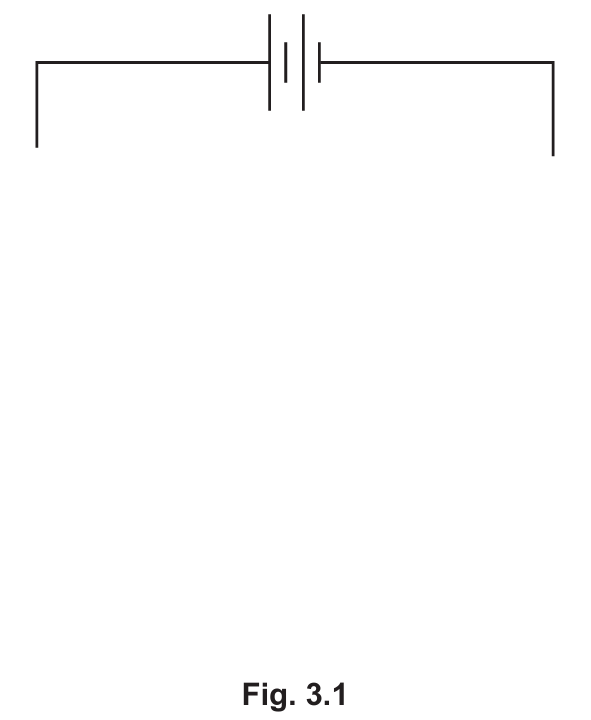
(a)(i) Correct symbols for lamp and switch, all connected in series
A complete series circuit needs a lamp symbol (circle with a cross/filament) and a switch symbol added in line with the two cells.
All components must be connected in a single loop with no branches, since the components are in series.
(a)(ii) Voltmeter connected in parallel across the lamp, using the correct circle-V symbol
A voltmeter measures potential difference, so it must be connected across (in parallel with) the lamp, not in series with it.
The correct symbol is a circle containing the letter V.
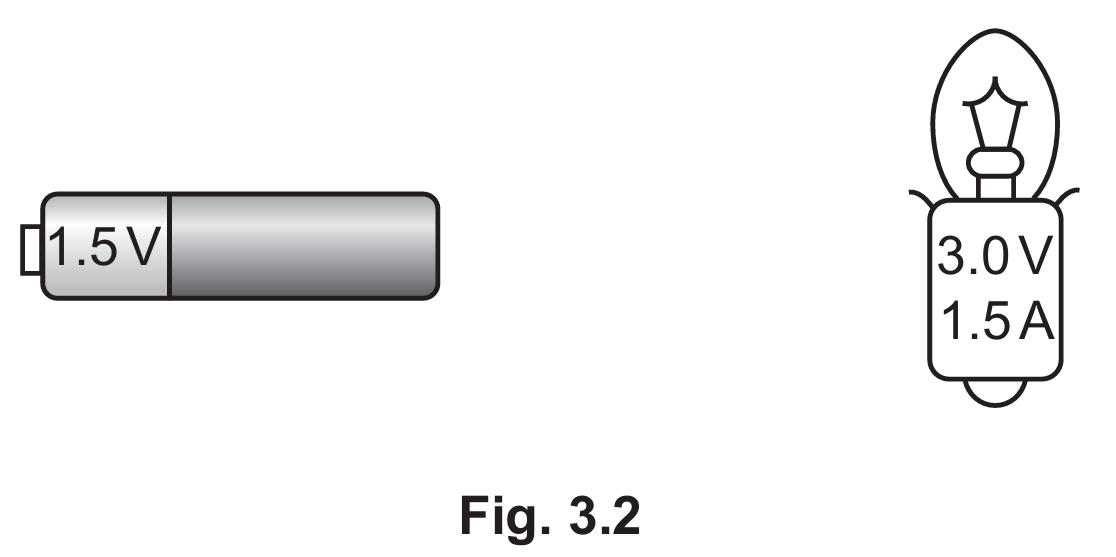
(a)(iii) The lamp needs 3.0 V to light normally, but one cell only supplies 1.5 V, so two 1.5 V cells in series are needed to provide 3.0 V
In a series circuit, the e.m.f.s of the cells add together.
Two 1.5 V cells in series give \(1.5 + 1.5 = 3.0\,\text{V}\), matching the lamp’s rated voltage.
(a)(iv) Resistance = 2.0 Ω
Resistance is calculated using \(R = \dfrac{V}{I}\).
Using the lamp’s rated values, \(R = \dfrac{3.0}{1.5} = 2.0\,\Omega\).
(a)(v) Volts (V)
The e.m.f. of a source, like potential difference, is a measure of energy transferred per unit charge.
It is therefore measured in the same unit as potential difference: volts (V).
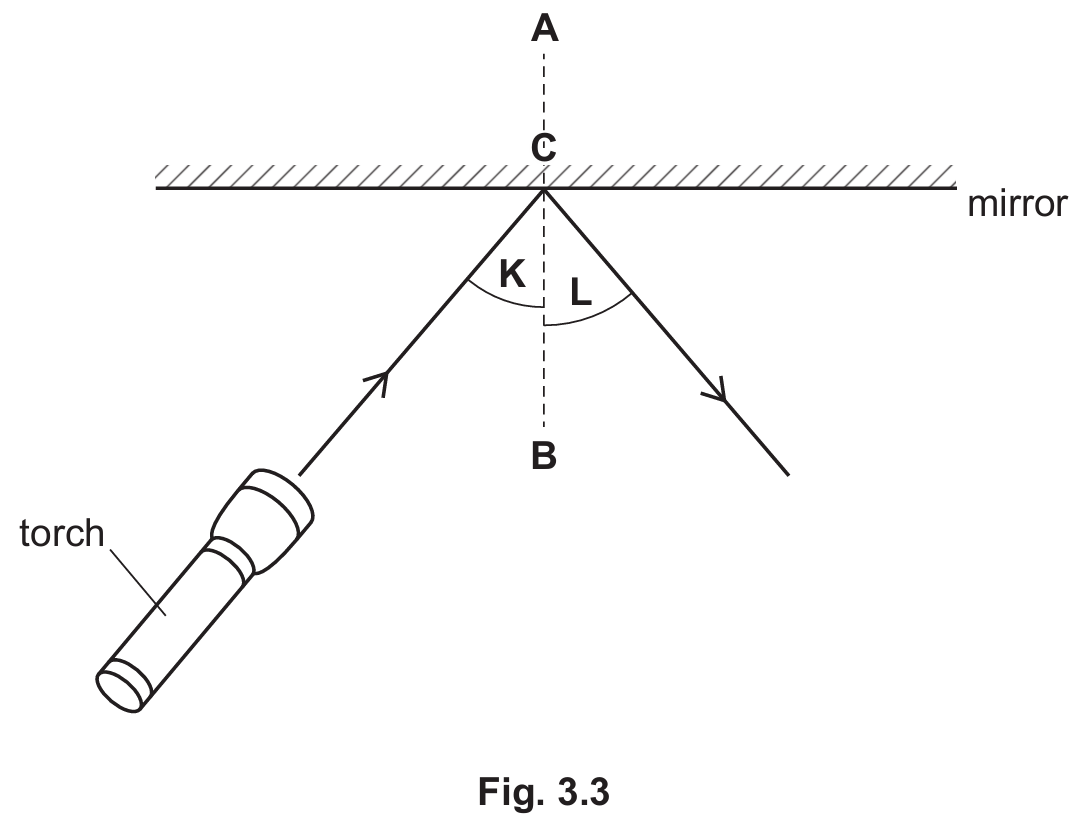
(b)(i) Angle K is equal to angle L
This is the law of reflection.
The angle of incidence (K) always equals the angle of reflection (L) when measured from the normal.
(b)(ii) Normal
Line AB is drawn perpendicular to the mirror surface at the point of incidence.
This perpendicular reference line is called the normal.
(b)(iii) The ray of light is reflected (reflection occurs)
At point C, the light ray meets the mirror surface and changes direction.
This change of direction at the surface is called reflection.