
▶️ Answer/Explanation
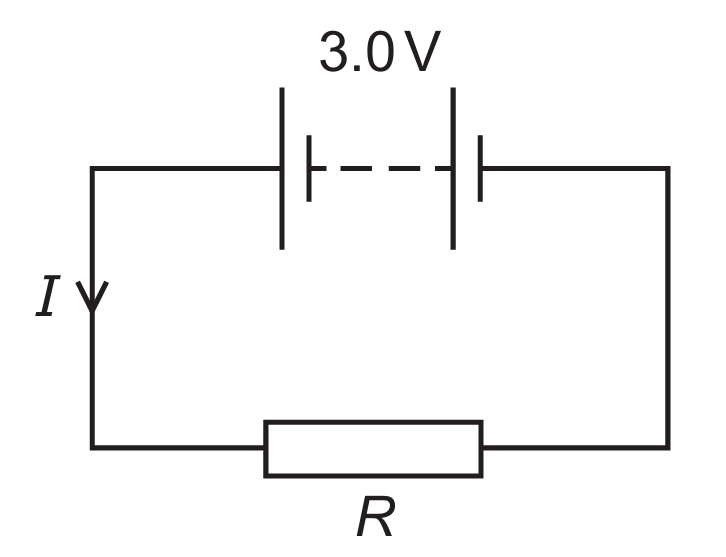
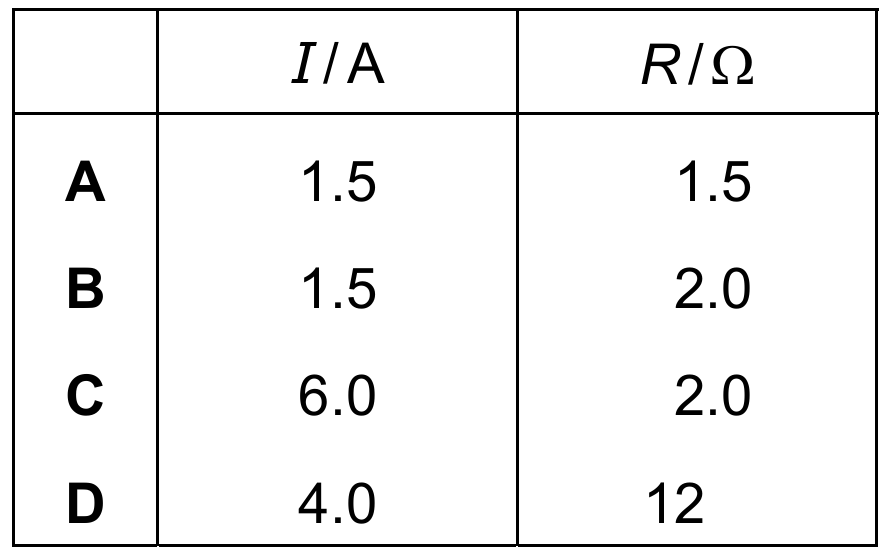
Using Ohm’s law \(R = \frac{V}{I}\), with \(V = 3.0\) V. For \(I = 1.5\) A, \(R = 3.0 / 1.5 = 2.0\) Ω. Option B correctly gives \(I = 1.5\) A and \(R = 2.0\) Ω. The other options do not satisfy \(V = IR\) with \(V = 3.0\) V.
✅ Answer: (B)
✅ Answer: (B)
▶️ Answer/Explanation
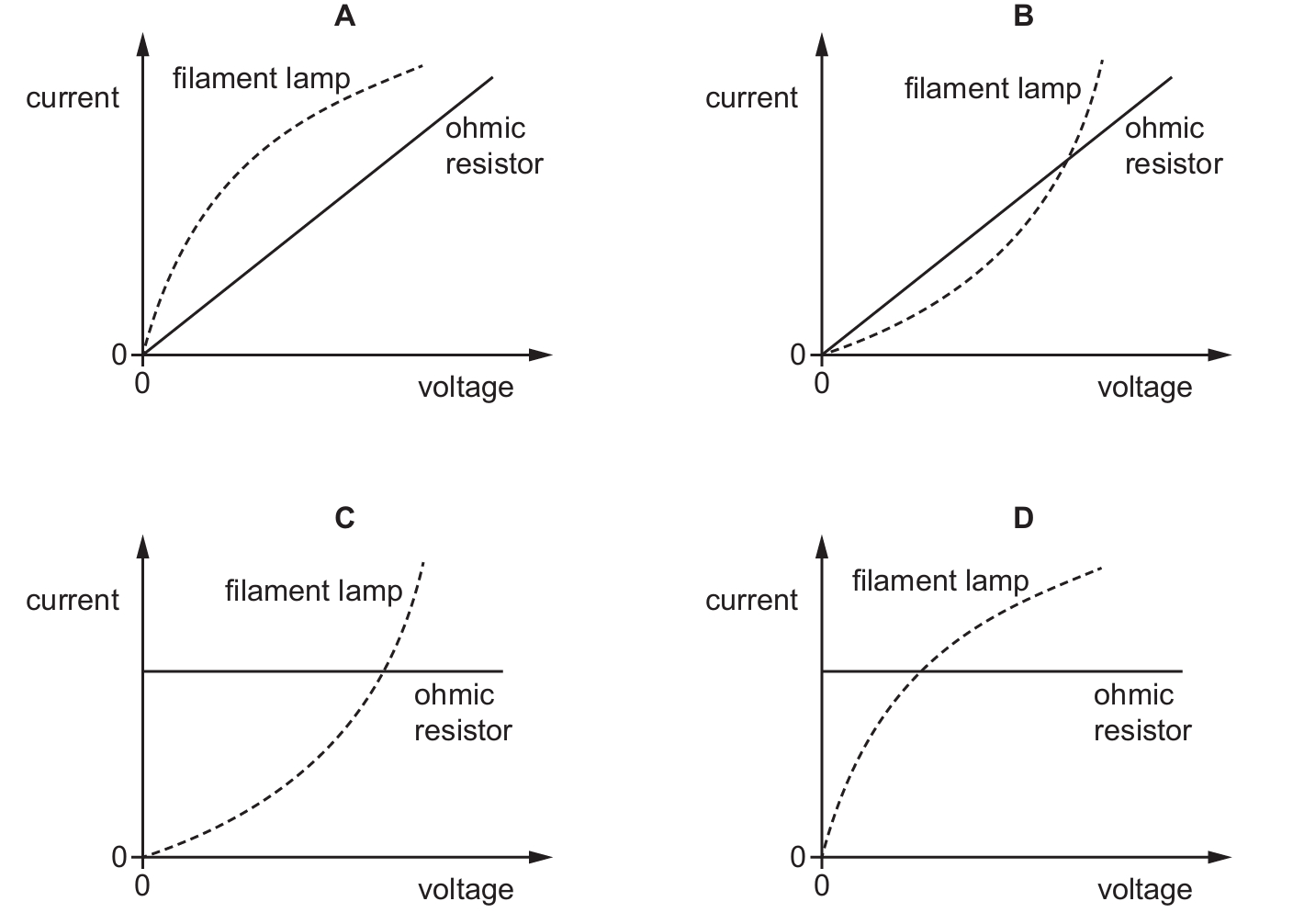
An ohmic resistor at constant temperature gives a straight line through the origin, since current is directly proportional to voltage.
A filament lamp heats up as current increases, so its resistance rises and the graph curves, flattening off at higher voltages.
Only graph A shows this combination correctly: a straight line for the resistor and a curve that bends towards the voltage axis for the lamp.
✅ Answer: (A)
A filament lamp heats up as current increases, so its resistance rises and the graph curves, flattening off at higher voltages.
Only graph A shows this combination correctly: a straight line for the resistor and a curve that bends towards the voltage axis for the lamp.
✅ Answer: (A)
▶️ Answer/Explanation
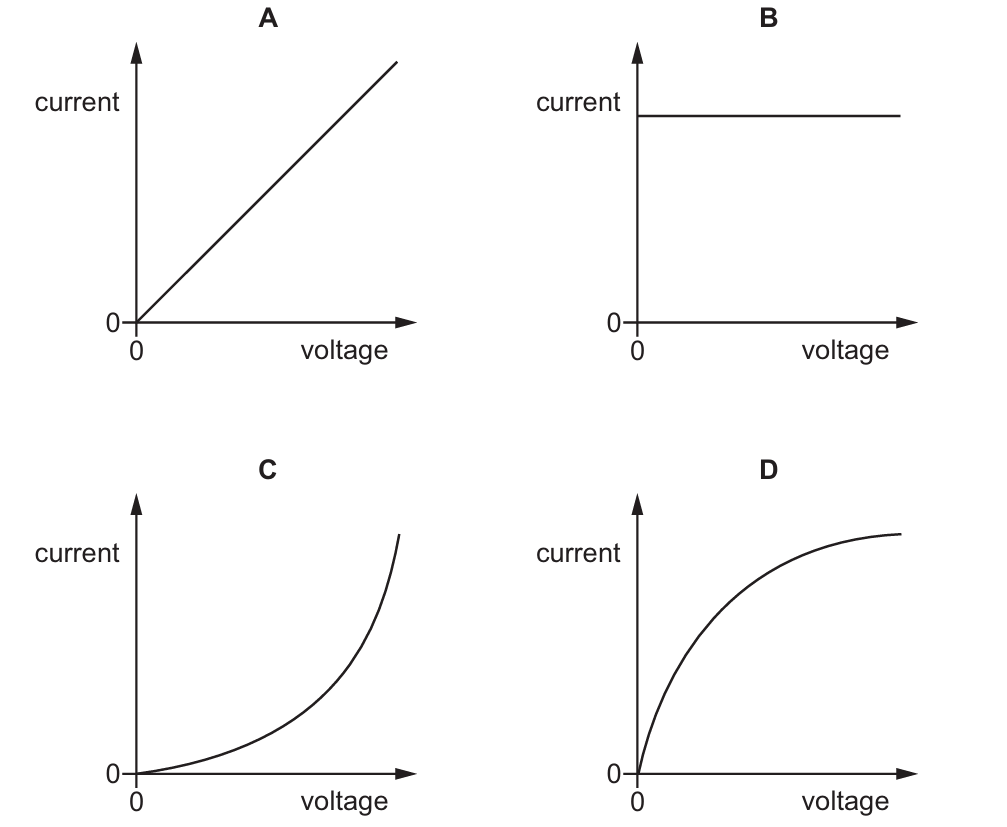
As voltage across a filament lamp increases, its temperature rises, which increases its resistance.
This means current increases less than proportionally with voltage, producing a curve that flattens out rather than a straight line.
✅ Answer: (D)
This means current increases less than proportionally with voltage, producing a curve that flattens out rather than a straight line.
✅ Answer: (D)
▶️ Answer/Explanation
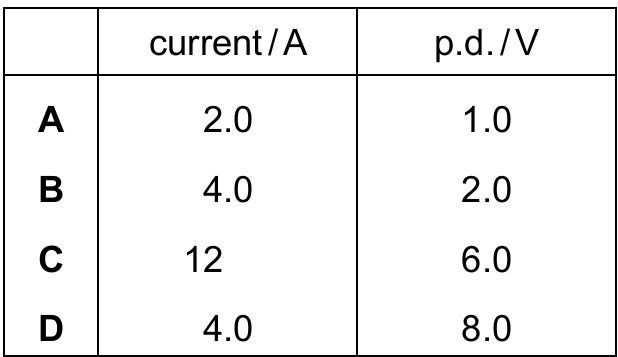
Resistance is calculated using \( R = \dfrac{V}{I} \) for each row.
For row D: \( R = \dfrac{8.0}{4.0} = 2.0\ \Omega \), which matches.
Checking the others: A gives 0.5 Ω, B gives 0.5 Ω, and C gives 0.5 Ω, so only D gives 2.0 Ω.
✅ Answer: (D)
For row D: \( R = \dfrac{8.0}{4.0} = 2.0\ \Omega \), which matches.
Checking the others: A gives 0.5 Ω, B gives 0.5 Ω, and C gives 0.5 Ω, so only D gives 2.0 Ω.
✅ Answer: (D)
▶️ Answer/Explanation
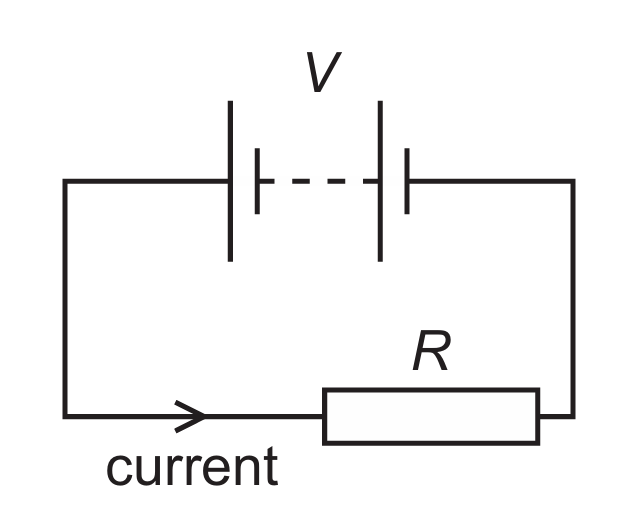
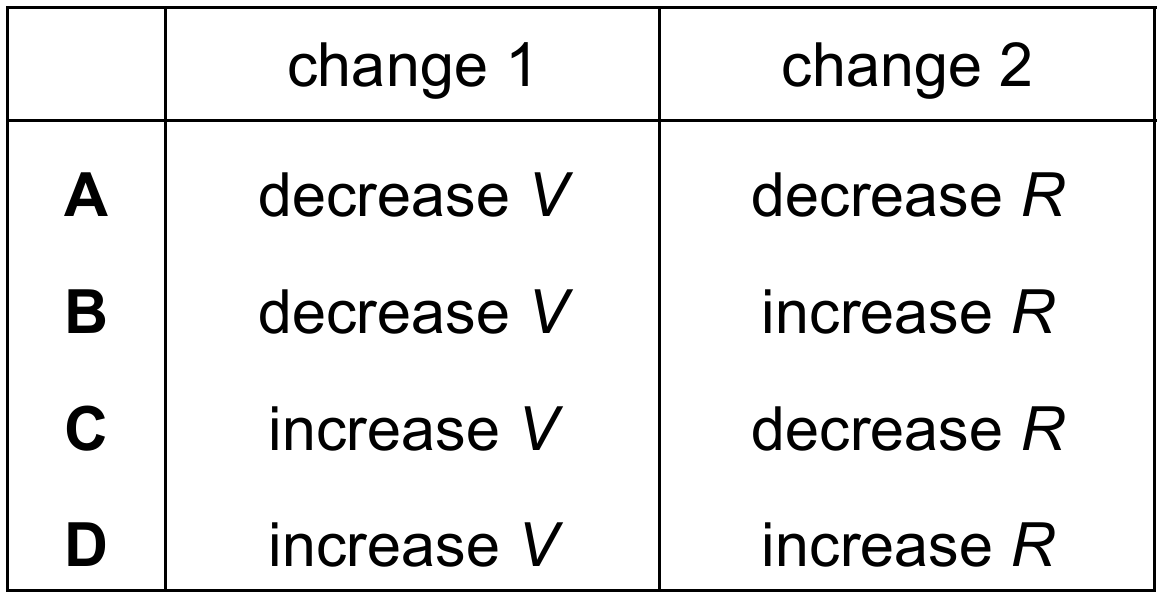
Rearranging \(V = IR\) gives \(I = \frac{V}{R}\), so \(I\) increases if \(V \uparrow\) or if \(R \downarrow\).
Only the row pairing “increase \(V\)” with “decrease \(R\)” makes the current larger in both cases simultaneously.
✅ Answer: (C)
Only the row pairing “increase \(V\)” with “decrease \(R\)” makes the current larger in both cases simultaneously.
✅ Answer: (C)