Home / iGCSE / Coordinated Sciences / P4.2.5 Electrical energy and electrical power Paper 2

CIE iGCSE Co-Ordinated Science P4.2.5 Electrical energy and electrical power Exam Style Questions Paper 2

Question

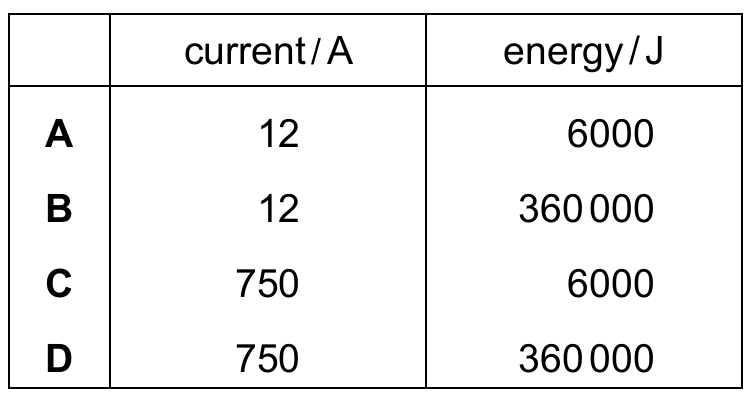
An electric kettle is rated at \(3.0\,\text{kW}\) and is connected to a \(250\,\text{V}\) supply. The kettle is switched on for 2.0 minutes.

Which row shows the current in the kettle and the energy transferred by the kettle?

▶️ Answer/Explanation
Power \(P = IV\), so \(I = P/V = 3000/250 = 12\,\text{A}\). Energy \(E = P \times t = 3000 \times (2 \times 60) = 3000 \times 120 = 360000\,\text{J}\). Thus current = 12 A, energy = 360,000 J. Option B.
Answer: (B)

Question

An electric heater operates at 220 V.

The current in the heater is 15 A.

Which expression gives the time for the heater to transfer \(1.0 \times 10^4 \, \text{J}\) of energy?

A. \(\frac{1.0 \times 10^4 \times 220}{15} \, \text{s}\)
B. \(\frac{1.0 \times 10^4 \times 15}{220} \, \text{s}\)
C. \(\frac{1.0 \times 10^4}{220 \times 15} \, \text{s}\)
D. \(1.0 \times 10^4 \times 220 \times 15 \, \text{s}\)

▶️ Answer/Explanation
The electrical energy transferred is given by \(E = IVt\). To find time, rearrange the equation: \(t = \frac{E}{IV}\). Substituting the values \(E = 1.0 \times 10^4 \, \text{J}\), \(I = 15 \, \text{A}\), and \(V = 220 \, \text{V}\) gives \(t = \frac{1.0 \times 10^4}{220 \times 15} \, \text{s}\).
Answer: (C)

Question

An electric kettle is connected to a \(250\text{ V}\) supply. The current in the heating element of the kettle is \(10\text{ A}\).

How much electrical energy is transferred in \(3.0\) minutes?

A. \(75\text{ J}\)  
B. \(4500\text{ J}\)  
C. \(7500\text{ J}\)  
D. \(450\,000\text{ J}\)

▶️ Answer/Explanation
Convert time to seconds: \(3.0\text{ min} \times 60 = 180\text{ s}\).
\(E = VIt = 250 \times 10 \times 180 = 450\,000\text{ J}\).
Answer: (D)

Question

Cables transmit electrical power. The power input to the cables is constant, but the voltage input is increased.

What happens to the power loss from the cables, and what happens to the current in the cables?

▶️ Answer/Explanation
Since \(P = VI\) and power is constant, increasing voltage means the current must decrease.
Power loss in the cables is \(I^2R\), so a lower current results in less power loss.
Answer: (A)

Question

A \( 3.0\ \Omega \) resistor is connected to a \( 12\ V \) power supply.

How much electrical energy does the resistor transfer in \( 10\ s \)?

A. 3.6 J
B. 4.8 J
C. 360 J
D. 480 J

▶️ Answer/Explanation
First find the current using \( I = \dfrac{V}{R} = \dfrac{12}{3.0} = 4.0\ A \).
Electrical power is given by \( P = VI = 12 \times 4.0 = 48\ W \).
Energy transferred is \( E = Pt = 48 \times 10 = 480\ J \).
Answer: (D)
Scroll to Top