
CIE iGCSE Co-Ordinated Science P4.2.5 Electrical energy and electrical power Exam Style Questions Paper 4
Question
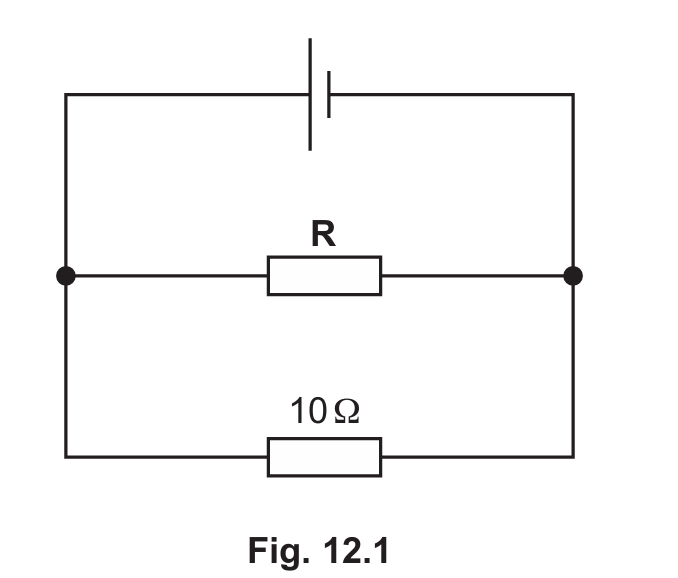
Mains potential difference is \(230\text{ V}\).
Calculate the electric current in the projector.
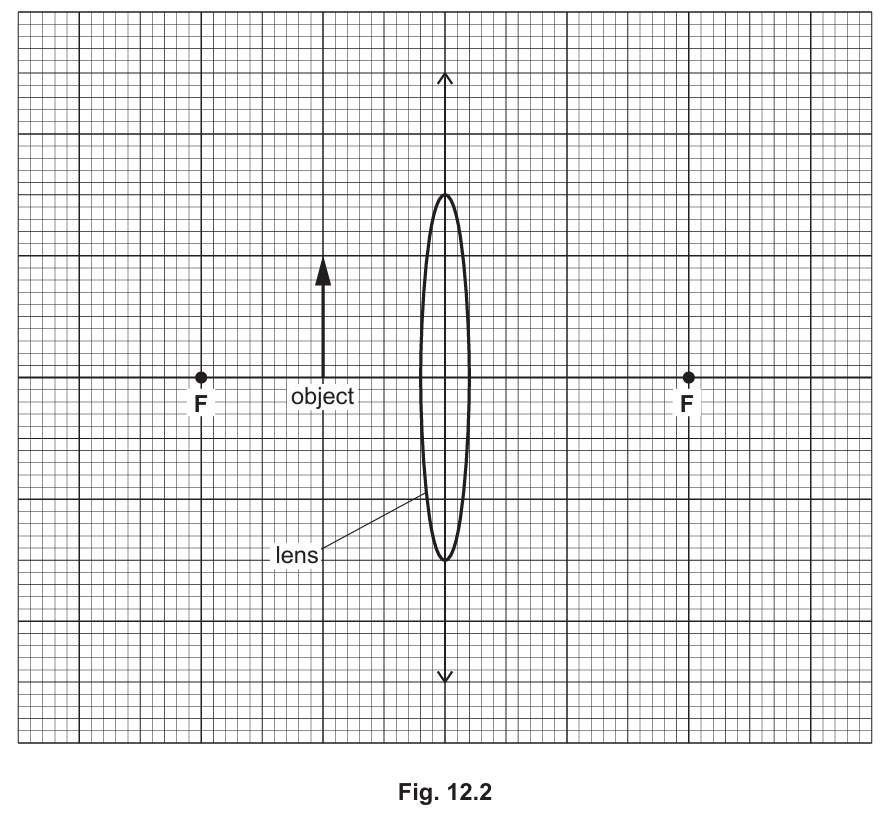
In another device, the object is placed between the principal focus and the lens.
On Fig. 12.2, draw rays to find the position of the image formed. Use an arrow to represent the image.
Topic codes:
• Topic P4.3.2 — Series and parallel circuits (Part (a) & (b))
• Topic P4.2.5 — Electrical energy and power (Part (c)(i))
• Topic P3.2.3 — Thin converging lens (Part (c)(ii) & (c)(iii))
▶️ Answer/Explanation
(a)(i) In a parallel circuit, the total current equals the sum of the currents in the branches.
Current in R = Total current − Current in \(10\Omega\) resistor
= \(0.32 – 0.18 = \mathbf{0.14\text{ A}}\)
(a)(ii) In a parallel circuit, the potential difference across each branch is the same as the cell voltage.
Potential difference across R = \(1.8\text{ V}\)
(b) For two resistors in parallel: \(\frac{1}{R_{\text{total}}} = \frac{1}{R_1} + \frac{1}{R_2}\)
\(\frac{1}{R_{\text{total}}} = \frac{1}{40} + \frac{1}{20} = \frac{1}{40} + \frac{2}{40} = \frac{3}{40}\)
\(R_{\text{total}} = \frac{40}{3} = \mathbf{13.3\ \Omega}\) (or \(13\ \Omega\) to 2 significant figures)
(c)(i) \(P = IV\), so \(I = P \div V\)
\(I = 750 \div 230 = \mathbf{3.3\text{ A}}\)
(c)(ii) When an object is placed between the principal focus and the lens, a virtual, upright and magnified image is formed on the same side as the object.
Rays to draw:
- A ray parallel to the principal axis refracts through the focal point on the other side
- A ray through the centre of the lens passes straight through
The rays diverge after passing through the lens, and are extended back to form a virtual image on the same side as the object.
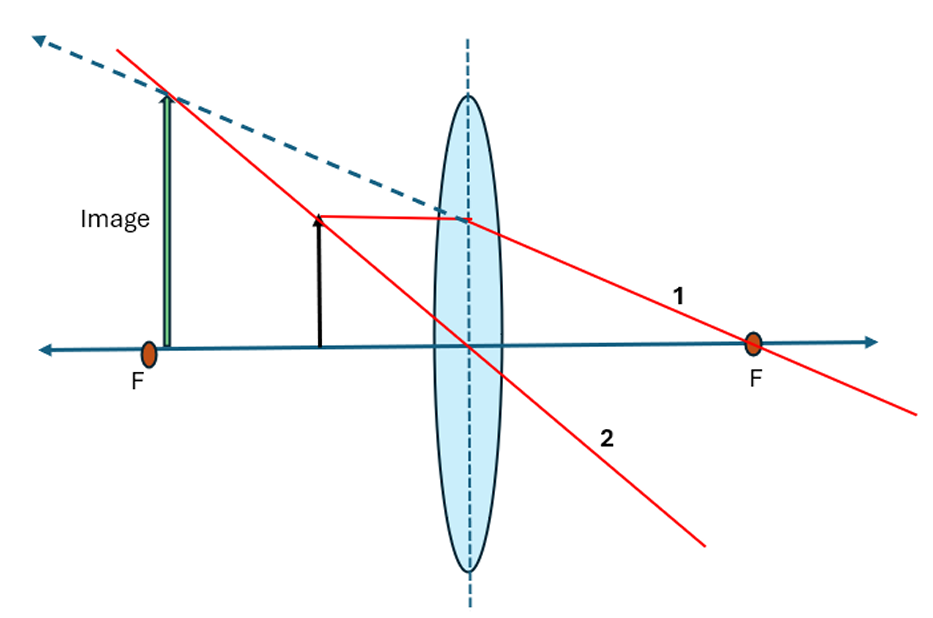
(c)(iii) This arrangement is used as a magnifying glass.
Question
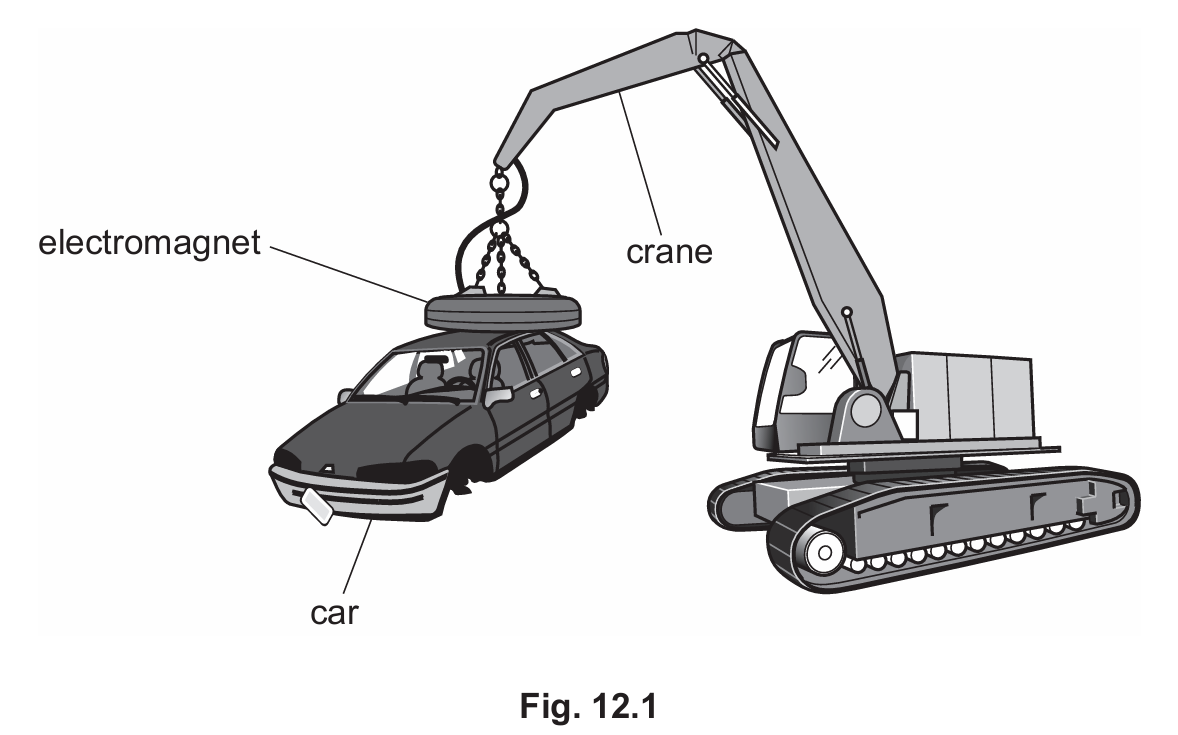
Fig. 12.2 shows a solenoid.
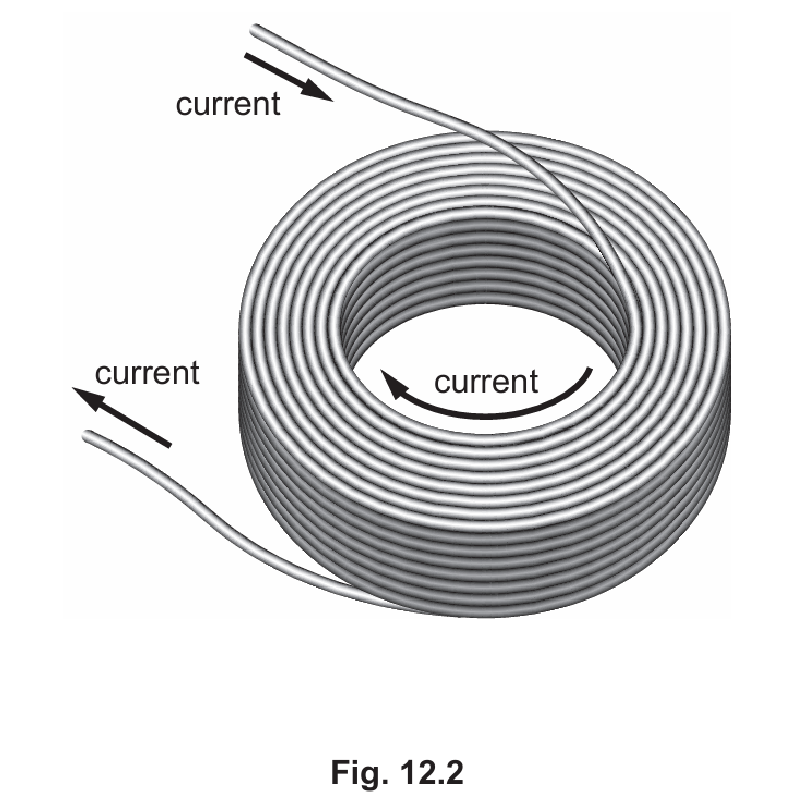
Include an arrow showing the direction of the magnetic field.
Calculate the amount of charge which flows through the solenoid in 30 s.
State the unit for your answer.
Calculate the power of the electromagnet.
State one other advantage of using an electromagnet to lift scrap metal.
Most-appropriate topic codes (Cambridge IGCSE Co-ordinated Sciences 0654, 2025–2027 syllabus):
• Topic P1.6.2 — Work (Part (a))
• Topic P4.5.3 — Magnetic effect of current (Part (b)(i))
• Topic P4.2.1 — Electrical charge (Part (b)(ii))
• Topic P4.2.5 — Electrical energy and electrical power (Part (b)(iii))
• Topic P4.5.3 — Magnetic effect of current (Part (c))
▶️ Answer/Explanation
(a)
Work done = force × distance = weight × height = \(mgh\).
\( W = 1200 \times 10 \times 15 = \mathbf{180\,000} \textbf{ J} \) (or \(1.8 \times 10^5 \text{ J}\)).
The work done equals the gravitational potential energy gained by the car.
(b)(i)
The magnetic field pattern of a solenoid resembles that of a bar magnet: field lines emerge from one end (north pole), curve around the outside of the solenoid, and re-enter at the other end (south pole).
Inside the solenoid, the field lines run parallel and are evenly spaced, indicating a uniform magnetic field.
The direction of the field (north pole end) is determined by the right-hand rule applied to the direction of current flow in the coil.
(b)(ii)
Using \( Q = It \): \( Q = 50 \times 30 = \mathbf{1500} \).
Unit: C (coulombs).
Charge is the product of current (in amperes) and time (in seconds), giving the total quantity of electric charge that has flowed.
(b)(iii)
First find the voltage: \( V = IR = 50 \times 5.0 = 250 \text{ V} \).
Then calculate power: \( P = IV = 50 \times 250 = \mathbf{12\,500} \textbf{ W} \).
Alternatively, \( P = I^2 R = 50^2 \times 5.0 = 2500 \times 5.0 = 12\,500 \text{ W} \).
(c)
One other advantage: the electromagnet can be switched on and off (by turning the current on or off).
This means the electromagnet can easily release the scrap metal by switching off the current, which a permanent magnet cannot do.
This makes it practical and controllable for lifting and dropping metal objects at a scrapyard.