
▶️ Answer/Explanation
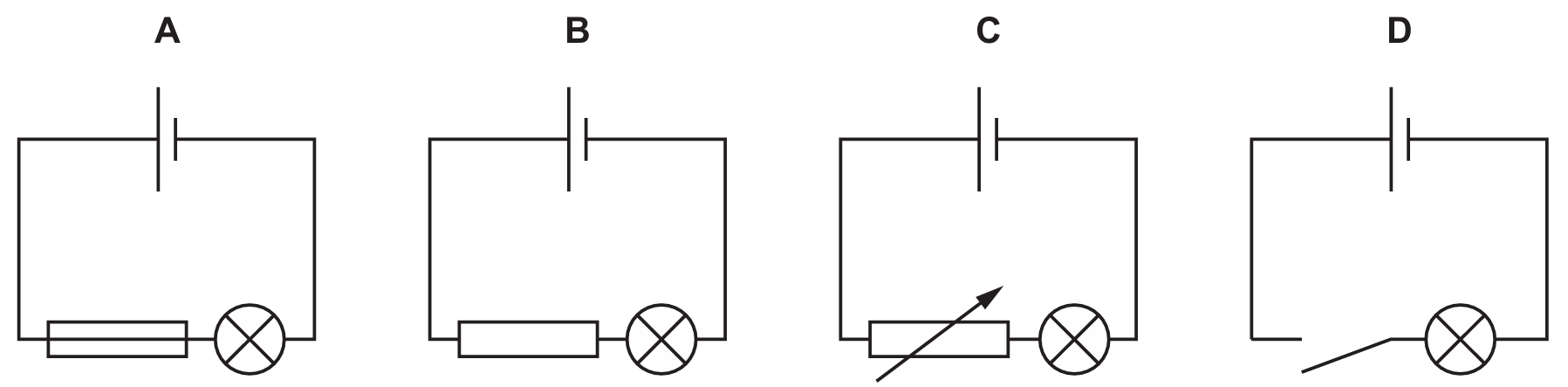
A variable resistor (rheostat) in series with the lamp allows the current through the lamp to be varied continuously, thus changing the brightness.
A fixed resistor only gives one brightness. A switch only turns it on/off, and a parallel connection with a variable resistor would not provide continuous variation.
✅ Answer: (C)
A fixed resistor only gives one brightness. A switch only turns it on/off, and a parallel connection with a variable resistor would not provide continuous variation.
✅ Answer: (C)

▶️ Answer/Explanation
Household lighting circuits connect lamps in parallel rather than in series.
In a parallel circuit, each lamp is on its own separate branch, so each lamp receives the full supply voltage and can be switched on or off independently of the others.
This matches row A: lamps connected in parallel, with the advantage that they can be switched separately.
✅ Answer: (A)
In a parallel circuit, each lamp is on its own separate branch, so each lamp receives the full supply voltage and can be switched on or off independently of the others.
This matches row A: lamps connected in parallel, with the advantage that they can be switched separately.
✅ Answer: (A)

▶️ Answer/Explanation
To measure current, the ammeter must be connected in series with the resistor so the same current flows through both.
To measure potential difference, the voltmeter must be connected in parallel across the resistor only.
The correct circuit places the ammeter in series with the resistor and the voltmeter in parallel across just the resistor.
✅ Answer: (A)
To measure potential difference, the voltmeter must be connected in parallel across the resistor only.
The correct circuit places the ammeter in series with the resistor and the voltmeter in parallel across just the resistor.
✅ Answer: (A)
Question
In which circuit can the brightness of the lamp be varied continuously?

▶️Answer/Explanation
Answer: A
Explanation: A variable resistor (rheostat) allows the current in the circuit to be adjusted, which in turn varies the brightness of the lamp continuously.