
▶️ Answer/Explanation
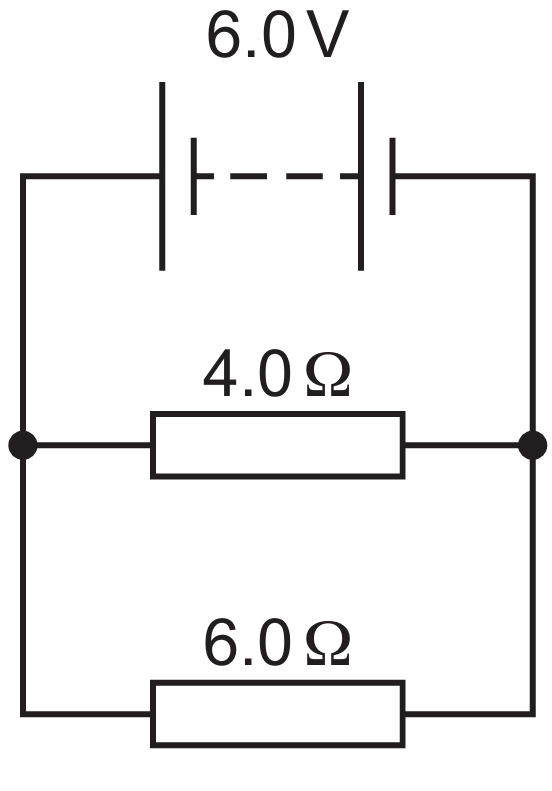
The circuit shows a parallel arrangement of a 4.0Ω resistor and a 6.0Ω resistor connected to a 6.0V supply. In a parallel circuit, the potential difference (p.d.) across each branch is equal to the supply voltage (6.0V). Using Ohm’s law \(I = \frac{V}{R}\), the current in the 4.0Ω resistor is \(\frac{6.0}{4.0} = 1.5 \text{ A}\). The current in the 6.0Ω resistor is \(\frac{6.0}{6.0} = 1.0 \text{ A}\). Therefore, option B is correct.
✅ Answer: (B)
✅ Answer: (B)
▶️ Answer/Explanation
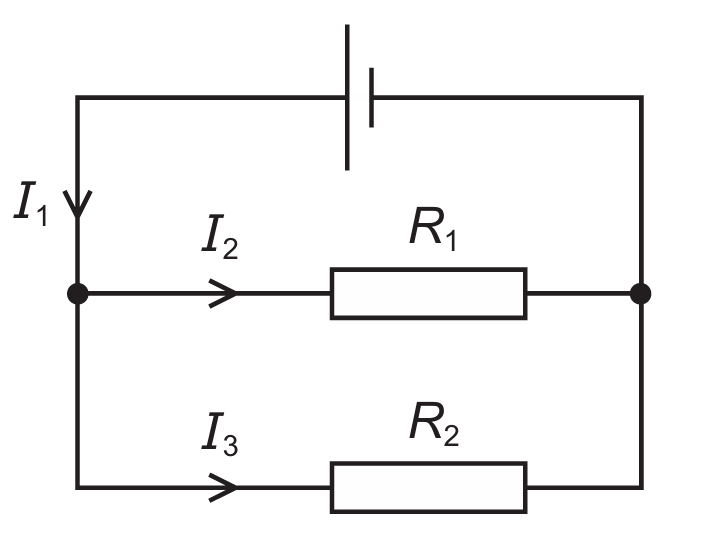
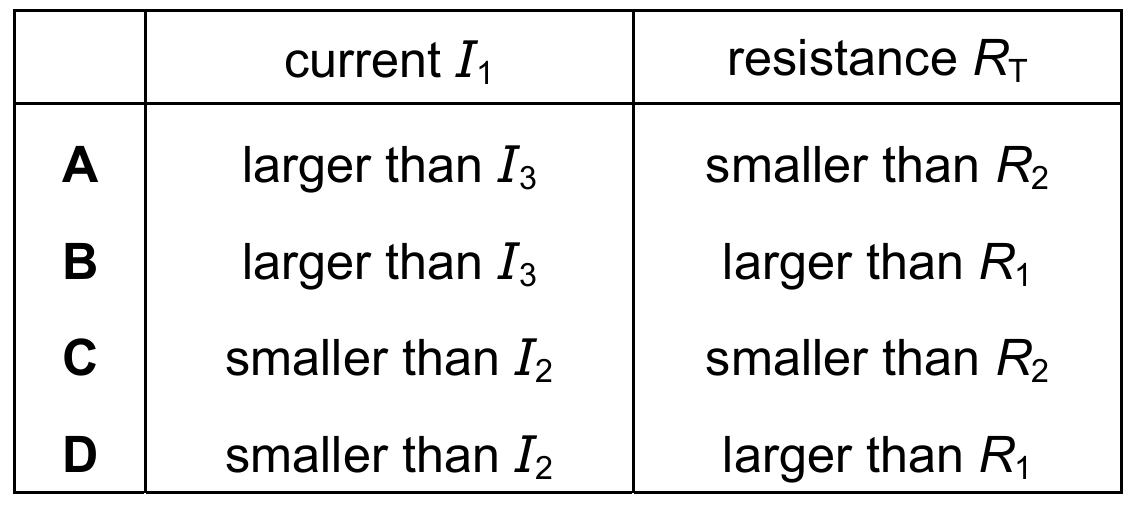
From the circuit, \(I_1\) is the total current from the source, which is greater than branch current \(I_3\). Also, the combined resistance \(R_{\mathrm{T}}\) is less than each individual resistor, so \(R_1\) is smaller than \(R_2\). Thus row A is correct.
✅ Answer: (A)
✅ Answer: (A)
▶️ Answer/Explanation
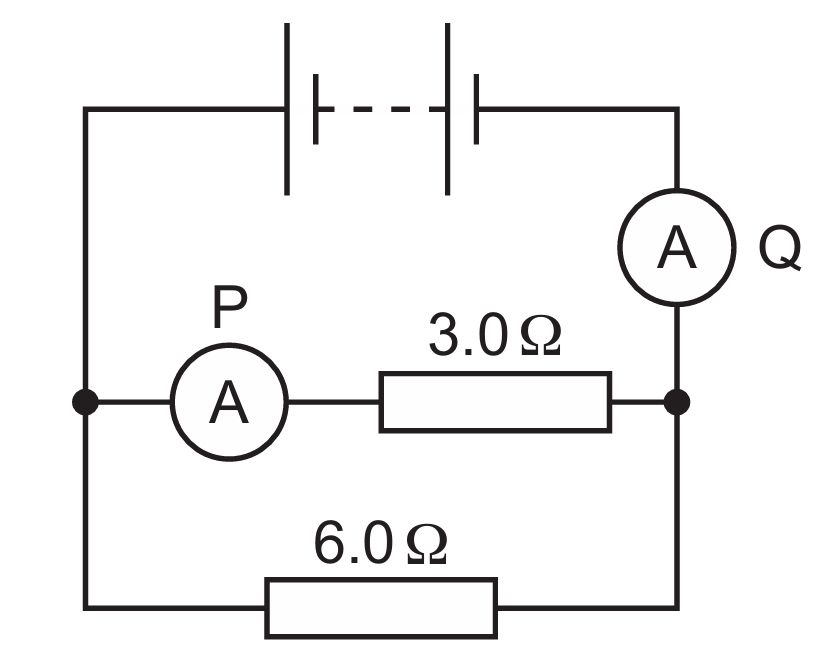
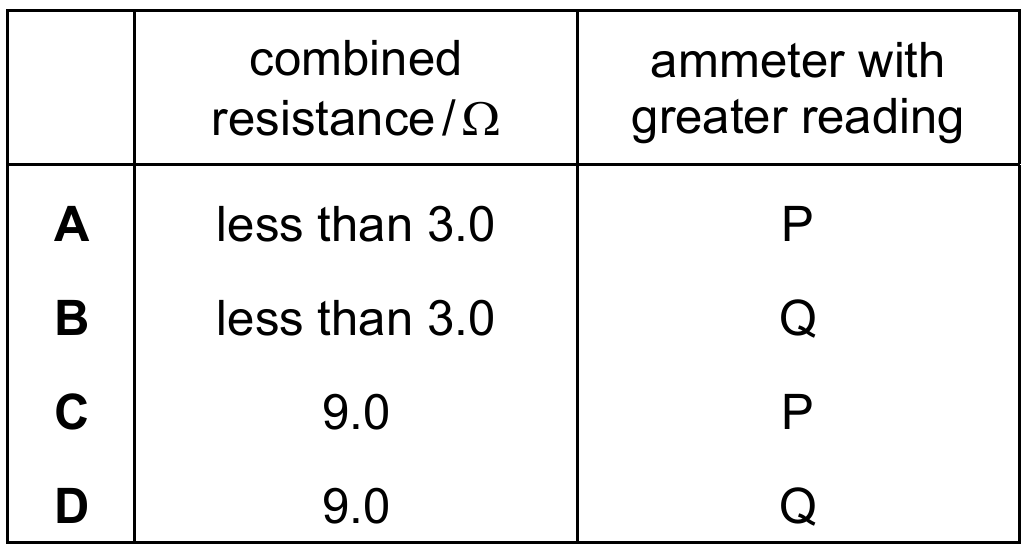
For resistors in parallel: \(\frac{1}{R} = \frac{1}{3.0} + \frac{1}{6.0} = \frac{1}{2.0}\), so \(R = 2.0\ \Omega\), which is less than 3.0 Ω.
Ammeter Q, positioned in the main circuit, measures the total combined current from both parallel branches.
Since the total current is always greater than the current in any single branch, ammeter Q gives the greater reading.
✅ Answer: (B)
Ammeter Q, positioned in the main circuit, measures the total combined current from both parallel branches.
Since the total current is always greater than the current in any single branch, ammeter Q gives the greater reading.
✅ Answer: (B)
▶️ Answer/Explanation
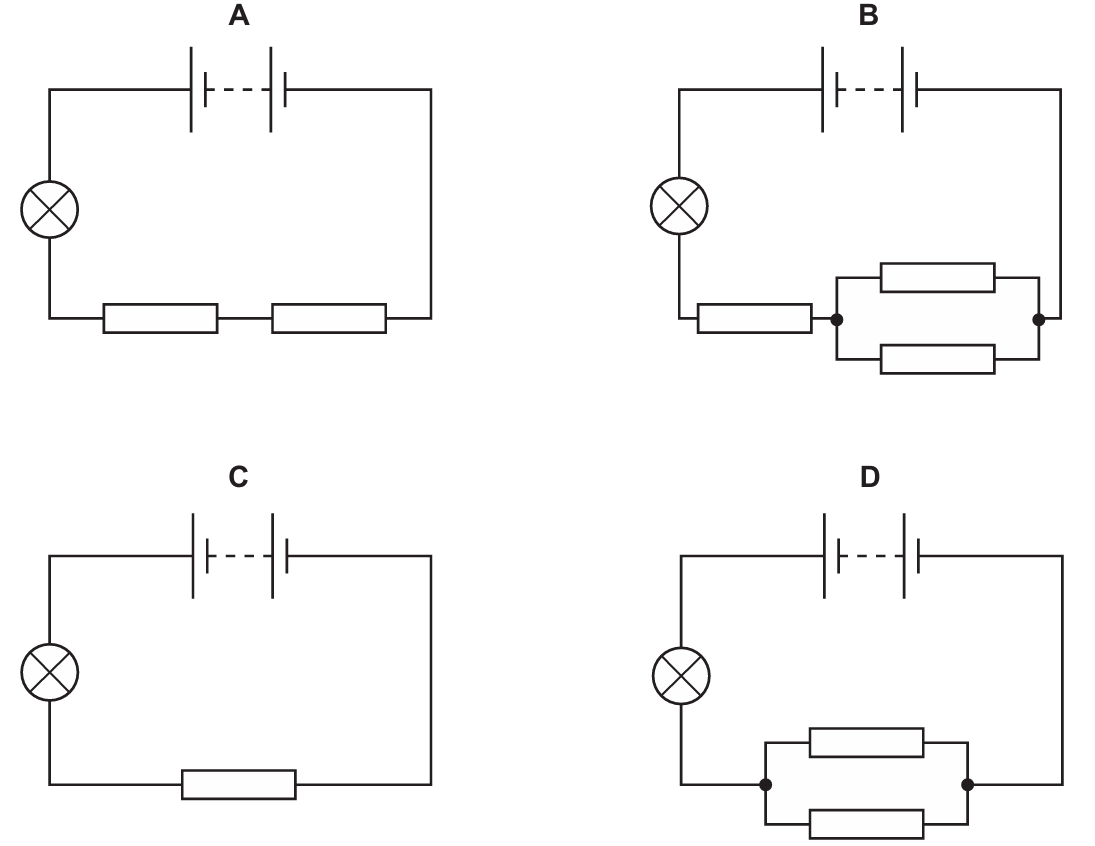
Lamp brightness increases with more current through it, which happens when the total circuit resistance is lowest.
Placing resistors in parallel (rather than in series) with the lamp reduces the overall resistance the battery has to drive current through, allowing more current to flow through the lamp.
Circuit D has the arrangement that gives the lowest effective resistance in the lamp’s branch, making the lamp brightest.
✅ Answer: (D)
Placing resistors in parallel (rather than in series) with the lamp reduces the overall resistance the battery has to drive current through, allowing more current to flow through the lamp.
Circuit D has the arrangement that gives the lowest effective resistance in the lamp’s branch, making the lamp brightest.
✅ Answer: (D)