Home / iGCSE / Coordinated Sciences / P4.4 Electrical safety Paper 2

CIE iGCSE Co-Ordinated Science P4.4 Electrical safety Exam Style Questions Paper 2

Question

The current in an electric kettle used to boil water is 9.0 A.

What is the most appropriate rating of fuse to use with this kettle?

A. 1 A
B. 3 A
C. 8 A
D. 13 A

▶️ Answer/Explanation
A fuse must have a rating slightly higher than the normal operating current, so it does not blow during normal use.
Since the kettle draws 9.0 A, any fuse rated below this (1 A, 3 A, or 8 A) would blow immediately during normal operation.
The 13 A fuse is the smallest standard rating that is still safely above 9.0 A, making it the most appropriate choice.
Answer: (D)

Question

What is the purpose of a fuse in an electric circuit?

A. to make the circuit more efficient
B. to protect the circuit from damage by a large current
C. to provide a constant current in the circuit
D. to provide a constant potential difference (p.d.) across the circuit

▶️ Answer/Explanation
A fuse contains a thin wire that melts and breaks the circuit if the current becomes too large.
This protects the circuit and appliance from damage or fire caused by excessive current, such as from a fault.
A fuse does not regulate current or voltage to a constant value — it simply disconnects the circuit when overloaded.
Answer: (B)

Question

Fuses are used in domestic electric circuits.

Which statement about fuses is correct?

A. A fuse is connected in the live wire.
B. A fuse is connected in the neutral wire.
C. A \(3.0\text{ A}\) fuse produces a current of exactly \(3.0\text{ A}\) in the circuit.
D. A \(3.0\text{ A}\) fuse produces a minimum current of \(3.0\text{ A}\) in the circuit.

▶️ Answer/Explanation
A fuse must be placed in the live wire, so that when it melts it disconnects the dangerous high-potential supply from the appliance.
A fuse does not produce a fixed or minimum current; it melts and breaks the circuit once \(I > 3.0\text{ A}\) (its rated value).
Answer: (A)

Question

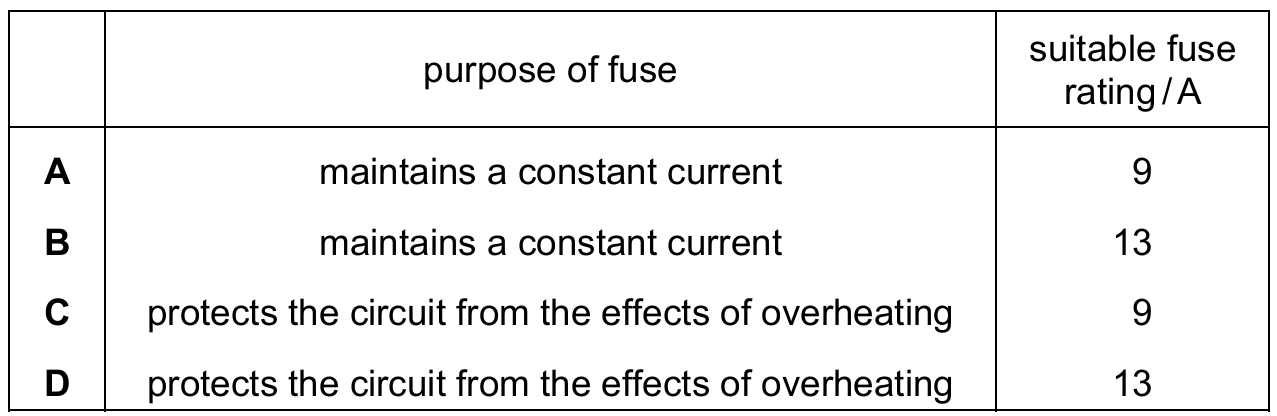
The current in an electric heater is 10 A when in normal use. The heater circuit contains a fuse.
What is the purpose of the fuse and what is a suitable rating for the fuse?

▶️ Answer/Explanation
A fuse protects a circuit by melting and breaking the circuit if the current becomes dangerously high, preventing overheating and fire — it does not maintain a constant current.
The fuse rating must be just above the normal operating current of 10 A, so a 13 A fuse is suitable (a 9 A fuse would blow immediately during normal use).
This matches “protects from overheating” with a 13 A rating.
Answer: (D)

Question

The current in an electric heater during normal use is 11A.

What is an appropriate rating for a fuse to protect the heater?

A. 3A
B. 10A
C. 13A
D. 36A

▶️ Answer/Explanation
A fuse must have a current rating higher than the normal operating current of the appliance, so that it does not blow during ordinary use.
Since the heater draws 11A, a 3A or 10A fuse would melt (blow) even under normal conditions, disconnecting the heater unnecessarily.
A 13A fuse is the smallest standard rating above 11A, so it lets the heater run normally but still melts quickly if a fault causes an excessive current, making it the most appropriate choice (36A would be far too high to offer proper protection).
Answer: (C)
Scroll to Top