
CIE iGCSE Co-Ordinated Science P4.4 Electrical safety Exam Style Questions Paper 3
Question
Most-appropriate topic codes (Cambridge IGCSE Coordinated Sciences 0654):
• Topic P2.3.2 — Convection (Part (a))
• Topic P2.1.1 — States of matter (Part (b))
• Topic P4.2.5 — Electrical energy and electrical power (Part (c)(i), (c)(ii), (c)(iii))
• Topic P4.4 — Electrical safety (Part (d))
▶️ Answer/Explanation
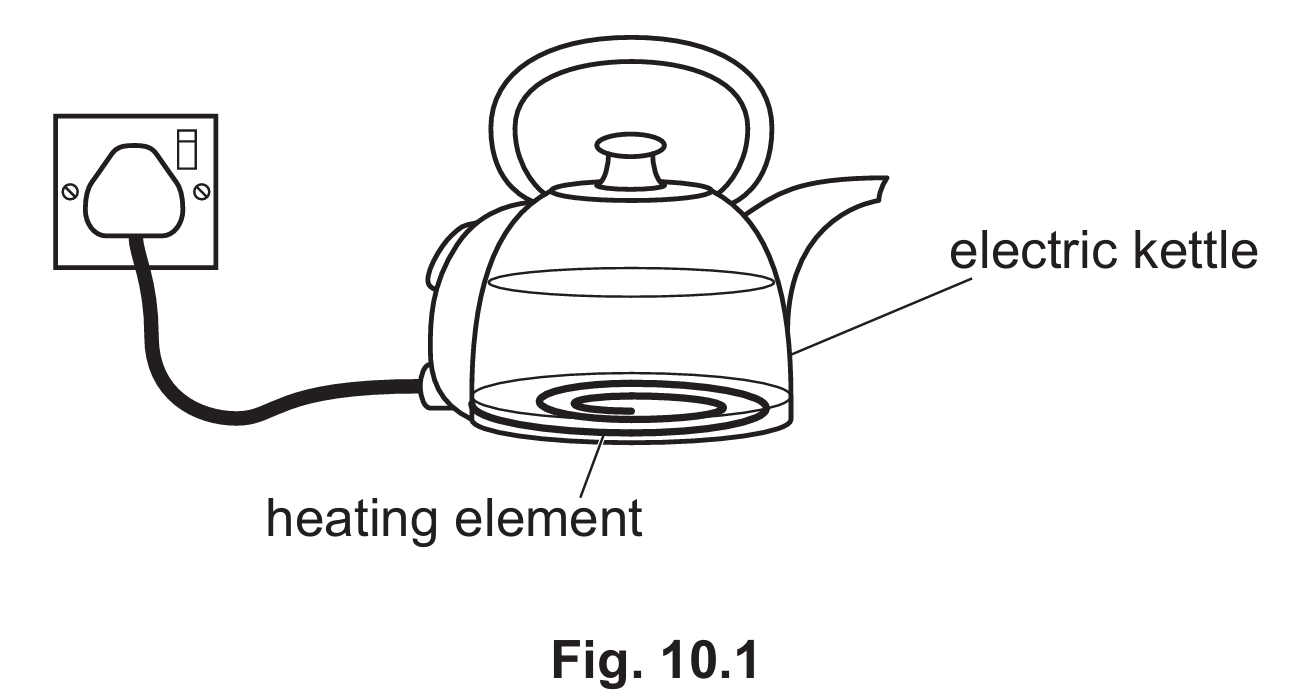
(a) convection
Convection is the transfer of thermal energy in fluids (liquids and gases) by the movement of the fluid itself. Heated water rises and cooler water sinks, creating convection currents.
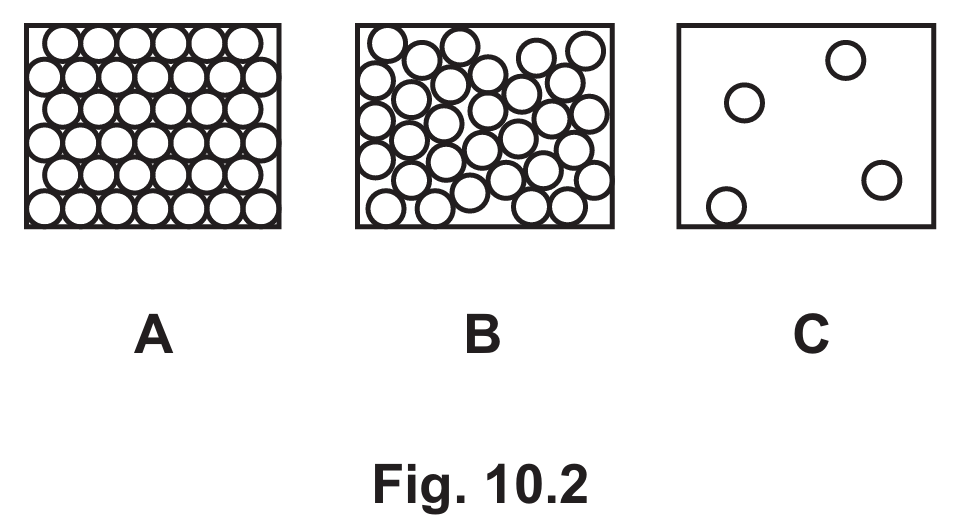
(b) (gas is diagram) C and (liquid is diagram) B
In a gas (C), particles are far apart and move randomly. In a liquid (B), particles are close together but can slide past each other.
(c)(i) P = IV (in any form) OR (current =) 3000/240; 12.5 (A)
Using P = IV, I = P/V = 3000/240 = 12.5 A.
(c)(ii) energy = power × time (in any form); conversion of minutes to hours; conversion of W to kW; (= 0.5 kWh)
Energy = 3000 W × (10/60) h = 3.0 kW × 0.167 h = 0.5 kWh.
(c)(iii) ($) 0.25
Cost = 0.5 kWh × $0.50/kWh = $0.25.
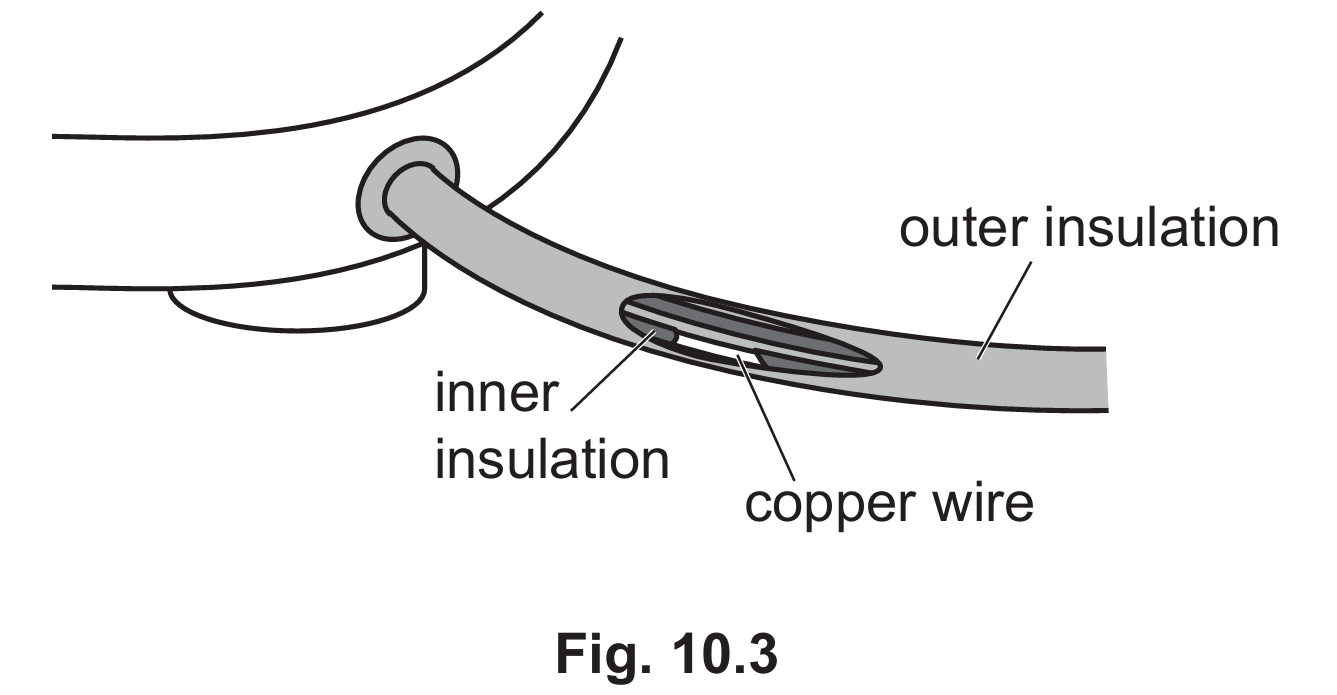
(d) insulation damaged / exposed (live) wire; electric shock
Damaged insulation exposes live wires. If a person touches the exposed wire, they may receive an electric shock, which can be fatal as current passes through the body.
Question
Most-appropriate topic codes (Cambridge IGCSE Co-ordinated Sciences 0654):
• Topic P1.4 — Density (Part (a)(i) & (a)(ii))
• Topic P2.1.1 — States of matter (Part (b)(i))
• Topic P2.1.2 — Particle model (Part (b)(ii) & (b)(iii))
• Topic P5.1 — The nucleus (Part (c))
• Topic P4.4 — Electrical safety (Part (d))
▶️ Answer/Explanation
(a)(i)
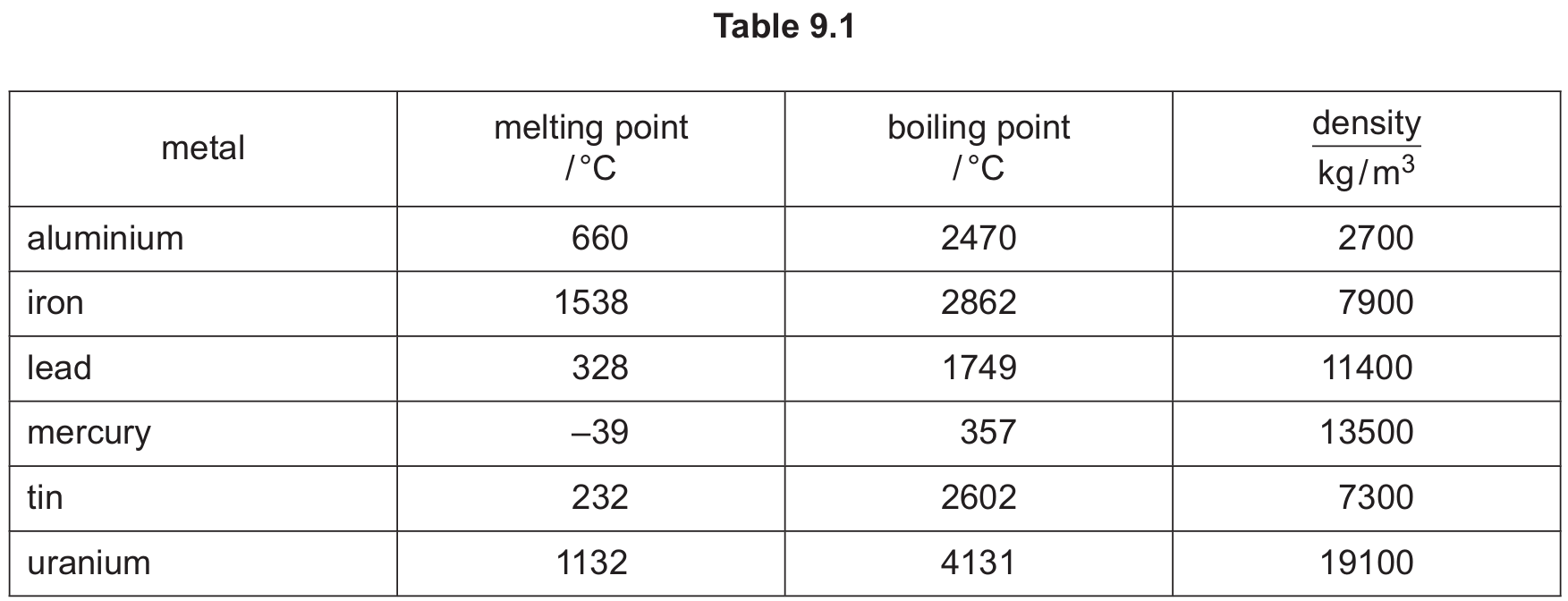
uranium (density = $19\,100\,\text{kg/m}^3$)
Density is defined as mass per unit volume. Comparing all six metals in Table 9.1, uranium has the highest density value, making it the densest metal listed.
(a)(ii)
All the metals have a density greater than that of water ($1000\,\text{kg/m}^3$).
An object sinks in a fluid when its density is greater than the density of the fluid. The least dense metal in the table is aluminium at $2700\,\text{kg/m}^3$, which is still nearly three times the density of water. Since every metal listed exceeds $1000\,\text{kg/m}^3$, all will sink.
(b)(i)
Mercury’s melting point (−39 °C) is below 20 °C, and its boiling point (357 °C) is above 20 °C.
Room temperature (20 °C) lies between the melting point and the boiling point of mercury. This means mercury is above its melting point (not a solid) and below its boiling point (not a gas), so it must be a liquid at room temperature.
(b)(ii)
Arrangement: random / irregular — particles are not held in fixed positions.
Separation: close together, most touching.
Liquid particles have enough energy to overcome the rigid lattice of a solid, allowing them to move past one another, but they remain close together and are not widely spaced like gas particles. This gives liquids a fixed volume but no fixed shape.
(b)(iii)
The particles move more slowly as temperature decreases.
Temperature is a measure of the average kinetic energy of the particles. As thermal energy is removed, particles lose kinetic energy, their speed decreases, and collisions become less frequent and less energetic. If cooled sufficiently below its melting point of −39 °C, mercury would solidify.
(c)
92 protons and 146 neutrons
In the nuclide notation $^{238}_{92}\text{U}$, the lower number (92) is the proton number giving the number of protons, and the upper number (238) is the nucleon number (total protons + neutrons). The number of neutrons is therefore $238 – 92 = 146$.
(d)
1. If too large a current flows, the fuse wire heats up due to the heating effect of the current.
2. The temperature rises above 200 °C and the fuse wire melts.
3. This breaks the circuit, stopping all current flow and protecting the device.
The fuse is connected in series so that all current must pass through it. Its low-melting-point alloy ensures it melts before the current reaches a level that would overheat the wiring or damage the appliance, acting as a deliberate weak point that sacrifices itself to protect the rest of the circuit.