
CIE iGCSE Co-Ordinated Science P4.5.1 Electromagnetic induction Exam Style Questions Paper 3
Question
State what has been added to or removed from the car for it to become charged.
State the type of energy stored in the fuel.
Explain why this is.
Complete the sentences to describe how a solar cell can provide energy.
Light energy from the …………….. is absorbed by the solar cell.
The solar cell changes the light energy to ………………. energy.
The turning effect of the motor can be increased by increasing the number of turns on the coil in the motor.
State one other way to increase the turning effect of the d.c. motor.
The lamps are connected in parallel.
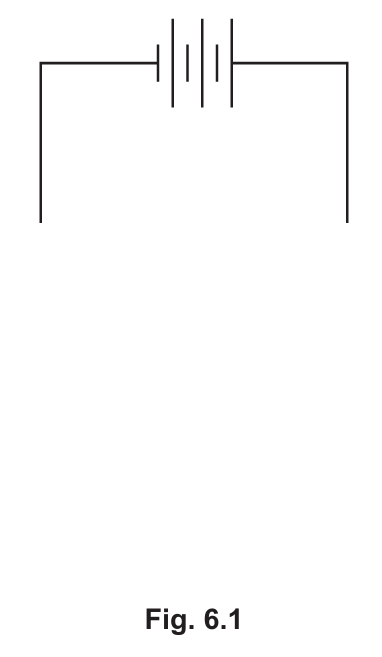
Complete the circuit diagram in Fig. 6.1 to show the two lamps connected in parallel, both controlled by one switch.
The battery has been drawn for you.
Most-appropriate topic codes (Cambridge IGCSE Co-ordinated Sciences 0654):
• Topic P1.6.1 — Energy (Parts (a)(i), (a)(iii), (a)(iv))
• Topic P4.2.1 — Electrical charge (Part (a)(ii))
• Topic P6.2.3 — Galaxies and the Universe (Part (b))
• Topic P4.5.5 — The d.c. motor (Part (c))
• Topic P4.5.1 — Electromagnetic induction (Part (d)(i))
• Topic P4.5.2 — The a.c. generator (Part (d)(ii))
• Topic P4.5.6 — The transformer (Part (d)(ii))
▶️ Answer/Explanation
(a)(i) Kinetic energy
A moving object possesses kinetic energy because of its motion.
The faster the car moves, the greater its kinetic energy.
Kinetic energy depends on both the mass and speed of the car.
(a)(ii) Electrons
Electrostatic charging occurs when electrons are transferred between surfaces.
Friction between the car and the air (or road) causes electrons to be added to or removed from the car.
This leaves the car with an overall electric charge.
(a)(iii) Chemical potential energy
Fuel stores energy in the chemical bonds of its molecules.
This is released as thermal energy during combustion in the engine.
The energy is described as chemical potential energy.
(a)(iv)
Not all of the chemical energy is converted into useful kinetic energy.
Some energy is transferred to thermal energy due to friction in moving parts.
Some energy is also transferred as sound energy, and both are lost to the surroundings.
(b) Sun; electrical
Light energy from the Sun reaches the solar cell.
The solar cell absorbs this light energy.
It then converts (transfers) the light energy into electrical energy.
(c) Increase the strength of the magnetic field, or increase the current
The turning effect (torque) on the coil depends on the magnetic field strength, current, and number of turns.
Increasing the current passing through the coil increases the force on it.
A stronger magnetic field also increases the turning effect for the same current.
(d)(i)
The circuit is drawn with the two lamps on separate parallel branches.
Both branches connect back to the same battery, so each lamp receives the full battery voltage.
A single switch is placed in the main circuit (before the branches split) so that it controls both lamps together.
(d)(ii) If one lamp fails, the other still lights up
In a parallel circuit, each lamp is connected on its own independent branch.
If one branch breaks (lamp fails), current can still flow through the other branch.
This means the remaining lamp continues to work normally.
Question

In the cell, ……………………………… energy is transferred to electrical energy in the circuit.
Electrical energy in the circuit is transferred to ……………………………… energy and ……………………………… energy emitted from the lamp.
Most-appropriate topic codes (Cambridge IGCSE Co-ordinated Sciences 0654):
• Topic P4.5.1 — Electromagnetic induction (Parts (a)(i), (b)(i))
• Topic P4.2.5 — Electrical energy and electrical power (Part (a)(ii))
• Topic P4.2.4 — Resistance (Part (a)(iii))
• Topic P4.2.1 — Electrical charge (Part (b)(ii))
• Topic P4.5.2 — The a.c. generator (Part (c))
▶️ Answer/Explanation
(a)(i) Cell, switch and lamp connected in a single loop
The correct circuit symbol for a cell (a long line and a short line) is drawn.
A switch symbol is added in the loop, shown open or closed.
All three components — cell, switch and lamp — are joined by wires in one continuous series loop.
(a)(ii) chemical; light; thermal
In the cell, chemical energy is transferred to electrical energy in the circuit.
Electrical energy in the circuit is transferred to light energy and thermal (heat) energy emitted from the lamp.
(a)(iii) \( 1.5\,\text{A} \)
Using \( V = IR \), rearrange to give \( I = \dfrac{V}{R} \).
\( I = \dfrac{12}{8.0} = 1.5\,\text{A} \).
(b)(i) Ammeter
An ammeter is connected in series in a circuit to measure the current flowing through it.
(b)(ii) Electrons
Copper is a metal, and current in a metal wire is due to the flow of free (delocalised) electrons.
These electrons drift through the metal lattice when a potential difference is applied.
(c) \( 7\,\Omega \)
For resistors connected in series, the combined resistance is the sum of the individual resistances.
\( R_{\text{total}} = R_1 + R_2 = 3 + 4 = 7\,\Omega \).