
CIE iGCSE Co-Ordinated Science P4.5.1 Electromagnetic induction Exam Style Questions Paper 4
Question
The angle of incidence is 53°.
The refractive index of glass is 1.5.
Calculate the angle of refraction \(r\).
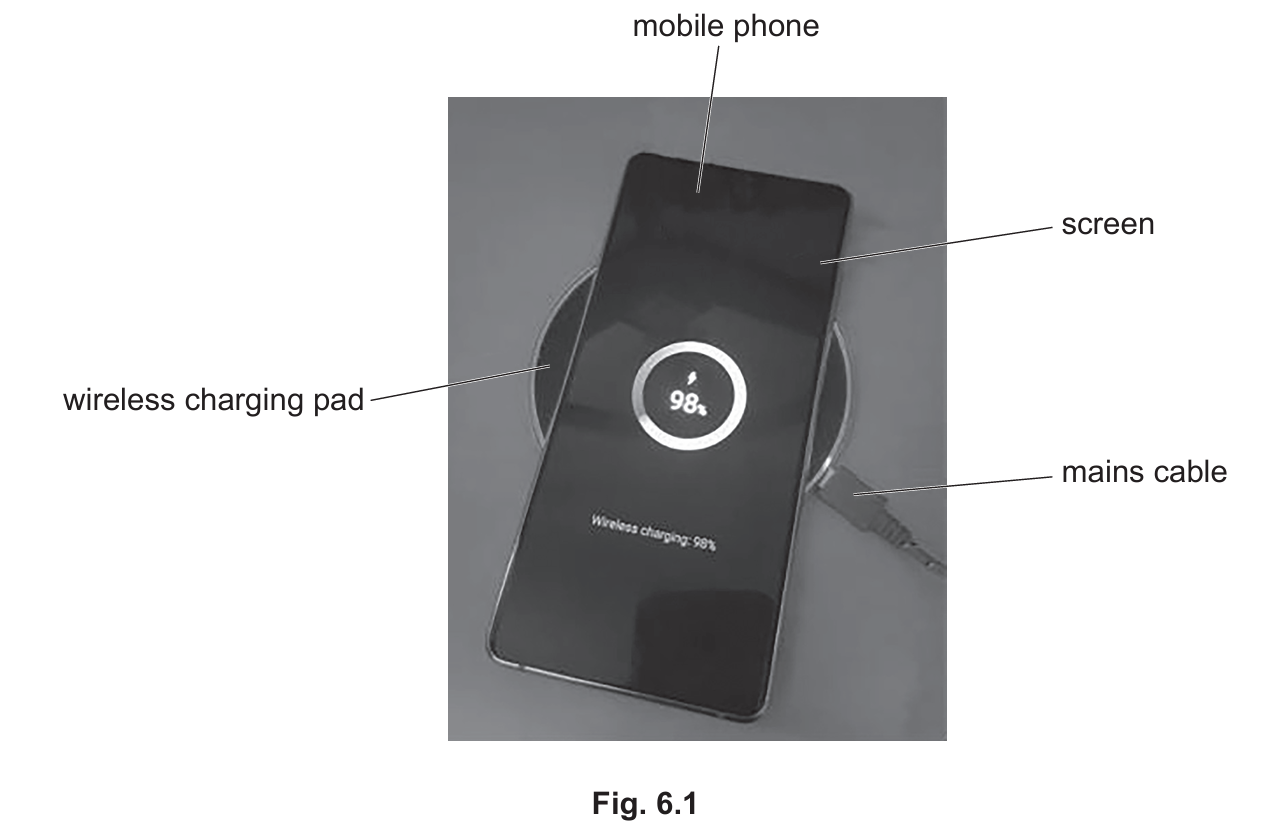
The current used to charge the battery is 0.60A.
Calculate the time taken to fully charge the mobile phone battery.
The mobile phone contains a second coil of wire.
Describe how an electromotive force (e.m.f.) is induced in the second coil of wire when the mobile phone is placed on the charging pad.
Most-appropriate topic codes (Cambridge IGCSE Co-ordinated Sciences 0654):
• Topic P3.2.2 — Refraction of light (Part (a))
• Topic P4.2.2 — Electric current (charge) (Part (b))
• Topic P4.5.1 — Electromagnetic induction (Part (c))
▶️ Answer/Explanation
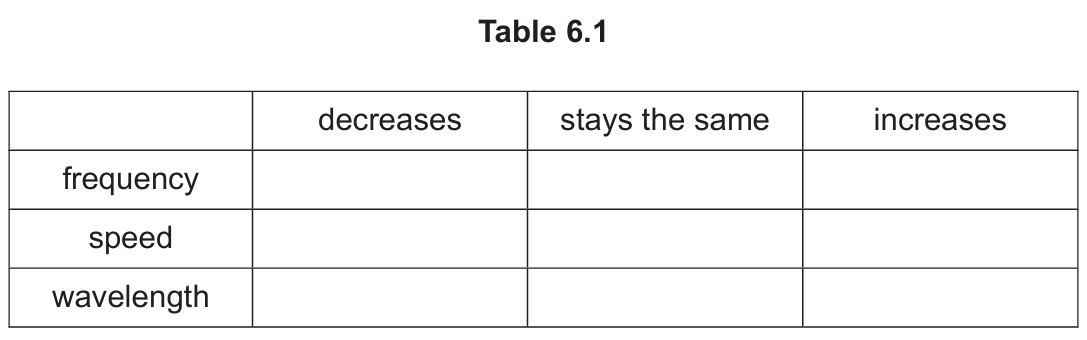
(a)(i) Frequency stays the same; speed decreases; wavelength decreases
Frequency is set by the light source and does not change when entering a new medium.
Glass is denser (optically) than air, so light slows down on entering it, and since \(v = f\lambda\) with f constant, the wavelength must also decrease.
(a)(ii) 32°
Using \(n = \dfrac{\sin i}{\sin r}\): \(1.5 = \dfrac{\sin 53°}{\sin r}\).
\(\sin r = \dfrac{\sin 53°}{1.5} = \dfrac{0.7986}{1.5} = 0.532\), so \(r = 32°\).
(b) 5500 s
Charge is related to current and time by \(Q = It\), so \(t = \dfrac{Q}{I}\).
\(t = \dfrac{3300}{0.60} = 5500 \, \text{s}\).
(c) A changing magnetic field around the first coil induces an e.m.f. in the second coil
The alternating current in the charging-pad coil produces a continuously changing magnetic field around it.
When the phone’s coil is placed within this changing field, the changing magnetic flux through it induces an e.m.f. (electromagnetic induction).
Question
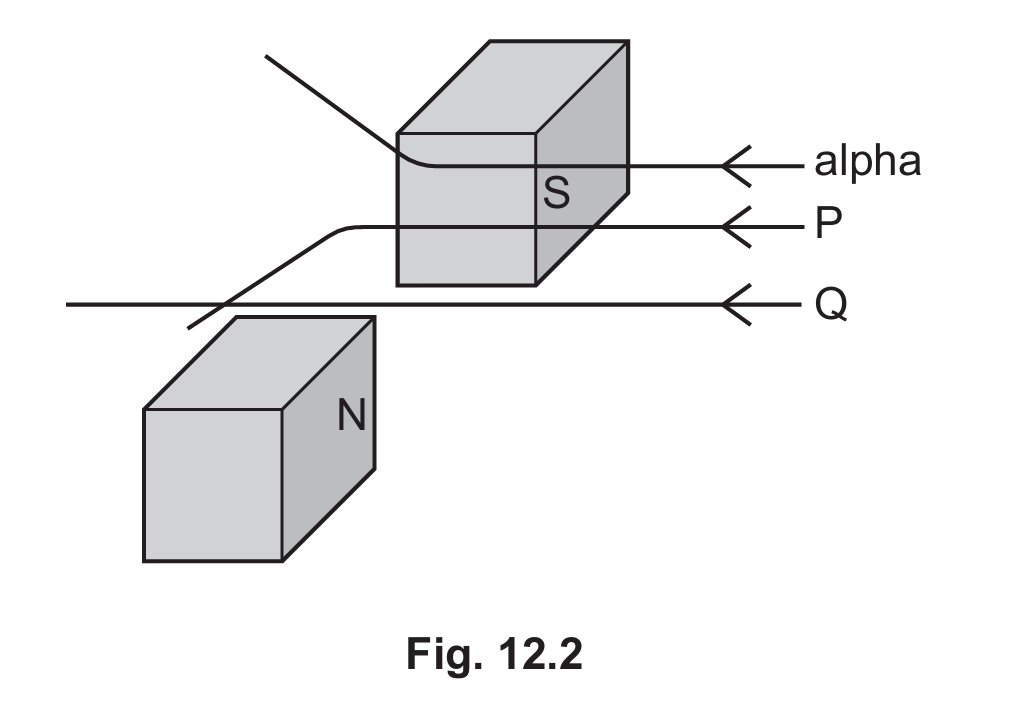
State the types of radiation which would follow the paths labelled P and Q.
Use the correct nuclide notation to complete the decay equation for americium-241.

Most-appropriate topic codes (Cambridge IGCSE Co-ordinated Sciences 0654, 2025–2027 syllabus):
• Topic P4.5.1 — Electromagnetic induction (Part (a)(i)–(ii))
• Topic P5.2.2 — The three types of nuclear emission (Part (b)(i)–(iii))
▶️ Answer/Explanation
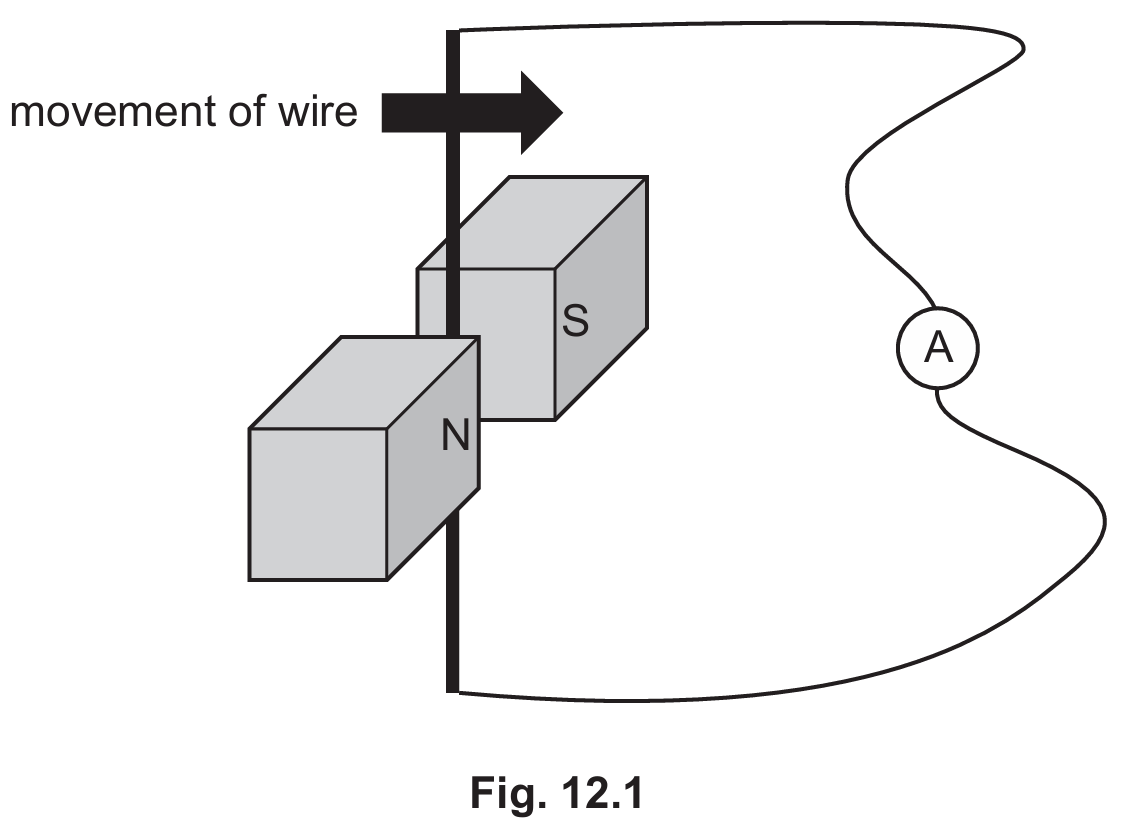
(a)(i) The wire experiences a changing magnetic field, inducing an emf
As the wire moves between the poles of the magnet, it cuts through the magnetic field lines.
This changing magnetic field induces an emf in the wire, which drives a current around the circuit.
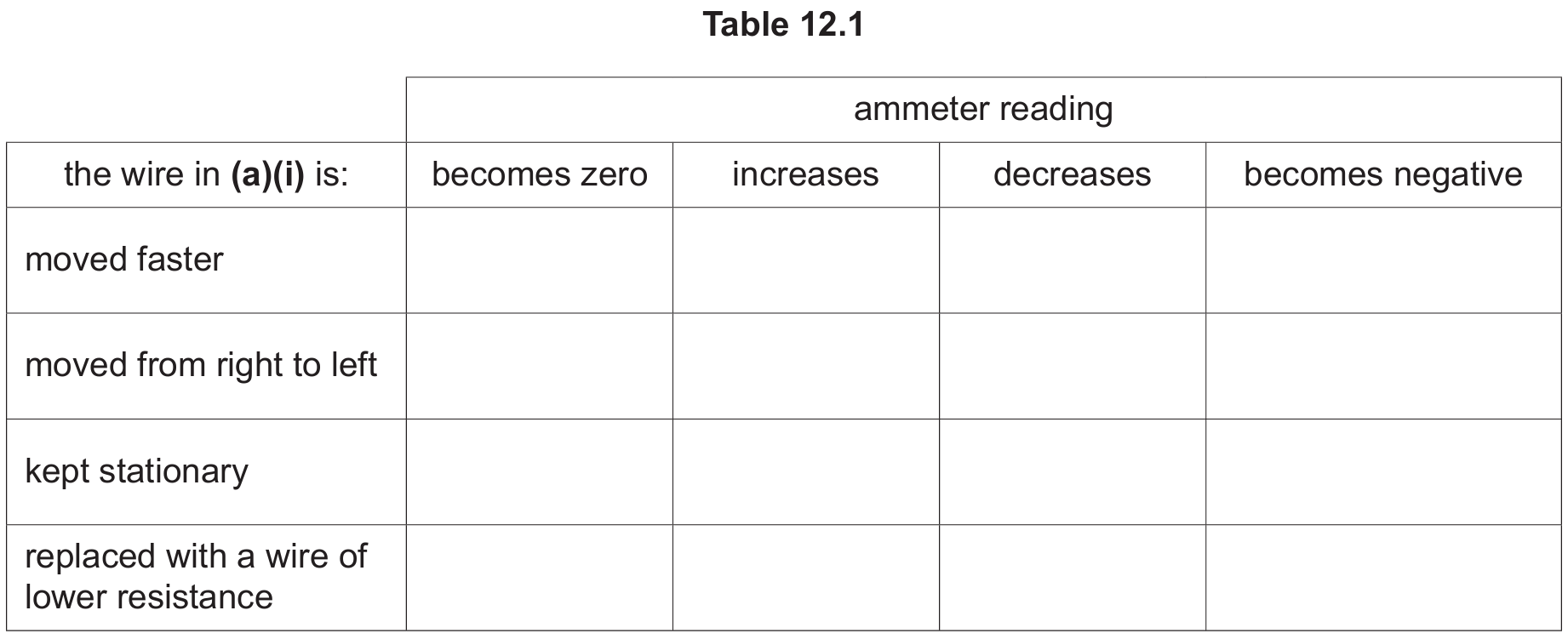
(a)(ii) 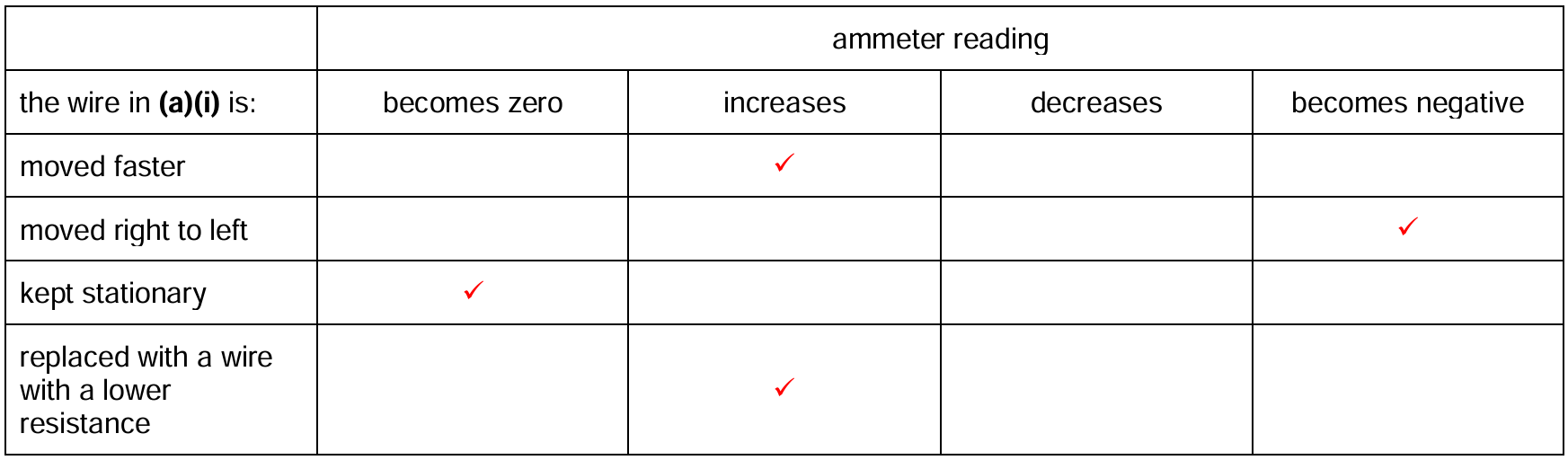
Moving the wire faster increases the rate of change of magnetic field, so the ammeter reading increases.
Reversing the direction of motion (right to left) reverses the induced current, so the reading becomes negative.
Keeping the wire stationary means there is no changing field, so the reading becomes zero.
Using a wire of lower resistance allows a larger current to flow for the same induced emf, so the reading increases.
(b)(i) P: beta; Q: gamma
Beta particles are deflected by a magnetic field, but less than alpha particles and in the opposite direction (since beta particles are negatively charged), matching path P.
Gamma radiation has no charge, so it is not deflected by the magnetic field and travels in a straight line, matching path Q.
(b)(ii) \( ^{241}_{95}\text{Am} \rightarrow \, ^{237}_{93}\text{Np} + \, ^{4}_{2}\alpha \)
In alpha decay, the mass number decreases by 4 and the atomic number decreases by 2.
So \( 241 – 4 = 237 \) and \( 95 – 2 = 93 \), giving neptunium-237 as the daughter nuclide.
(b)(iii) Least penetrating; easily stopped by smoke
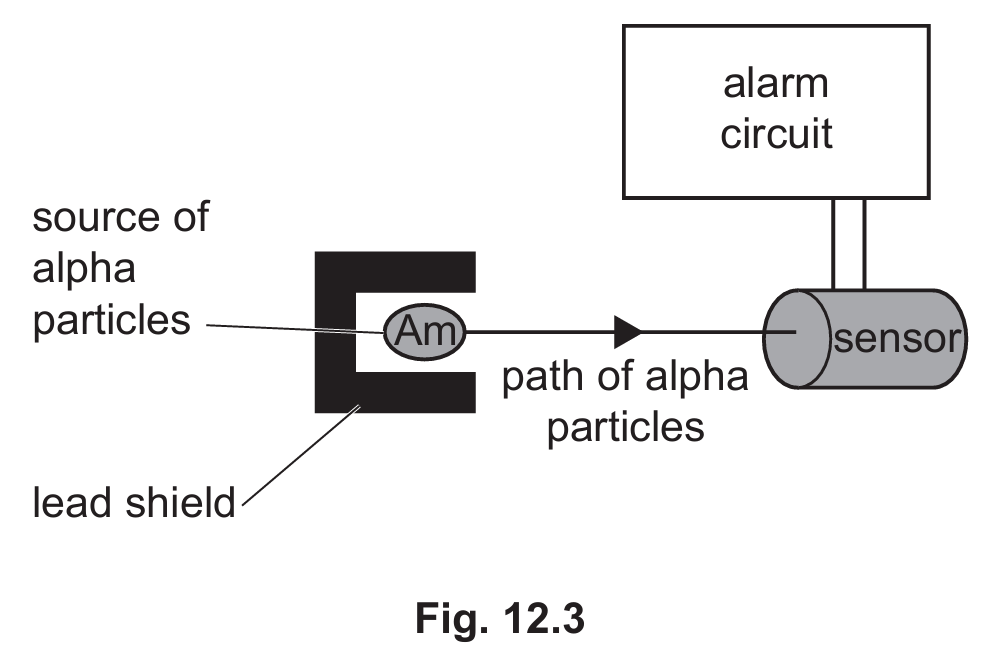
Alpha particles are the least penetrating and have a short range in air, so they are easily absorbed within the small space of the detector.
This means alpha particles are easily stopped or scattered by smoke particles, causing the detectable change in current needed to trigger the alarm.