
CIE iGCSE Co-Ordinated Science P4.5.3 Magnetic effect of current Exam Style Questions Paper 3
Question
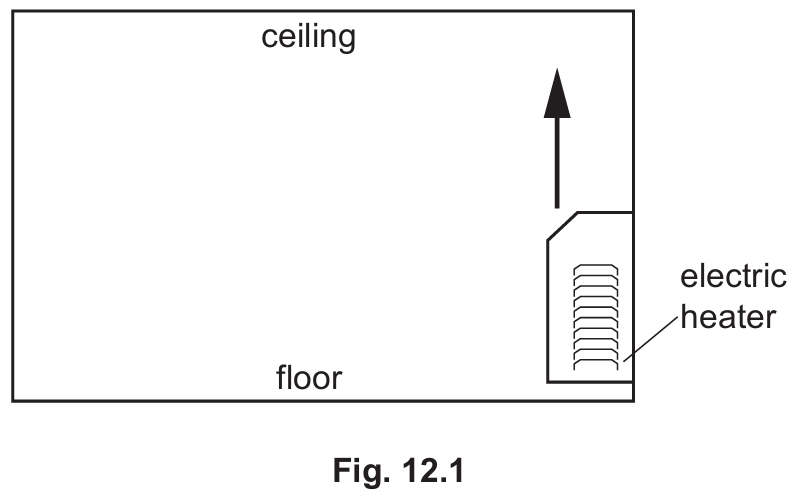
One arrow has been drawn for you.

Most-appropriate topic codes (Cambridge IGCSE Co-ordinated Sciences 0654):
• Topic P2.3.2 — Convection (Part (a))
• Topic P2.2.1 — Thermal Expansion of Solids, Liquids and Gases (Part (b))
• Topic P3.4 — Sound (Part (c)(i))
• Topic P4.5.3 — Magnetic effect of current (Part (c)(ii))
▶️ Answer/Explanation
(a)(i) Arrow rising from the heater, moving across the ceiling, dropping down the far wall, and moving back along the floor toward the heater
Warm air rises because it becomes less dense.
It cools as it moves along the ceiling and across, then sinks and returns along the floor, forming a complete convection current loop.
(a)(ii) Convection
Convection is the transfer of thermal energy through the bulk movement of a fluid (here, warm air rising and cool air sinking).
(b)(i) Celsius
The scale shown (with markings such as −10 to 110 °C) is the Celsius temperature scale.
(b)(ii) Alcohol (or mercury)
Both alcohol and mercury are commonly used liquids in liquid-in-glass thermometers.
(b)(iii) Volume (or density)
As temperature increases, the liquid expands, increasing its volume (and decreasing its density), which is used to indicate temperature change.
(c)(i) There is no medium for sound to travel through in a vacuum
Sound is a mechanical wave that requires particles to vibrate and pass on the wave.
A vacuum contains no particles, so sound has nothing to propagate through.
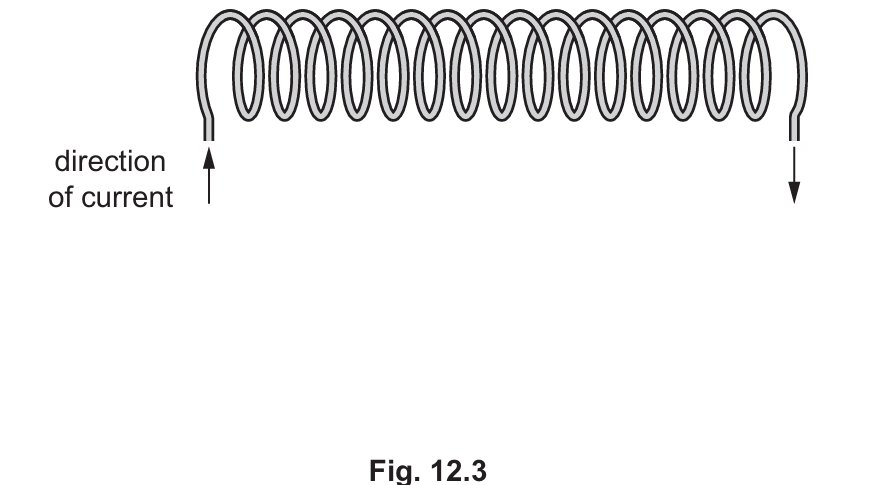
(c)(ii) Field lines run parallel and close together inside the solenoid (like a bar magnet), curving out and around the outside from one end to the other
Inside the solenoid, the magnetic field is strong and uniform, with lines running along the axis.
Outside, the field lines curve from the north end to the south end, similar to a bar magnet’s field pattern.