
CIE iGCSE Co-Ordinated Science P4.5.3 Magnetic effect of current Exam Style Questions Paper 4
Question
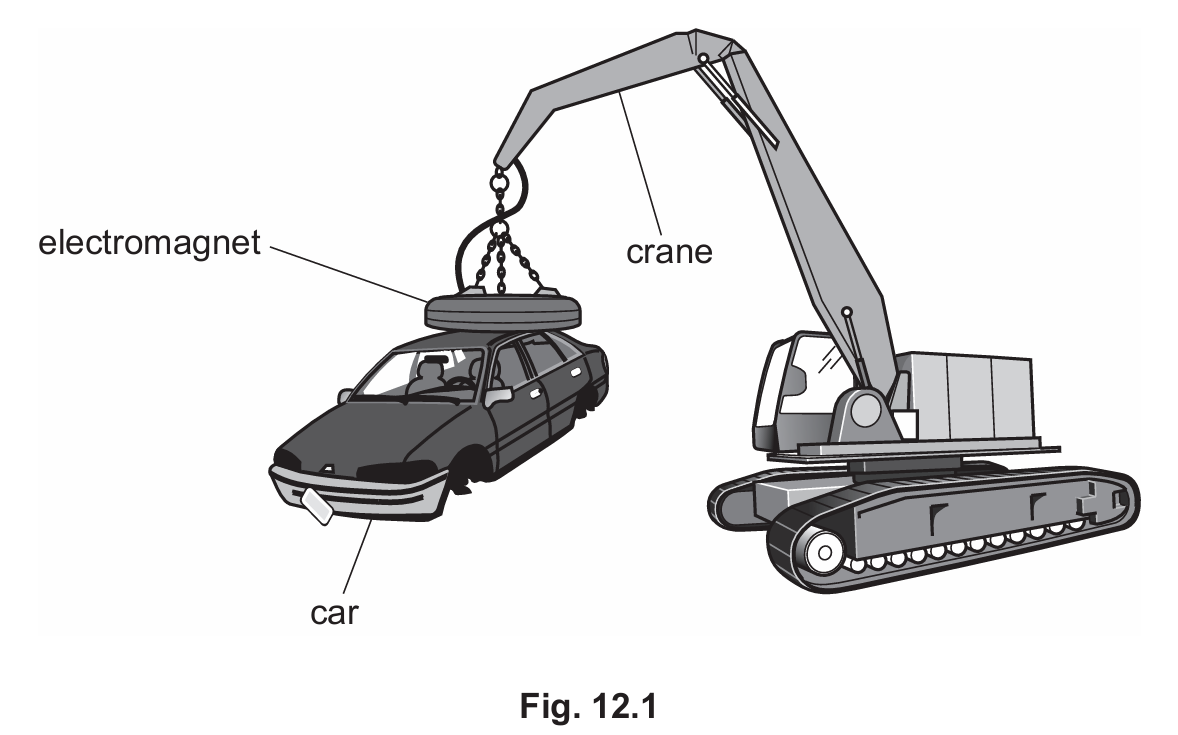
Fig. 12.2 shows a solenoid.
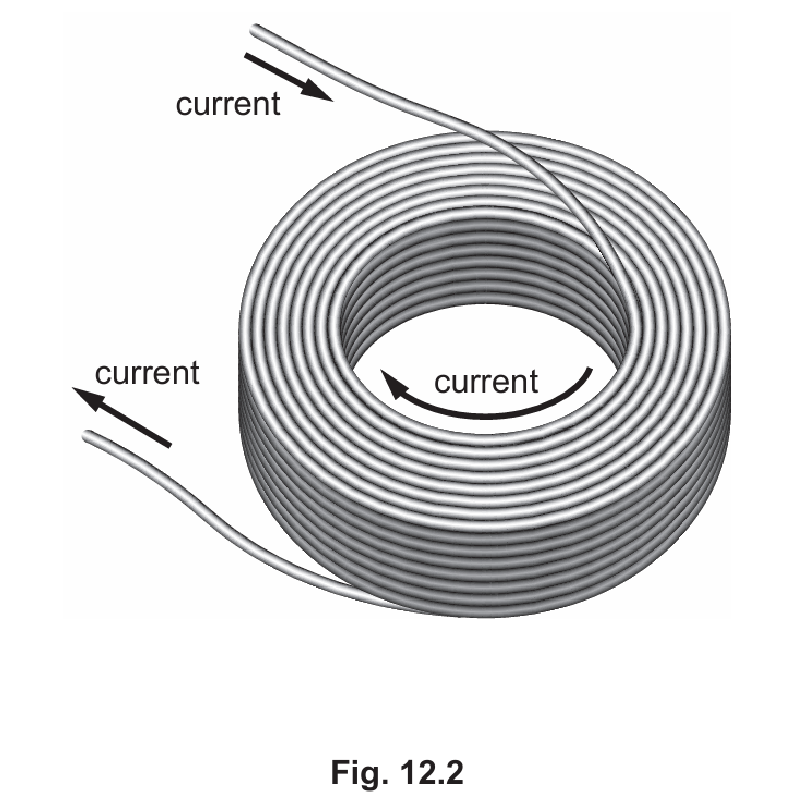
Include an arrow showing the direction of the magnetic field.
Calculate the amount of charge which flows through the solenoid in 30 s.
State the unit for your answer.
Calculate the power of the electromagnet.
State one other advantage of using an electromagnet to lift scrap metal.
Most-appropriate topic codes (Cambridge IGCSE Co-ordinated Sciences 0654, 2025–2027 syllabus):
• Topic P1.6.2 — Work (Part (a))
• Topic P4.5.3 — Magnetic effect of current (Part (b)(i))
• Topic P4.2.1 — Electrical charge (Part (b)(ii))
• Topic P4.2.5 — Electrical energy and electrical power (Part (b)(iii))
• Topic P4.5.3 — Magnetic effect of current (Part (c))
▶️ Answer/Explanation
(a)
Work done = force × distance = weight × height = \(mgh\).
\( W = 1200 \times 10 \times 15 = \mathbf{180\,000} \textbf{ J} \) (or \(1.8 \times 10^5 \text{ J}\)).
The work done equals the gravitational potential energy gained by the car.
(b)(i)
The magnetic field pattern of a solenoid resembles that of a bar magnet: field lines emerge from one end (north pole), curve around the outside of the solenoid, and re-enter at the other end (south pole).
Inside the solenoid, the field lines run parallel and are evenly spaced, indicating a uniform magnetic field.
The direction of the field (north pole end) is determined by the right-hand rule applied to the direction of current flow in the coil.
(b)(ii)
Using \( Q = It \): \( Q = 50 \times 30 = \mathbf{1500} \).
Unit: C (coulombs).
Charge is the product of current (in amperes) and time (in seconds), giving the total quantity of electric charge that has flowed.
(b)(iii)
First find the voltage: \( V = IR = 50 \times 5.0 = 250 \text{ V} \).
Then calculate power: \( P = IV = 50 \times 250 = \mathbf{12\,500} \textbf{ W} \).
Alternatively, \( P = I^2 R = 50^2 \times 5.0 = 2500 \times 5.0 = 12\,500 \text{ W} \).
(c)
One other advantage: the electromagnet can be switched on and off (by turning the current on or off).
This means the electromagnet can easily release the scrap metal by switching off the current, which a permanent magnet cannot do.
This makes it practical and controllable for lifting and dropping metal objects at a scrapyard.
Question
This is used to investigate water waves.
An electric motor causes the board to vibrate.
At a constant speed of rotation, the motor produces waves at a constant rate.
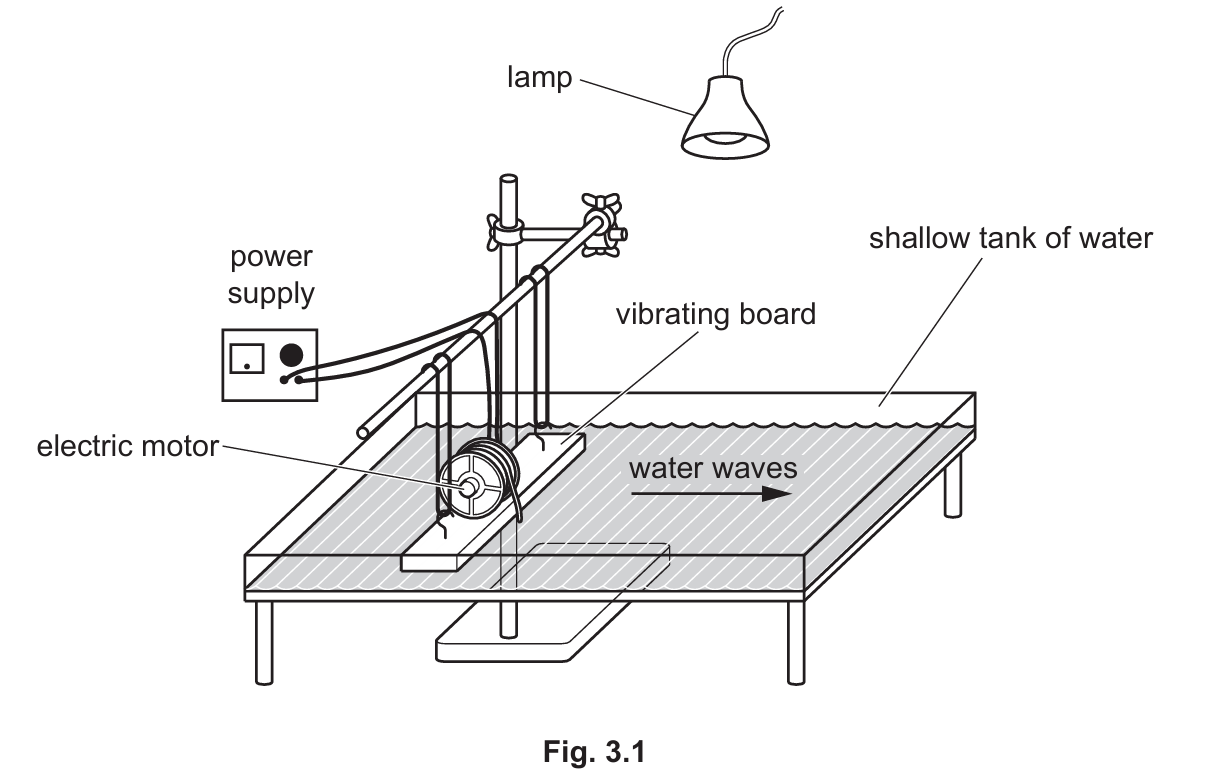
This produces water waves with the same frequency.
Calculate the wavelength of the water waves.
Include a description of what is observed.
You may draw a diagram to help with your answer.
Complete the sentences to explain how the motor rotates.
The current-carrying coil experiences a force because it is in a …………………………. field.
The force on one side of the coil is upwards and the force on the other side of the coil is …………………………., causing a turning effect.
During the demonstration, the filament lamp uses 24000 J of electrical energy.
Calculate how much charge passes through the filament lamp during the demonstration.
State the unit of your answer.
Most-appropriate topic codes (Cambridge IGCSE Co-ordinated Sciences 0654):
• Topic P3.1 — General properties of waves (Part (a))
• Topic P4.5.3 — Magnetic effect of current (Part (b))
• Topic P4.2..1 — Electrical charge (Part (c))
▶️ Answer/Explanation
(a)(i) The number of vibrations (oscillations) passing a point per unit time / second
Frequency describes how many complete wave cycles are produced or pass a fixed point each second.
It is measured in hertz (Hz), where 1 Hz = 1 oscillation per second.
(a)(ii) 0.04 m
Using the wave equation \(v = f\lambda\), rearranged to \(\lambda = \dfrac{v}{f}\).
\(\lambda = \dfrac{0.20}{5.0} = 0.04\) m.
(a)(iii) Place an obstacle with a gap similar in size to the wavelength in the ripple tank; circular waves are produced after the gap
When straight wavefronts meet a narrow gap (comparable to the wavelength), the waves spread out into the space beyond the gap.
The waves emerging from the gap appear as circular (curved) wavefronts, demonstrating diffraction.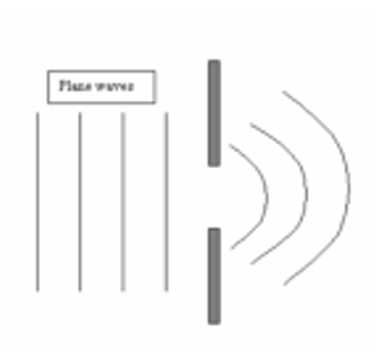
(b) Magnetic field; downwards
The current-carrying coil sits in a magnetic field, so each side of the coil experiences a force (the motor effect).
Since the current flows in opposite directions on each side of the coil, the force on one side is upwards while the force on the other side is downwards.
These opposite forces create a turning effect (couple) that rotates the coil.
(c)(i) Circuit symbol: a circle with a cross (✕) inside it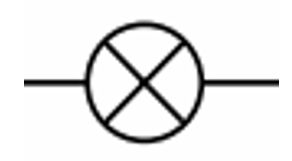
The standard IGCSE circuit symbol for a filament lamp is a circle with an “X” drawn inside it.
(c)(ii) 2000 C
Using \(E = QV\), rearranged to \(Q = \dfrac{E}{V}\).
\(Q = \dfrac{24000}{12} = 2000\) coulombs (C).