
▶️ Answer/Explanation
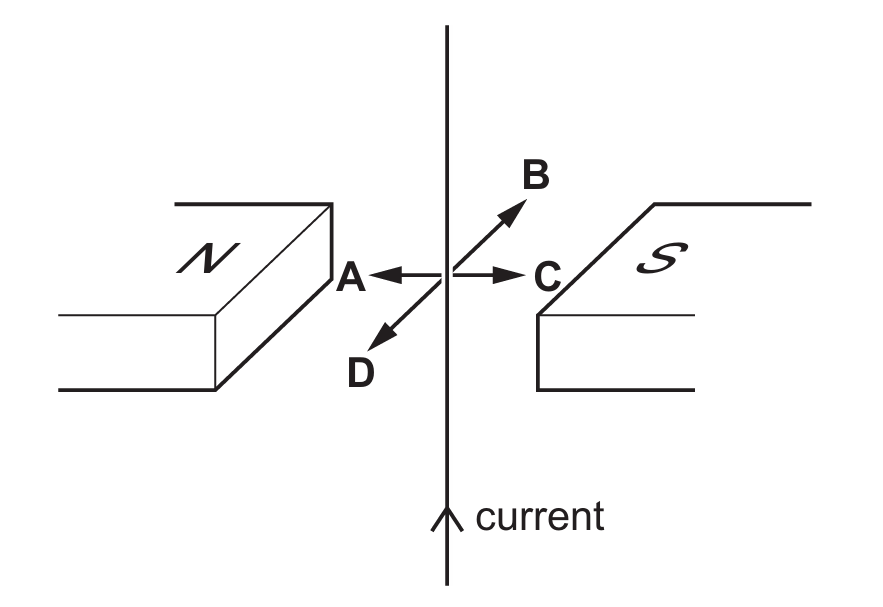
Using Fleming’s left-hand rule (thumb = force, first finger = magnetic field, second finger = current), the force direction is perpendicular to both. From the diagram, the correct direction is labelled B. Hence answer B.
✅ Answer: (B)
✅ Answer: (B)
▶️ Answer/Explanation
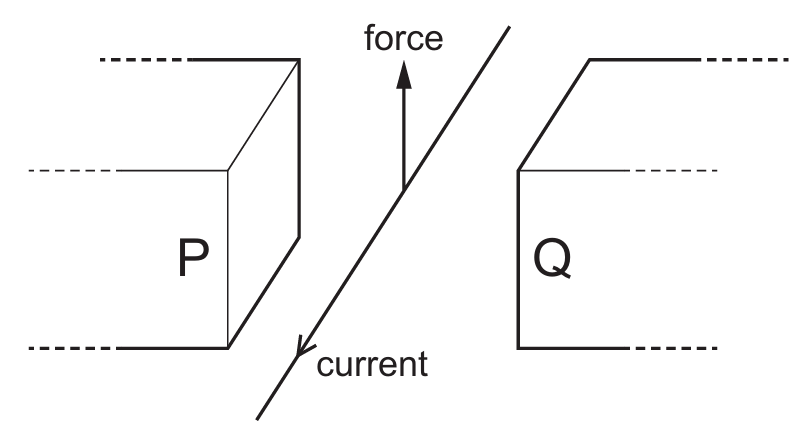
Using Fleming’s left-hand rule, with the thumb (force) pointing up and the second finger (current) in the given direction, the First finger (field) must point from P to Q.
This orientation of the three mutually perpendicular directions is what produces an upward force on the wire.
✅ Answer: (A)
This orientation of the three mutually perpendicular directions is what produces an upward force on the wire.
✅ Answer: (A)

▶️ Answer/Explanation
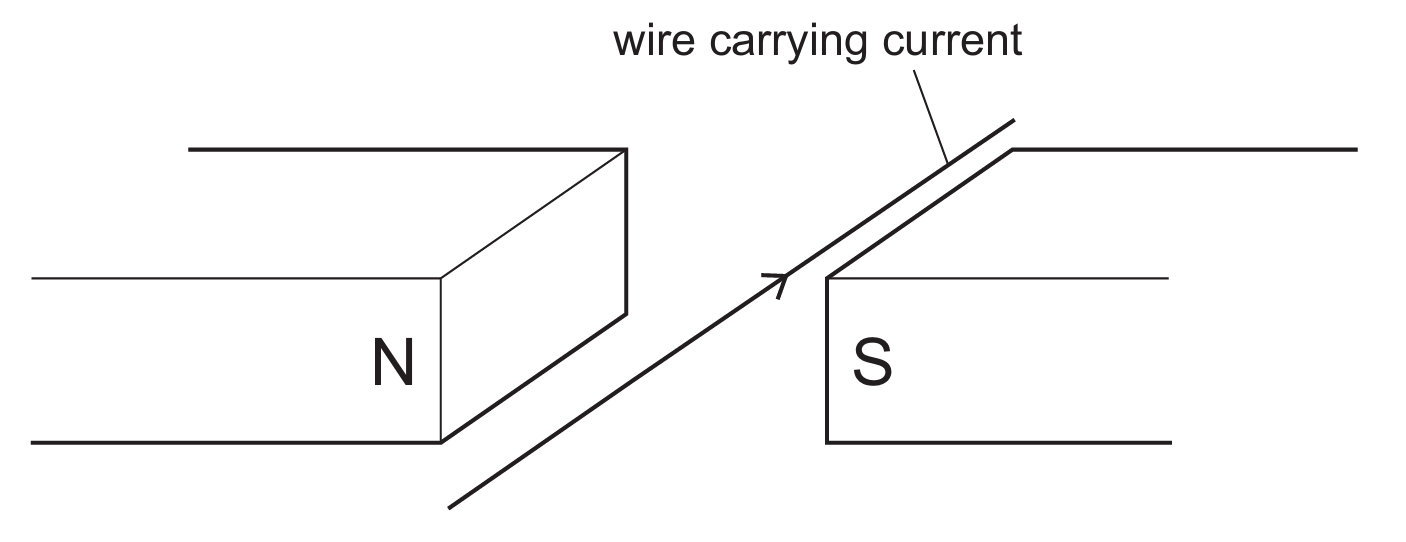
Using Fleming’s left-hand rule, with the field running from the North to the South pole and the current direction as shown, the thumb (force direction) points downwards.
This is the motor effect: the wire experiences a mechanical force perpendicular to both the current and the magnetic field.
✅ Answer: (A)
This is the motor effect: the wire experiences a mechanical force perpendicular to both the current and the magnetic field.
✅ Answer: (A)
▶️ Answer/Explanation
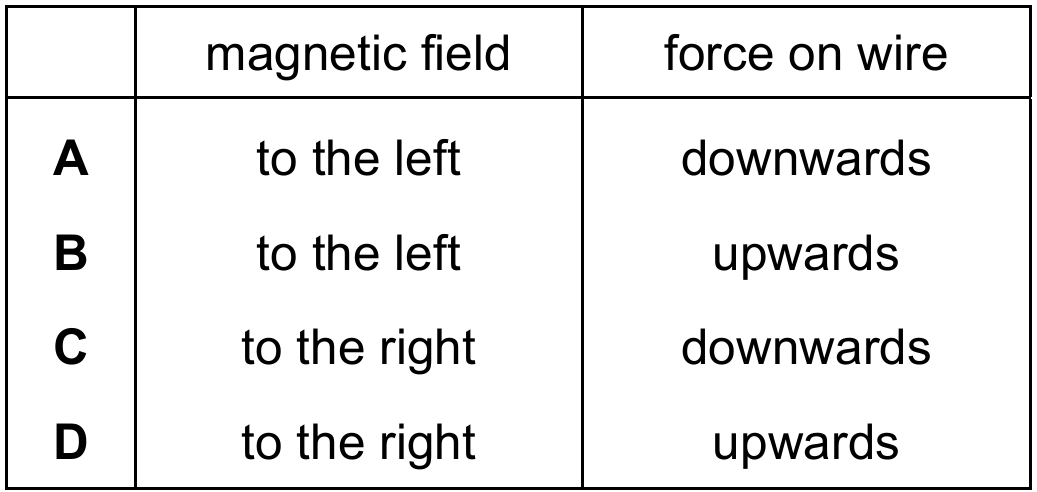
Magnetic field lines run from the north pole to the south pole, so with N on the left, the field points to the right.
Using the given current direction together with the field direction and applying the left-hand (motor) rule for force, field and current.
This combination produces a resultant force acting downwards on the wire.
✅ Answer: (C)
Using the given current direction together with the field direction and applying the left-hand (motor) rule for force, field and current.
This combination produces a resultant force acting downwards on the wire.
✅ Answer: (C)