
CIE iGCSE Co-Ordinated Science P4.5.6 The transformer Exam Style Questions Paper 4
Question
Most-appropriate topic codes (Cambridge IGCSE Co-ordinated Sciences 0654):
• Topic P4.5.6 — The transformer / Transformer construction (Part (a)(i))
• Topic P4.5.6 — The transformer / Power loss calculations (Part (a)(ii))
• Topic P4.2.2 — Electric current / Direct vs alternating current (Part (b))
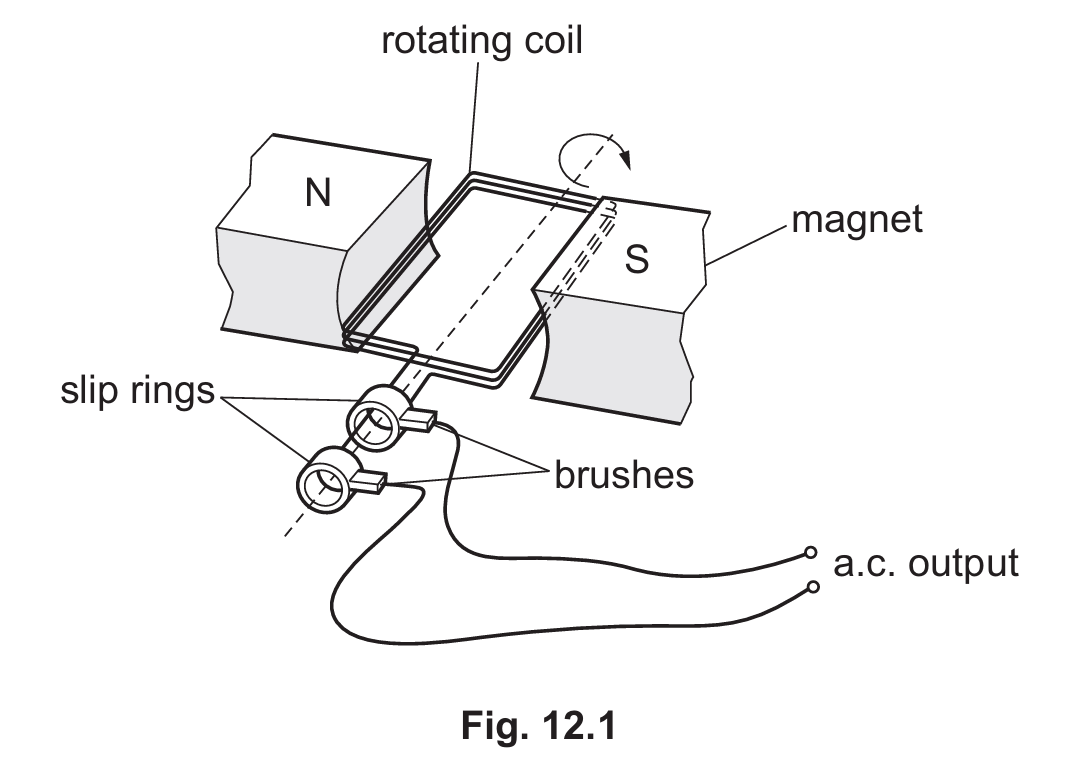
• Topic P4.5.2 — The a.c. generator / Slip rings (Part (c)(i))
• Topic P4.5.2 — The a.c. generator / e.m.f. graphs (Part (c)(ii) & (c)(iii))
▶️ Answer/Explanation
(a)(i) A step-up transformer consists of a soft iron core with a primary coil having fewer turns than the secondary coil.
The soft iron core provides a path for the magnetic field, and the turns ratio determines the voltage transformation. In a step-up transformer, the secondary coil has more turns, which increases the voltage.
(a)(ii) \( P = I^2R = 500^2 \times 0.60 = 250,000 \times 0.60 = 150,000 \text{ W} \)
Power loss in a transmission wire is calculated using \( P = I^2R \). The higher the current, the greater the energy lost as heat in the wires. Stepping up the voltage reduces the current and thus reduces power loss.
(b) Direct current (d.c.) flows in one direction only, while alternating current (a.c.) reverses direction periodically.
In d.c., the electric charge flows consistently from positive to negative. In a.c., the direction of charge flow changes repeatedly, typically in a sinusoidal pattern.
(c)(i) Slip rings maintain a continuous electrical connection to each side of the rotating coil, preventing the wires from twisting or tangling.
As the coil rotates, the slip rings rotate with it while the carbon brushes remain stationary, ensuring a constant electrical connection to the external circuit without wires becoming twisted.
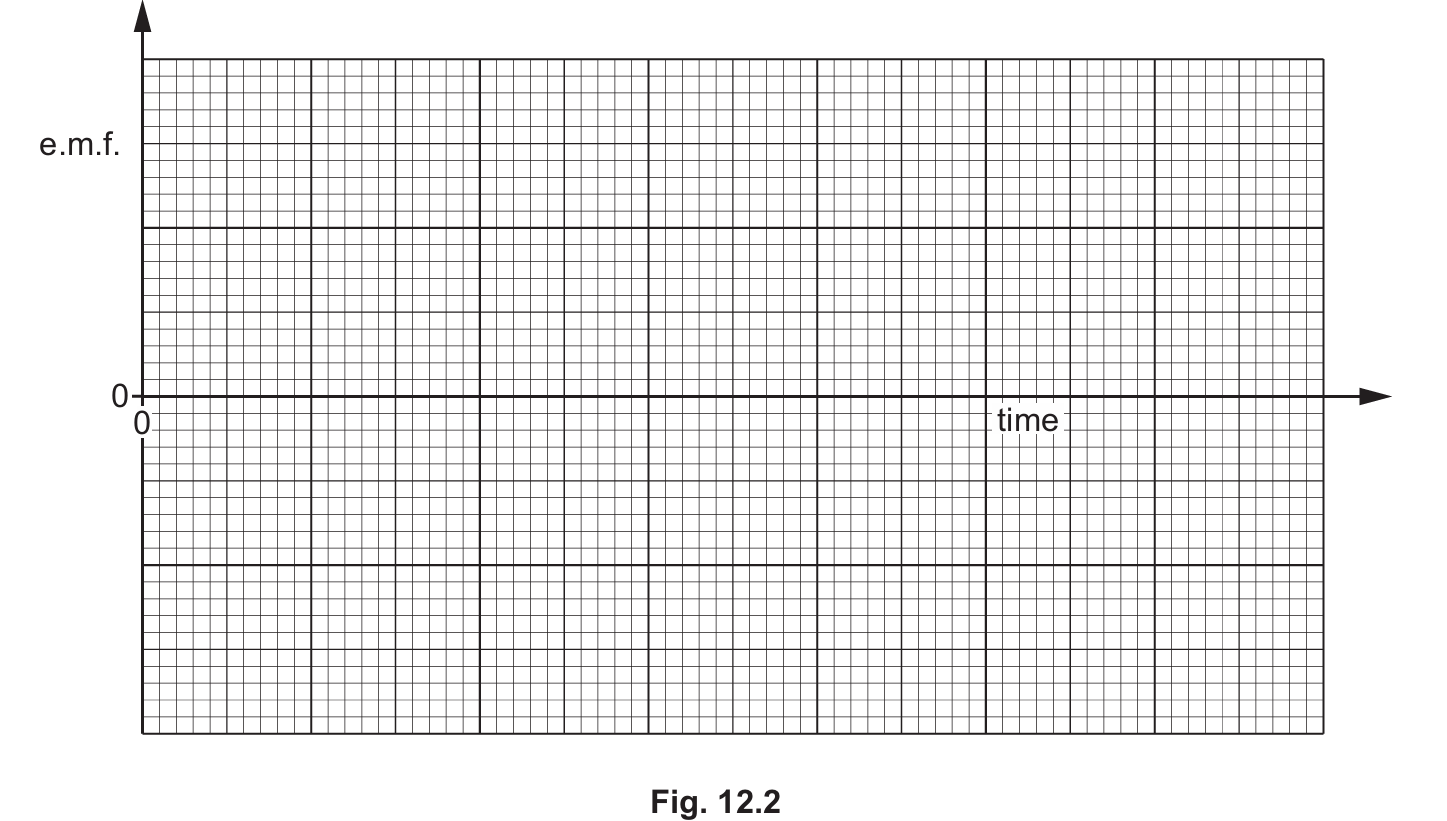
(c)(ii) The graph should be a sine wave with positive and negative e.m.f. values, showing constant amplitude and a constant period.
As the coil rotates at constant speed, the e.m.f. varies sinusoidally: maximum positive, zero, maximum negative, and back to zero in one complete rotation. The amplitude and period remain constant.
(c)(iii) The amplitude of the e.m.f. doubles, and the period halves (the frequency doubles).
Doubling the rotation speed means the coil cuts through the magnetic field lines twice as fast, generating double the e.m.f. It also completes each rotation in half the time, so the period is halved.
Question
Most-appropriate topic codes (Cambridge IGCSE Co-ordinated Sciences 0654):
• Topic P4.5.5 — The d.c. motor
• Topic P4.5.6 — The transformer
▶️ Answer/Explanation
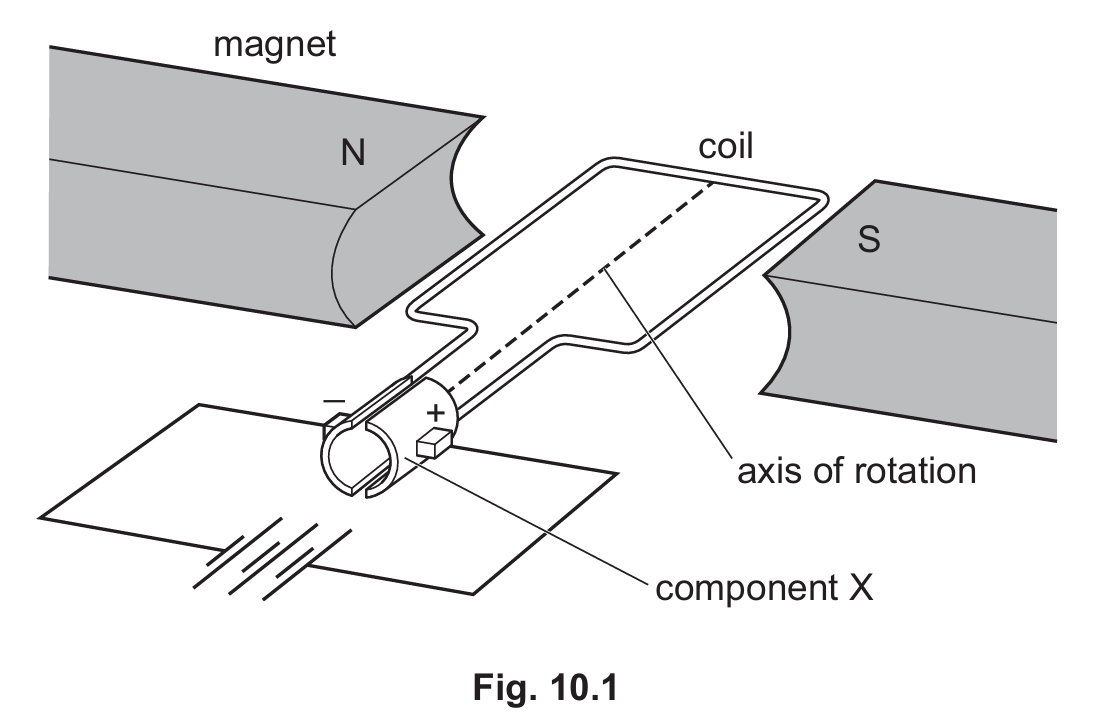
(a)(i) more turns of wire / more turns on the coil ; increase current ; stronger magnetic field
The turning effect (torque) on a coil in a magnetic field increases with the number of turns, the current flowing through the coil, and the strength of the magnetic field.
(a)(ii) split-ring commutator
The split-ring commutator is a device that reverses the direction of current through the coil every half-turn.
(a)(iii) reverses the direction of the current (in the coil) ; every half a turn
The commutator ensures that the current in the coil always flows in a direction that produces a turning force in the same rotational direction, allowing continuous rotation.
(b)(i) step-up
A step-up transformer increases the voltage for efficient long-distance transmission of electrical power.
(b)(ii) higher voltage ; means lower current (for same power transferred) ; (reference to) P = I²R or power loss proportional to current squared
By stepping up the voltage, the current in the transmission cables is reduced. Since power loss in cables is proportional to I²R, lower current significantly reduces energy losses.
(c) 46,000 turns
Using the transformer equation: Vₚ/Vₛ = Nₚ/Nₛ
230/3.6 = Nₚ/720
Nₚ = (230 × 720) ÷ 3.6 = 46,000
A step-down transformer reduces the high transmission voltage to a safer, usable voltage for domestic appliances.