CIE iGCSE Co-Ordinated Science P5.1 The nucleus Exam Style Questions Paper 1
Question
A nucleus has atomic number Z and mass number A.
What is equal to the value of A – Z?
A. the number of electrons orbiting the nucleus
B. the number of neutrons in the nucleus
C. the number of nucleons in the nucleus
D. the number of protons in the nucleus
▶️ Answer/Explanation
Subtracting A − Z removes the proton count, leaving only the neutrons.
Therefore \(A – Z\) is equal to the number of neutrons in the nucleus.
✅ Answer: (B)
Question
An atom of an isotope of strontium (Sr) has a proton number of 38 and contains 52 neutrons.
What is the nuclide notation for this isotope?
A. \(^{52}_{38}\textrm{Sr}\)
B. \(^{90}_{38}\textrm{Sr}\)
C. \(^{38}_{52}\textrm{Sr}\)
D. \(^{90}_{52}\textrm{Sr}\)
▶️ Answer/Explanation
The mass number (top number) equals protons plus neutrons, so \(38 + 52 = 90\).
Nuclide notation places the mass number above the proton number, giving \(^{90}_{38}\textrm{Sr}\).
✅ Answer: (B)
Question
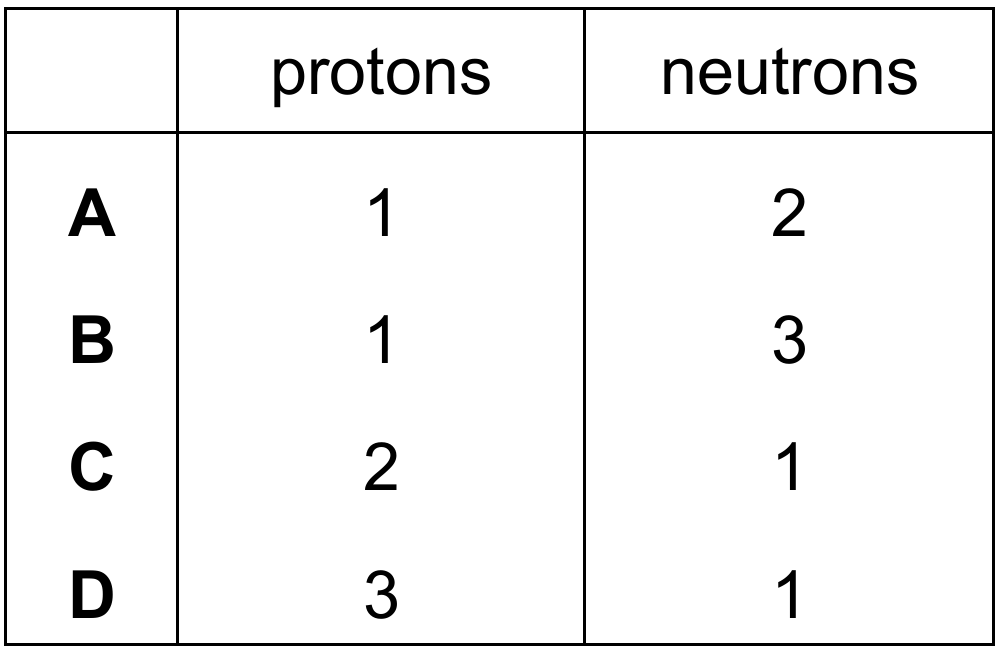
A nuclide of hydrogen is represented by \( ^{3}_{1}\text{H} \).
Which row shows the number of protons and the number of neutrons in this nuclide?

▶️ Answer/Explanation
Here \( Z = 1 \), so there is 1 proton, and \( A = 3 \), so the total number of protons and neutrons is 3.
The number of neutrons is \( A – Z = 3 – 1 = 2 \), giving
Question
The nucleus of an isotope of gold contains 79 protons and 118 neutrons. The symbol for gold is Au.
What is the nuclide symbol for this isotope?
A. \( ^{79}_{118}\text{Au} \)
B. \( ^{79}_{197}\text{Au} \)
C. \( ^{118}_{79}\text{Au} \)
D. \( ^{197}_{79}\text{Au} \)
▶️ Answer/Explanation
The nucleon number (top number) is the total number of protons and neutrons: \( 79 + 118 = 197 \).
So the correct nuclide symbol is \( ^{197}_{79}\text{Au} \), with 197 on top and 79 on the bottom.
✅ Answer: (D)
Question
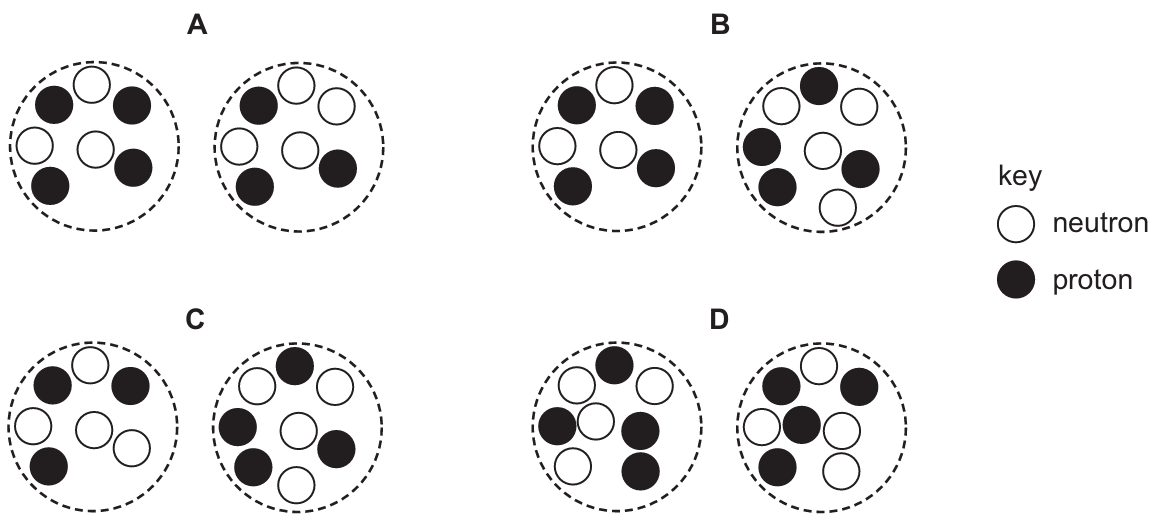
The diagrams represent pairs of nuclei of some atoms.
Which pair shows nuclei of different isotopes of the same element?

▶️ Answer/Explanation
Checking each pair of diagrams for equal proton counts but differing neutron counts identifies pair B as the correct match.
✅ Answer: (B)
