
CIE iGCSE Co-Ordinated Science P5.1 The nucleus Exam Style Questions Paper 4
Question
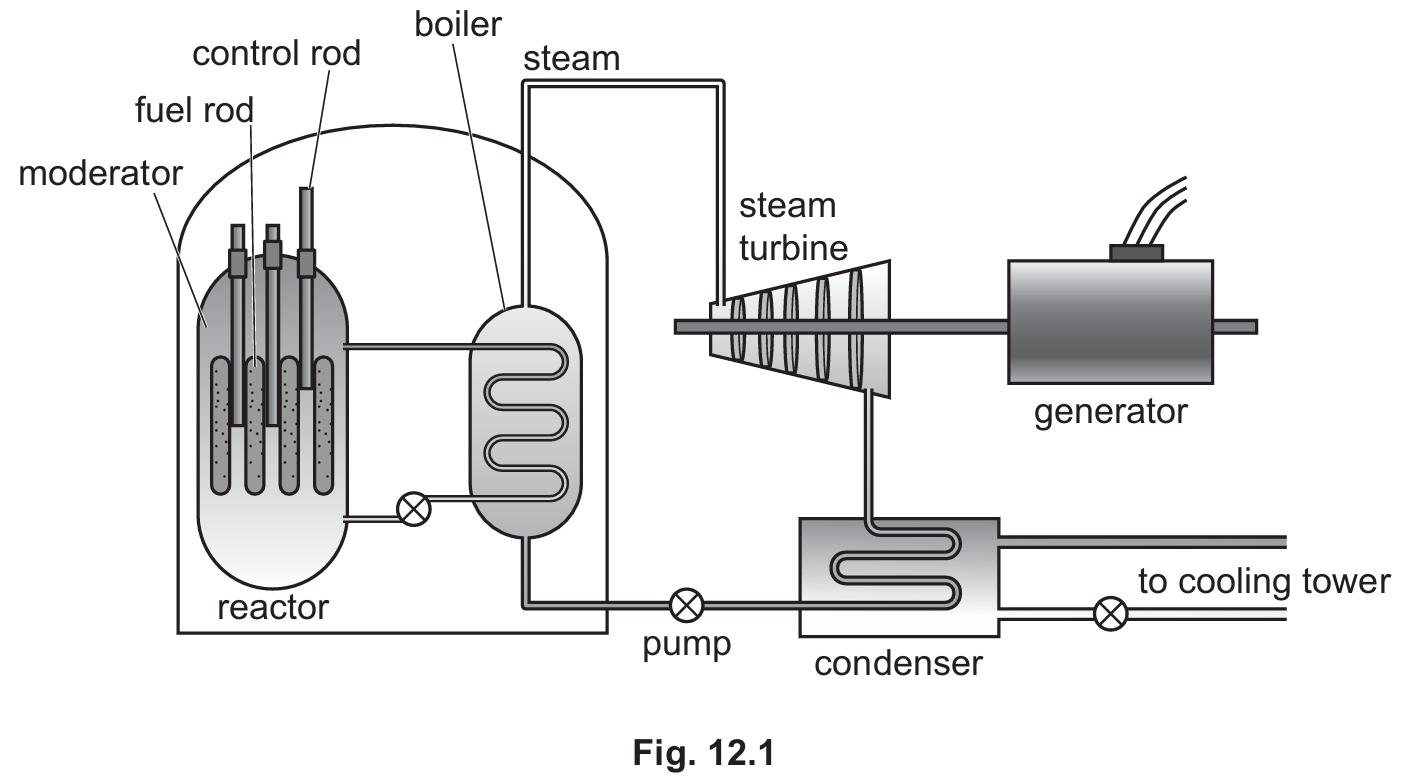
The Sun is the source of energy for all our energy resources except nuclear, ………… and tidal.
State what happens to the pressure of the steam if the temperature of the steam is increased.
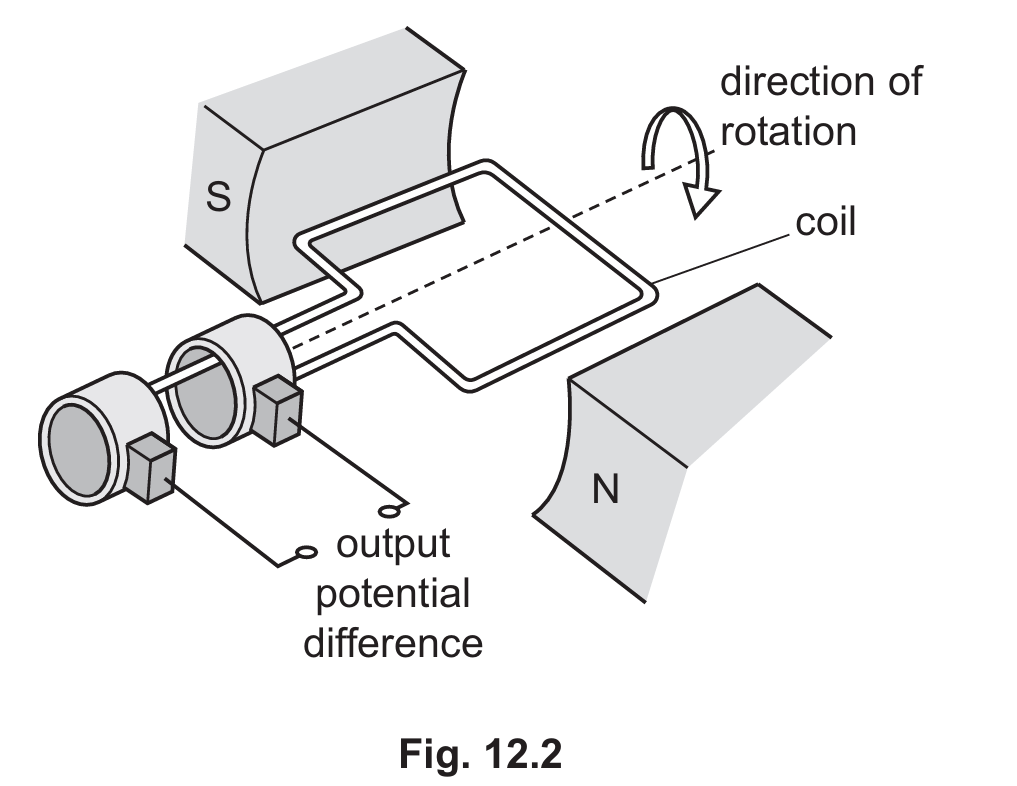
The efficiency of the generator is 75%.
Calculate the kinetic energy required to produce \(3600\,\text{J}\) of electrical energy.

Most-appropriate topic codes (Cambridge IGCSE Co-ordinated Sciences 0654, 2025–2027 syllabus):
• Topic P5.1 — The nucleus (Part (a)(i))
• Topic P1.6.3 — Energy resources (Part (a)(ii))
• Topic P2.1.3 — Pressure changes (Part (b))
• Topic P4.5.2 — The a.c. generator (Part (c)(i))
• Topic P1.6.1 — Energy (Part (c)(ii))
• Topic P5.2.3 — Radioactive decay (Part (d))
▶️ Answer/Explanation
(a)(i) Nuclear fission
In the reactor, uranium nuclei split apart in a process called nuclear fission, releasing large amounts of energy.
(a)(ii) Geothermal
Geothermal energy comes from heat within the Earth, not from the Sun, just like nuclear and tidal energy.
(b)(i) Molecules collide with the walls, exerting a force
Steam molecules move rapidly and randomly within the boiler.
As these molecules collide with the container walls, each collision exerts a small force, and the combined effect of many collisions produces pressure.
(b)(ii) Pressure increases
At constant volume, increasing the temperature increases the average kinetic energy and speed of the molecules.
Faster, more frequent and more forceful collisions with the walls result in increased pressure.
(c)(i) The coil experiences a changing magnetic flux, inducing a p.d.
As the coil rotates within the magnetic field, the magnetic flux passing through it continuously changes.
This changing flux induces an output potential difference across the coil, by electromagnetic induction.
(c)(ii) \(4800\,\text{J}\)
Efficiency \( = \dfrac{\text{output energy}}{\text{input energy}} \times 100\%\).
Rearranging: input (kinetic) energy \( = \dfrac{3600}{75} \times 100 = 4800\,\text{J}\).
(d) \(^{235}_{92}\text{U} \rightarrow\, ^{231}_{90}\text{Th} + \,^{4}_{2}\alpha\)
In alpha decay, the mass number decreases by 4 and the atomic number decreases by 2.
Mass number: \(235 – 4 = 231\); atomic number: \(92 – 2 = 90\), identifying the daughter nuclide as thorium-231.
Question

Most-appropriate topic codes (Cambridge IGCSE Co-ordinated Sciences 0654):
• Topic P5.1 — The nucleus (Part (a)(i), (a)(ii), (a)(iii))
• Topic P5.2.3 — Radioactive decay (Part (b)(i))
• Topic P5.2.4 — Half-life (Part (b)(ii), (b)(iii))
▶️ Answer/Explanation
(a)(i) Number of protons = 79.
In the nuclide notation \( ^{A}_{Z}\text{X} \), the bottom number (Z) is the proton number (atomic number), which represents the number of protons in the nucleus. For \( ^{197}_{79}\text{Au} \), Z = 79, so there are 79 protons.
(a)(ii) Number of neutrons = 197 − 79 = 118.
The top number (A) is the nucleon number (mass number), which is the total number of protons and neutrons in the nucleus. The number of neutrons is calculated by subtracting the proton number from the nucleon number: \( A – Z = 197 – 79 = 118 \) neutrons.
(a)(iii) The word that describes these two gold atoms is isotopes.
Atoms of the same element (same number of protons) but with different numbers of neutrons are called isotopes. \( ^{197}_{79}\text{Au} \) and \( ^{198}_{79}\text{Au} \) both have 79 protons (so they are both gold), but they have different numbers of neutrons (118 and 119 respectively). Therefore, they are isotopes. They are not ions (which are charged particles formed by loss or gain of electrons) and they are not charged overall as they are neutral atoms.
(b)(i) \( ^{198}_{79}\text{Au} \rightarrow ^{198}_{80}\text{Hg} + ^{0}_{-1}\beta \)
In beta decay, a neutron in the nucleus changes into a proton and an electron (beta particle). The beta particle is emitted from the nucleus. The atomic number increases by 1 (from 79 to 80), so the atom becomes mercury (Hg). The mass number remains unchanged at 198 because the total number of nucleons is conserved (a neutron is replaced by a proton, which has approximately the same mass). The beta particle is represented as \( ^{0}_{-1}\beta \) (or \( ^{0}_{-1}\text{e} \)).
(b)(ii) Half-life is the (average) time taken for half the nuclei of the isotope in a sample to decay.
Half-life is a measure of the rate of radioactive decay. It is defined as the average time taken for the activity of a radioactive sample to decrease to half its original value, or equivalently, the time taken for half of the nuclei in a sample to decay. It is a constant for a given isotope and does not depend on the size of the sample or external conditions.
(b)(iii) Mass remaining = 35 g.
Number of half-lives = 8.1 ÷ 2.7 = 3 half-lives.
Mass remaining = 280 ÷ 2³ = 280 ÷ 8 = 35 g.
To calculate the mass remaining after a certain time:
- Determine the number of half-lives that have passed: \( \text{Number of half-lives} = \frac{\text{Time elapsed}}{\text{Half-life}} = \frac{8.1}{2.7} = 3 \) half-lives.
- After each half-life, the mass halves. After n half-lives, the remaining mass is: \( \text{Remaining mass} = \text{Initial mass} \times \left(\frac{1}{2}\right)^n \).
\( \text{Remaining mass} = 280 \times \left(\frac{1}{2}\right)^3 = 280 \times \frac{1}{8} = 35 \text{ g} \).