Home / iGCSE / Coordinated Sciences / P5.2.1 Detection of radioactivity Paper 3

CIE iGCSE Co-Ordinated Science P5.2.1 Detection of radioactivity Exam Style Questions Paper 3

Question

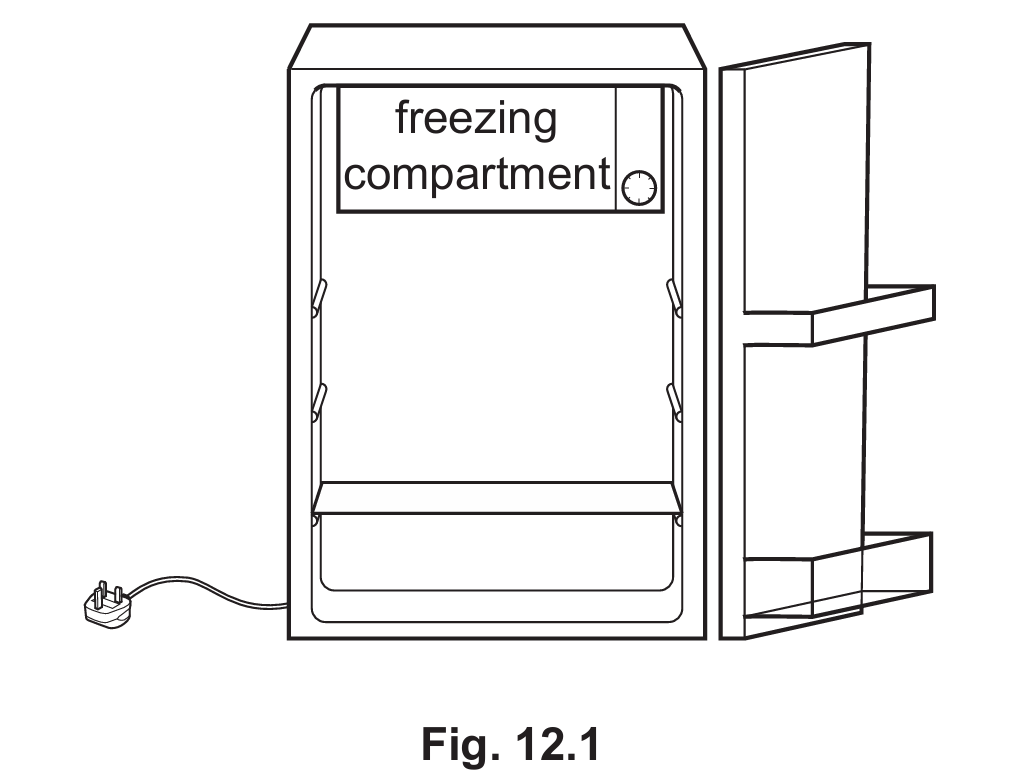
Fig. 12.1 shows a refrigerator.
(a) (i) The refrigerator uses electrical energy to
  • power the electric motor which operates the cooler
  • light the lamp inside the refrigerator.
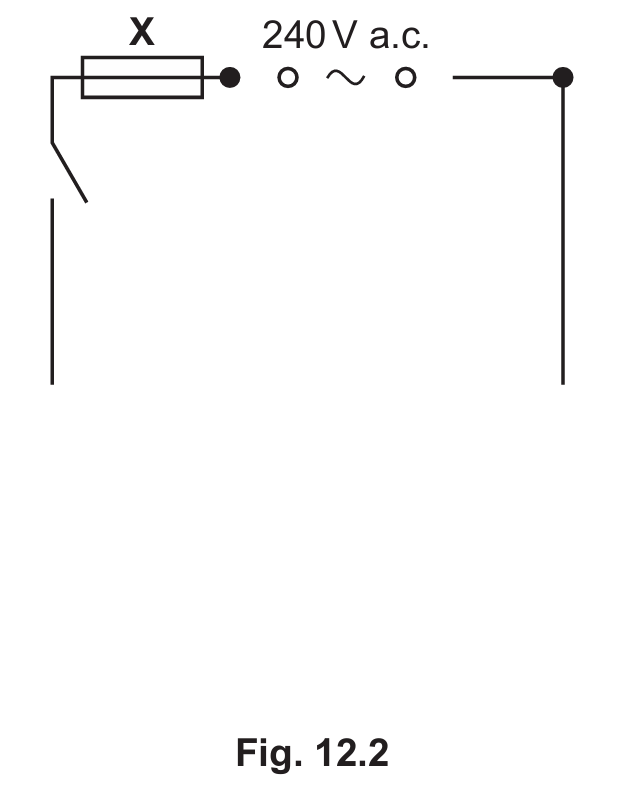
The electric motor and the lamp are connected in parallel.
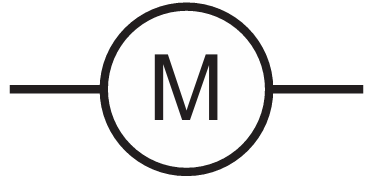
The circuit symbol for a motor is
Complete the circuit diagram for the refrigerator shown in Fig. 12.2.
(ii) State the name of component X.
(iii) State the purpose of component X in this circuit.
(b) Food is kept in a refrigerator so that it stays fresh for longer.
Another way to preserve food is to treat it with \(\gamma\)-radiation.
\(\gamma\)-radiation is a form of ionising radiation.
State the name of one other form of ionising radiation.
(c) The volume of air in the refrigerator is \(0.25 \, \text{m}^3\).
The density of the air is \(1.28 \, \text{kg/m}^3\).
Calculate the mass of the air in the refrigerator in grams.
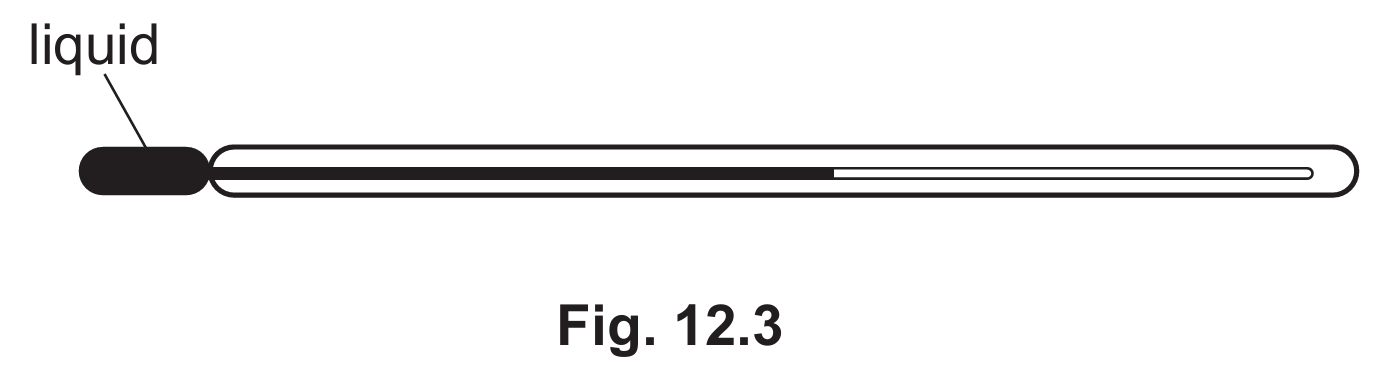
(d) Fig. 12.3 shows a liquid-in-glass thermometer.
The thermometer is used to measure the temperature inside the freezing compartment of the refrigerator. This temperature is \(-18\,^\circ\text{C}\).
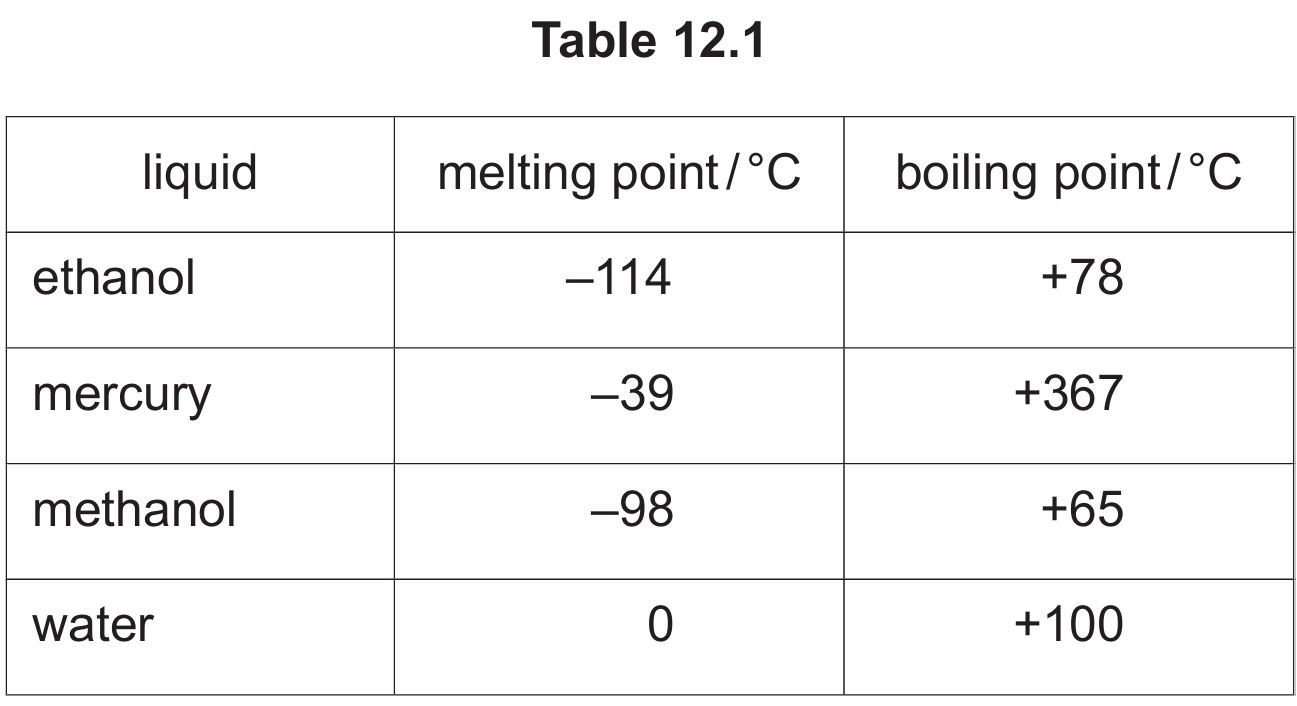
Table 12.1 gives some information about four liquids.
(i) Identify all the liquids from Table 12.1 that are suitable for use in this thermometer.
(ii) State the physical property of the liquid in the thermometer that varies with temperature.

Most-appropriate topic codes (Cambridge IGCSE Co-ordinated Sciences 0654):

• Topic P4.3.2 — Series and parallel circuits (Part (a))
• Topic P5.2.1 — Detection of radioactivity (Part (b))
• Topic P1.4 — Density (Part (c))
• Topic P2.2.1 — Thermal expansion of solids, liquids and gases (Part (d))

▶️ Answer/Explanation

(a)(i) Correct symbol for lamp; lamp and motor in parallel

The lamp should be drawn using the standard circle-with-cross circuit symbol.
The lamp and motor branches should each connect separately across the supply, forming a parallel arrangement.

(a)(ii) Fuse

Component X, shown in series in the main circuit, is a fuse.

(a)(iii) Protects the circuit

The fuse melts and breaks the circuit if the current becomes too large.
This prevents damage to the circuit components and reduces the risk of fire.

(b) Alpha, beta or X-rays

Any of these three types of radiation are also classified as ionising radiation, alongside gamma radiation.

(c) 320 g

Mass = density × volume.
Mass \(= 1.28 \times 0.25 = 0.32 \, \text{kg}\).
Converting to grams: \(0.32 \times 1000 = 320 \, \text{g}\).

(d)(i) Ethanol, mercury and methanol

A suitable thermometer liquid must remain liquid at \(-18\,^\circ\text{C}\), meaning its melting point must be below this temperature.
Ethanol \((-114\,^\circ\text{C})\), mercury \((-39\,^\circ\text{C})\) and methanol \((-98\,^\circ\text{C})\) all satisfy this, but water \((0\,^\circ\text{C})\) does not, since it would be frozen solid.

(d)(ii) Density (or volume)

As temperature increases, the liquid expands, changing its volume (and therefore its density).
This physical change is what allows the thermometer to indicate a temperature reading.

Question

(a) A technician is checking for sources of radioactive emissions around a building. 

(i) A radiation detector is placed in front of a source of ionising radiation. A piece of paper is placed in front of the source, and the radiation is no longer detected from the source. Identify the type of radiation being emitted by the source.

▶️Answer/Explanation

Alpha radiation (α). Alpha particles are stopped by a piece of paper, which is why the radiation is no longer detected when the paper is placed in front of the source.

(ii) The radioactive source is removed. State why the radiation detector continues to detect a small amount of radiation.

▶️Answer/Explanation

Background radiation. Even when the radioactive source is removed, the detector will still pick up background radiation from natural sources such as cosmic rays, rocks, and building materials.

(b) The graph in Fig. 9.1 shows the decay curve for a radioactive source.

Determine the half-life of the source. Show on the graph how you determined your answer. 

▶️Answer/Explanation

The half-life is the time taken for the activity of the radioactive source to decrease to half of its initial value. To determine the half-life from the graph, identify the point where the activity is half of its initial value and read the corresponding time from the x-axis. For example, if the initial activity is 80 counts per second, the half-life is the time it takes for the activity to drop to 40 counts per second. This can be shown by drawing a horizontal line from 40 counts per second to the curve and then dropping a vertical line to the time axis.

(c) The radiation detector is powered by a battery. Fig. 9.2 shows the part of the electrical circuit which lights a lamp when the detector is switched on. 

(i) The technician checks the potential difference across the lamp. On Fig. 9.2, add the circuit symbol for a meter to measure the potential difference across the lamp.

▶️Answer/Explanation

To measure the potential difference across the lamp, a voltmeter should be connected in parallel with the lamp. The circuit symbol for a voltmeter is a circle with a “V” inside it. Draw this symbol across the lamp in the circuit diagram.

(ii) The current supplied by the battery is 0.1A. The technician adds another cell to the battery. Describe how the current changes.

▶️Answer/Explanation

Adding another cell to the battery increases the voltage (potential difference) of the battery. According to Ohm’s Law (V = IR), if the resistance of the circuit remains constant, an increase in voltage will result in an increase in current. Therefore, the current in the circuit will increase.

(iii) Complete the sentence to describe current in metals.

Current in metals is due to the flow of ……

▶️Answer/Explanation

electrons. In metals, electric current is due to the flow of free electrons, which are negatively charged particles.

Scroll to Top