
▶️ Answer/Explanation
Alpha particles have the least penetrating ability and can be stopped by a few centimetres of air or a piece of paper.
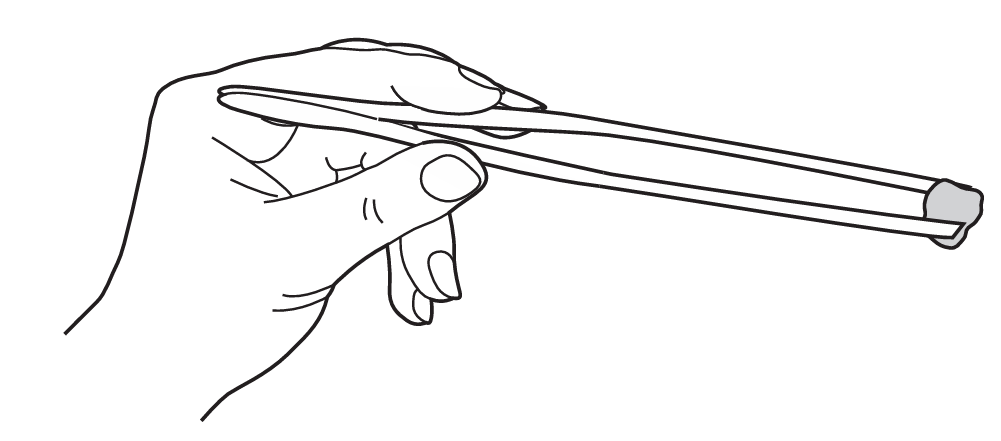
Tongs providing a distance of 10 cm in air would be sufficient to protect against alpha radiation, as alpha particles cannot travel that far.
Beta particles and gamma rays have greater penetration and would require more shielding.
✅ Answer: (A)
Tongs providing a distance of 10 cm in air would be sufficient to protect against alpha radiation, as alpha particles cannot travel that far.
Beta particles and gamma rays have greater penetration and would require more shielding.
✅ Answer: (A)
▶️ Answer/Explanation
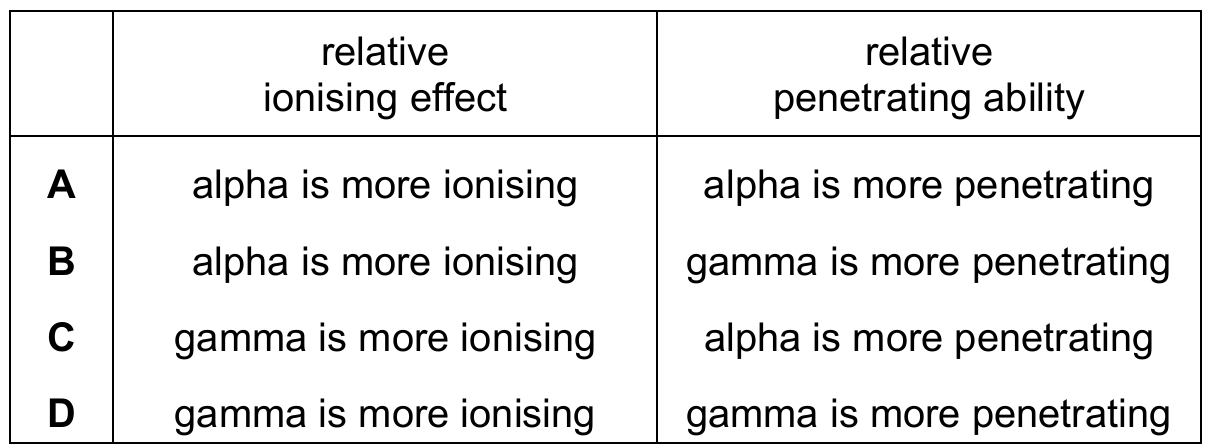
Alpha particles are large and heavily charged, giving them a strong ionising effect but poor penetrating ability.
Gamma rays have no charge and very little mass, making them weakly ionising but highly penetrating.
This gives: alpha is more ionising, while gamma is more penetrating.
✅ Answer: (B)
Gamma rays have no charge and very little mass, making them weakly ionising but highly penetrating.
This gives: alpha is more ionising, while gamma is more penetrating.
✅ Answer: (B)


▶️ Answer/Explanation
Alpha radiation is stopped by paper, beta radiation passes through paper but is stopped by aluminium foil, and gamma radiation passes through both paper and aluminium but is greatly reduced by lead.
Matching the penetrating power shown for L, M and N in the diagram against these known properties identifies the correct radiation type for each.
✅ Answer: (C)
Matching the penetrating power shown for L, M and N in the diagram against these known properties identifies the correct radiation type for each.
✅ Answer: (C)
▶️ Answer/Explanation
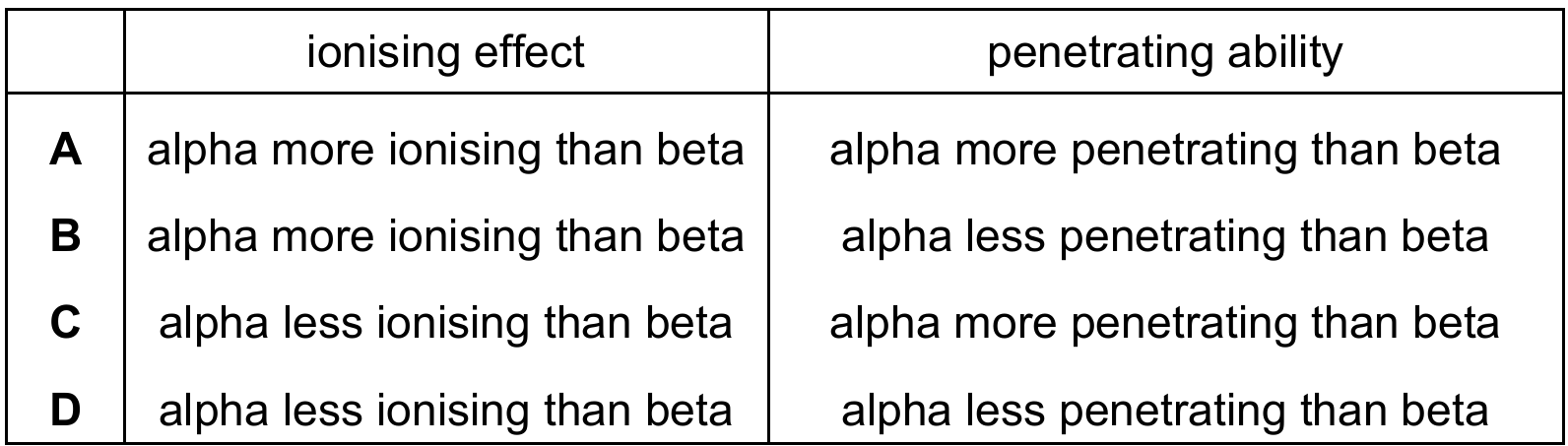
Alpha particles are large and heavily charged, so they interact strongly with atoms they pass, making them highly ionising, but this also means they lose their energy very quickly.
Because of this rapid energy loss, alpha particles can only travel a short distance and are stopped easily (e.g. by paper or skin), making them far less penetrating than beta particles.
Beta particles are smaller and less charged, so they ionise less per collision but travel further, making them more penetrating than alpha.
✅ Answer: (B)
Because of this rapid energy loss, alpha particles can only travel a short distance and are stopped easily (e.g. by paper or skin), making them far less penetrating than beta particles.
Beta particles are smaller and less charged, so they ionise less per collision but travel further, making them more penetrating than alpha.
✅ Answer: (B)