Home / iGCSE / Coordinated Sciences / P5.2.2 The three types of nuclear emission Paper 2

CIE iGCSE Co-Ordinated Science P5.2.2 The three types of nuclear emission Exam Style Questions Paper 2

Question

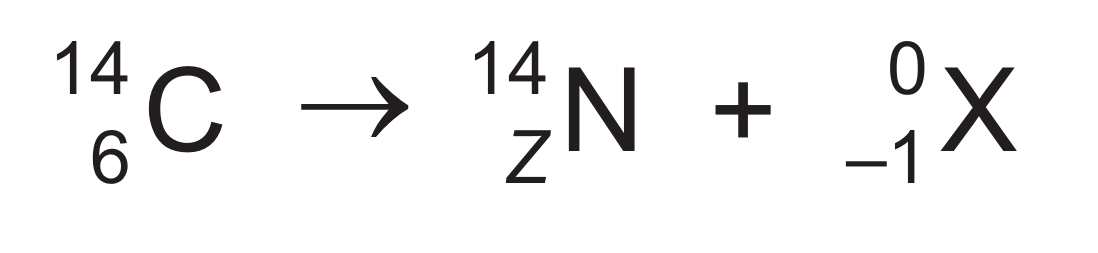
A carbon-14 nucleus decays to form a nitrogen-14 nucleus and one particle X of ionising radiation.

The decay equation is shown.

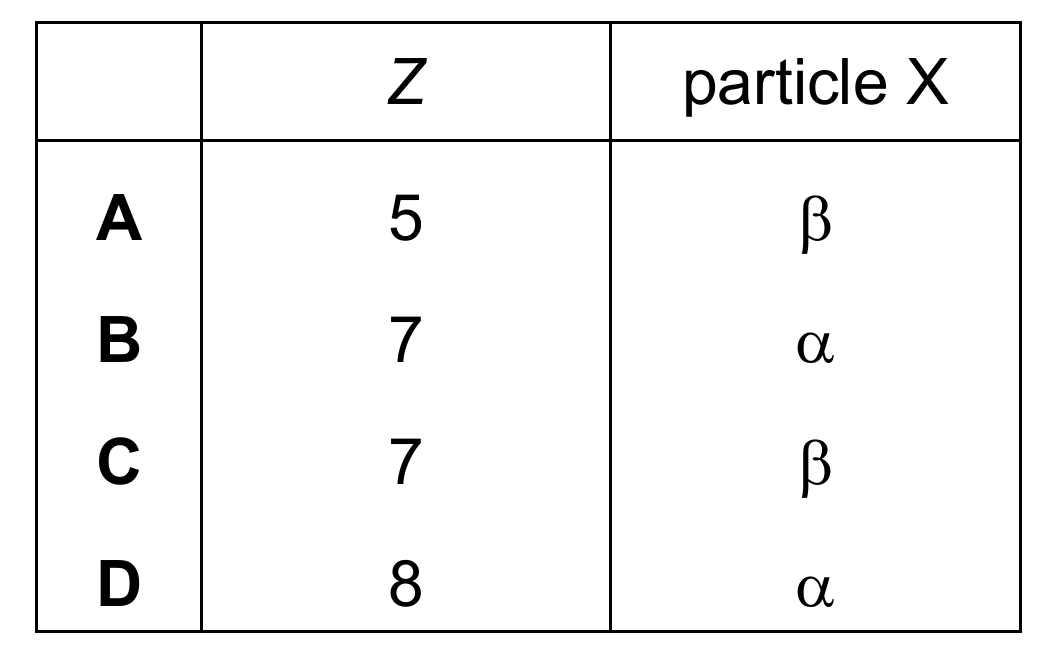
Which row gives the value of Z and the identity of particle X?

▶️ Answer/Explanation
In beta (β⁻) decay, a neutron in the nucleus changes into a proton and an electron, and the electron (beta particle) is emitted. The nucleon number remains the same, but the proton number increases by 1. For carbon-14 (proton number 6), beta decay produces nitrogen-14 (proton number 7). The emitted particle is a beta particle (⁰₋₁β).
Answer: (C)

Question

Three types of ionising radiation enter a magnetic field at right angles to the field.

Which types of radiation are deflected?

A. \(\alpha\) and \(\beta\) only
B. \(\alpha\) and \(\gamma\) only
C. \(\beta\) and \(\gamma\) only
D. \(\alpha\), \(\beta\) and \(\gamma\)

▶️ Answer/Explanation
Magnetic fields only exert a force on moving charged particles, deflecting their path.
Alpha particles are positively charged and beta particles are negatively charged, so both experience a force and are deflected (in opposite directions).
Gamma radiation is uncharged electromagnetic radiation, so it passes straight through the magnetic field undeflected.
Answer: (A)

Question

Electric and magnetic fields can cause deflection of ionising radiation.

Which statements about the deflection are correct?

1 In an electric field, \(\alpha\)-particles and \(\beta\)-particles are deflected in opposite directions.
2 In a magnetic field, \(\alpha\)-particles and \(\beta\)-particles are deflected in the same direction.
3 \(\gamma\)-rays are not deflected by electric fields or by magnetic fields.

A. 1 and 3
B. 1 only
C. 2 and 3
D. 2 only

▶️ Answer/Explanation
Alpha particles are positive and beta particles are negative, so in an electric field they are pushed toward opposite plates, deflecting in opposite directions; statement 1 is correct.
In a magnetic field, opposite charges moving in the same direction experience force in opposite directions, so alpha and beta particles deflect in opposite ways, making statement 2 incorrect.
Gamma rays are uncharged electromagnetic radiation, so they are undeflected by both electric and magnetic fields; statement 3 is correct.
Answer: (A)

Question

The diagram shows a beam of β-particles and a beam of γ-rays entering the electric field between two charged plates.

What is the effect of the electric field on each of the beams?

▶️ Answer/Explanation
Beta particles are negatively charged, so they are attracted towards the positive plate and deflected in that direction.
Gamma rays have no charge and no mass in the usual sense, so they pass straight through an electric field undeflected.
Answer: (C)

Question

The diagrams show a beam of beta-particles passing into an electric field and another beam of beta-particles passing into a magnetic field.

In which direction is the beam deflected in each case?

▶️ Answer/Explanation
A beta particle is an electron with charge \(-1e\), so in the electric field it is attracted toward the \(+\)ve plate.
Applying the left-hand rule (motor effect) to a negative charge moving between the \(N\) and \(S\) poles gives a deflection out of the page.
Answer: (D)
Scroll to Top