CIE iGCSE Co-Ordinated Science P5.2.3 Radioactive decay Exam Style Questions Paper 1
Question
An atom emits radiation by radioactive decay.
Which part of the atom is the radiation emitted from?
A. stable orbiting electrons
B. stable nucleus
C. unstable orbiting electrons
D. unstable nucleus
▶️ Answer/Explanation
Radioactive decay is a nuclear process that occurs in unstable nuclei. When an unstable nucleus undergoes radioactive decay, it emits radiation (alpha particles, beta particles, and/or gamma rays) in order to become more stable.
Electrons orbiting the nucleus are not involved in radioactive decay processes. The electrons are involved in chemical reactions and electron transfer, not nuclear processes. The emission from a nucleus changes the identity of the atom (transmutation).
Therefore, the radiation emitted by radioactive decay comes from the unstable nucleus of the atom.
✅ Answer: (D)
Question
A radioactive material has a half-life of 4.0 days. The rate of emission of radiation from a sample of the material is 32 emissions per minute.
What was the rate of emission from the sample 8.0 days earlier?
A. 8.0 emissions per minute
B. 128 emissions per minute
C. 256 emissions per minute
D. 1024 emissions per minute
▶️ Answer/Explanation
This can be verified by working forward: \(128 \xrightarrow{\times\frac{1}{2}} 64 \xrightarrow{\times\frac{1}{2}} 32\) — after two half-lives (8 days), the rate drops from 128 to 32, confirming the answer.
✅ Answer: (B)
Question
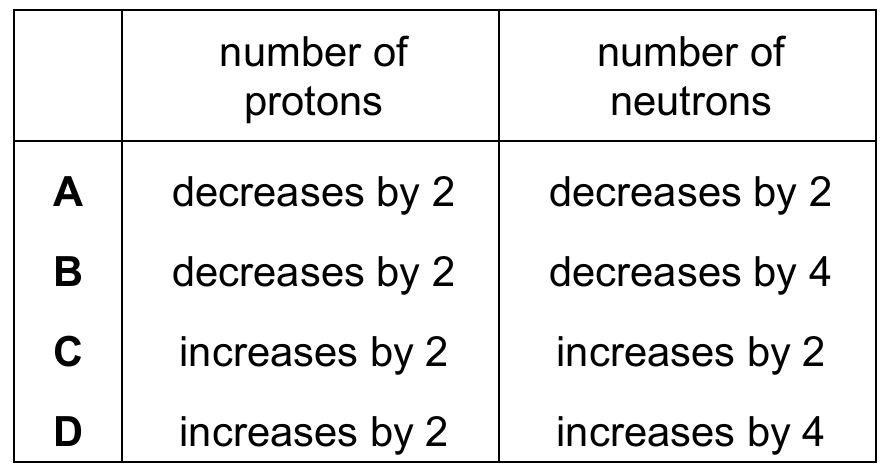
The nucleus of an atom emits an \( \alpha \)-particle.
How do the number of protons and the number of neutrons in the nucleus change?

▶️ Answer/Explanation
When a nucleus emits an alpha particle, it loses these 2 protons and 2 neutrons from its own nucleus.
So the number of protons decreases by 2 and the number of neutrons decreases by 2.
✅ Answer: (A)
Question
A radioactive nucleus emits a β-particle. What happens to the proton number (atomic number) of the nucleus?
A. It stays the same.
B. It increases by 1.
C. It decreases by 2.
D. It decreases by 4.
▶️Answer/Explanation
Answer: B
Explanation: When a nucleus emits a β-particle (an electron), a neutron is converted into a proton, increasing the proton number by 1.
