Home / iGCSE / Coordinated Sciences / P5.2.3 Radioactive decay Paper 2

CIE iGCSE Co-Ordinated Science P5.2.3 Radioactive decay Exam Style Questions Paper 2

Question

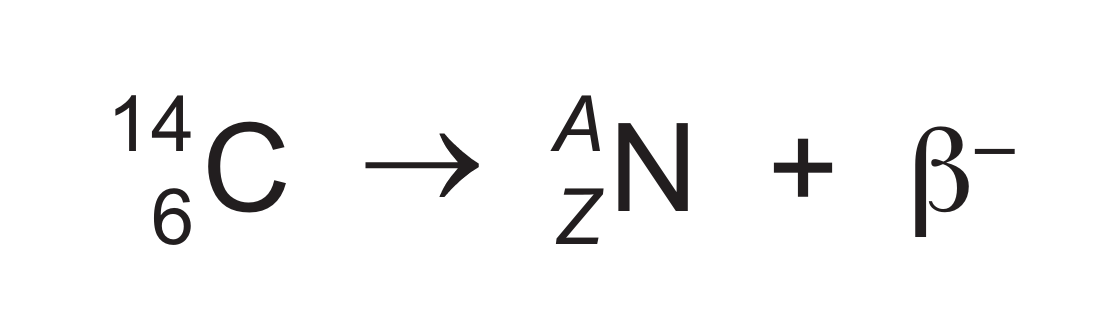
A carbon-14 nucleus undergoes \(\beta^-\) decay and produces an isotope of nitrogen.

The decay equation is shown.

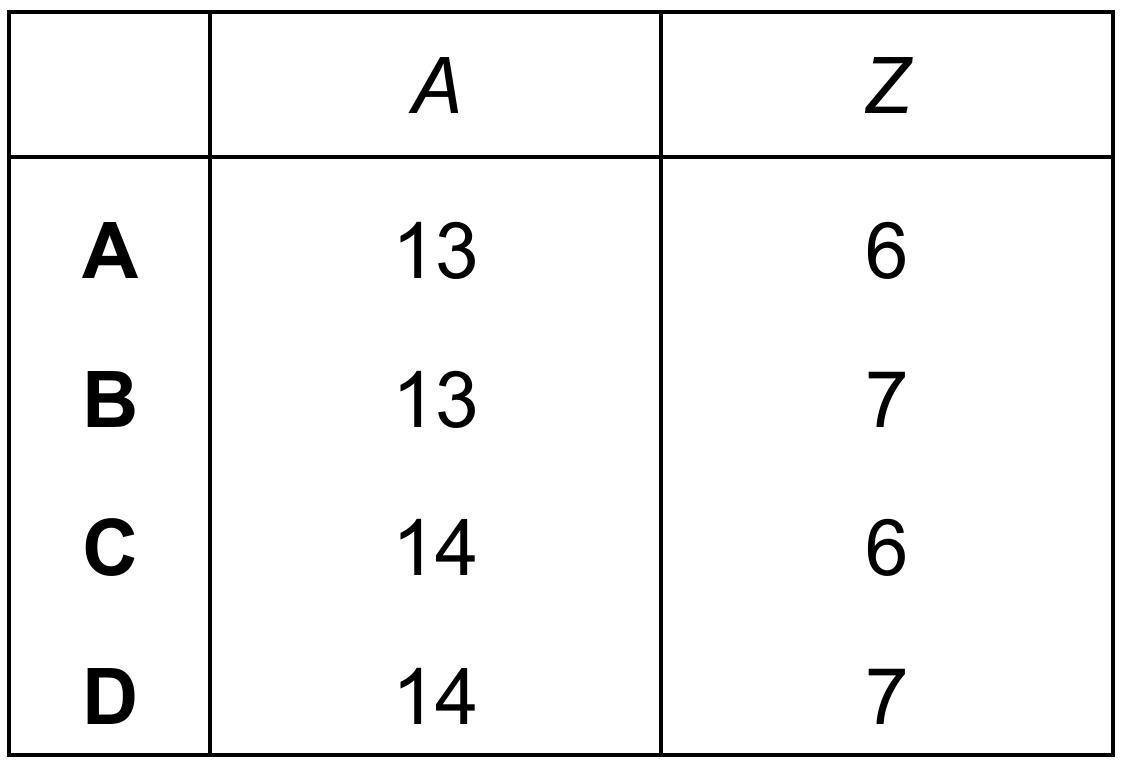
Which row gives the values of \(A\) and \(Z\)?

▶️ Answer/Explanation
In \(\beta^-\) decay, a neutron changes into a proton, so the proton number increases by 1 (from 6 to 7) while the nucleon number remains unchanged (14). So \(A = 14\) and \(Z = 7\).
Answer: (D)

Question

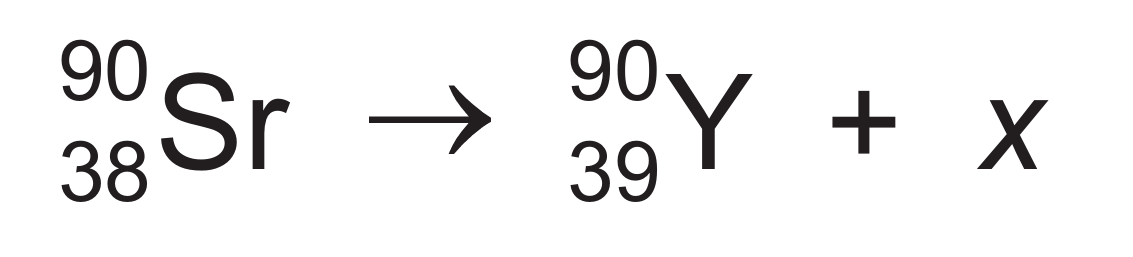
A decay equation for strontium-90 is shown.

What is \(x\)?

A. alpha particle
B. beta particle
C. neutron
D. proton

▶️ Answer/Explanation
In the decay equation, the nucleon number (90) stays the same, but the proton number increases from 38 to 39. This means a neutron in the nucleus has converted into a proton, emitting a beta particle (electron) in the process. The emitted particle must therefore be a beta particle. This is characteristic of beta decay where a neutron changes into a proton, increasing the atomic number by 1 with no change in mass number.
Answer: (B)

Question

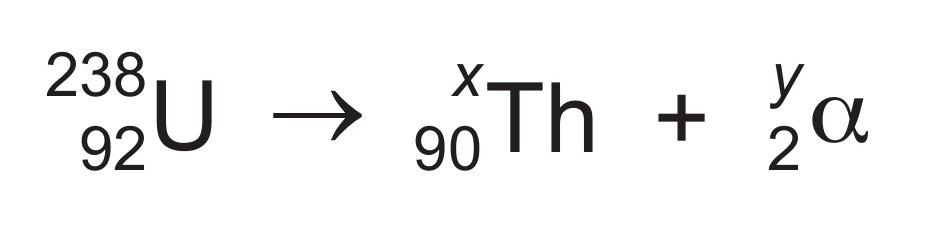
The isotope uranium-238 (U) decays by alpha emission to thorium (Th). The decay equation is shown.

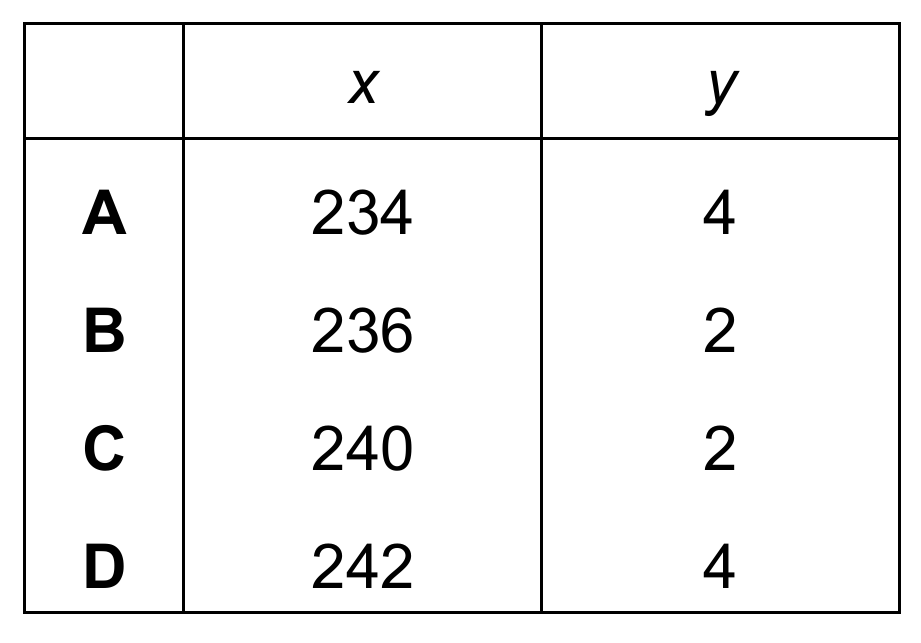
What are \(x\) and \(y\)?

▶️ Answer/Explanation
In alpha decay, the nucleus loses an alpha particle (\(^{4}_{2}\text{He}\)), so nucleon number decreases by 4 and proton number decreases by 2. From \(^{238}_{92}\text{U}\), \(x = 238 – 4 = 234\) and \(y = 4\). Thorium is \(^{234}_{90}\text{Th}\).
Answer: (A)

Question

A radioactive nucleus \(_{92}^{238}\textrm{U}\) decays into a thorium (Th) nucleus by emitting an alpha-particle.

What is the symbol for the thorium nucleus formed?

A. \(_{90}^{234}\textrm{Th}\)  
B. \(_{92}^{234}\textrm{Th}\)  
C. \(_{90}^{238}\textrm{Th}\)  
D. \(_{92}^{238}\textrm{Th}\)

▶️ Answer/Explanation
An alpha particle is \(_2^4\textrm{He}\), so emitting one gives \(_{92}^{238}\textrm{U} \rightarrow \, _{90}^{234}\textrm{Th} + \, _2^4\textrm{He}\).
Mass number: \(238-4=234\); proton number: \(92-2=90\).
Answer: (A)

Question

A uranium nucleus decays into a thorium nucleus. The thorium nucleus then decays into a protactinium nucleus.

$_{238}^{92}\textrm{U}\to _{234}^{90}\textrm{Th}\to _{234}^{91}\textrm{Pa}$

Which emissions take place during the decays?

(A)  an alpha-particle followed by a beta-particle
(B)  an alpha-particle followed by another alpha-particle
(C)  a beta-particle followed by an alpha-particle
(D) a beta-particle followed by another beta-particle

▶️Answer/Explanation

Ans: A

Scroll to Top