
CIE iGCSE Co-Ordinated Science P5.2.3 Radioactive decay Exam Style Questions Paper 3
Question
Topic codes:
• Topic P6.1 — The Solar System (Part (a))
• Topic P5.2.3 — Radioactive decay (Part (b))
• Topic P1.4 — Density (Part (c)(i), (c)(iii) & (d))
• Topic P1.3 — Mass and weight (Part (c)(ii))
• Topic P1.5.1 — Effects of forces (Part (d))
▶️ Answer/Explanation
(a) Planets in order from closest to the Sun:
Mercury, Venus, Earth, Mars, Jupiter, Saturn, Uranus, Neptune
The eight planets of our Solar System in order of increasing distance from the Sun are: Mercury, Venus, Earth, Mars, Jupiter, Saturn, Uranus, Neptune. Pluto is classified as a dwarf planet and is not included.
(b) neutron → proton + electron (β⁻ particle)
During β⁻ emission, a neutron in the nucleus of an atom decays into a proton and an electron (β⁻ particle). The electron is emitted from the nucleus, and the proton remains in the nucleus, increasing the atomic number by 1.
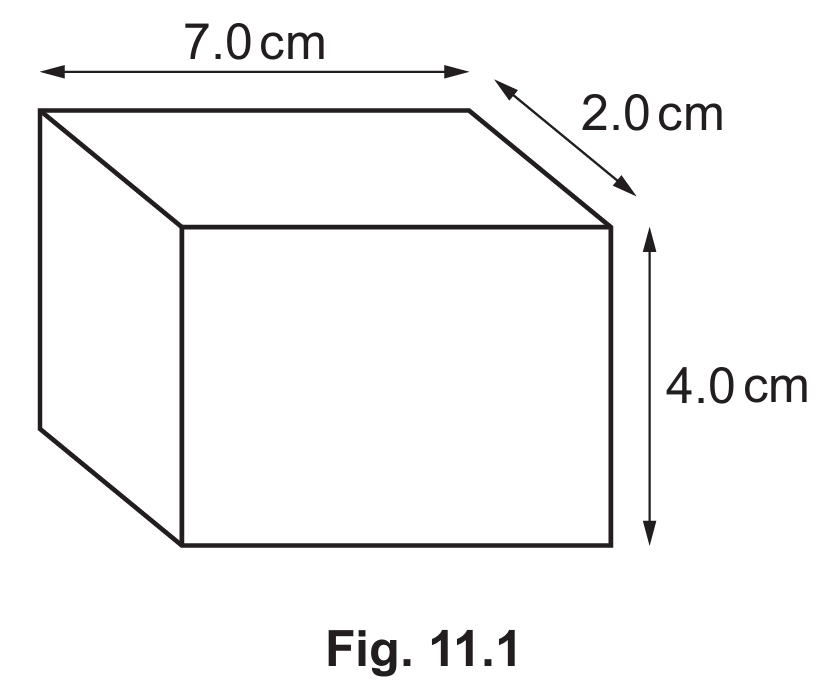
(c)(i) Volume = 56 cm³
Volume = length × width × height = 7.0 × 4.0 × 2.0 = 56 cm³
(c)(ii) Mass calculation:
Weight = mass × gravitational field strength
\(W = m \times g\)
\(m = \frac{W}{g} = \frac{1.47}{9.8} = 0.15\) kg
Converting from kg to g: 0.15 × 1000 = 150 g
(c)(iii) Density = 2.7 g/cm³
Density = mass ÷ volume
\(\rho = \frac{150}{56} = 2.68 \approx 2.7\) g/cm³
(d) The density of granite is greater than the density of water.
An object will sink in a fluid if its density is greater than the density of the fluid. The granite block has a density of 2.7 g/cm³, which is greater than the density of water (1.0 g/cm³). Therefore, the upward buoyant force from the water is less than the weight of the block, causing it to sink.
Question

greatest penetration ………………………………
least penetration ………………………………
Calculate the mass of plutonium-239 remaining after 96 000 years.
plutonium-239 → …………………………… + ……………………………
Most-appropriate topic codes (Cambridge IGCSE Co-ordinated Sciences 0654):
• Topic P1.6.3 — Energy resources (Parts (a)(i), (ii), (iv))
• Topic P1.6.1 — Energy (Part (a)(iii) — chemical energy store)
• Topic P3.3 — Electromagnetic spectrum (Part (b)(i)–(ii))
• Topic P5.2.2 — The three types of nuclear emission (Part (b)(iii)–(iv))
• Topic P5.2.4 — Half-life (Part (c)(i))
• Topic P5.2.3 — Radioactive decay (Part (c)(ii))
▶️ Answer/Explanation
(a)(i) Coal
Coal is a fossil fuel, so burning it to generate electricity releases carbon dioxide.
Geothermal, hydroelectric, nuclear and solar do not involve combustion, so they do not directly produce carbon dioxide.
(a)(ii) Tides / wind / waves
Tidal, wind and wave power are all renewable energy resources not included in the original list.
These resources do not run out and have a much lower environmental impact than fossil fuels.
(a)(iii) Chemical (potential) energy
Coal is a fuel, and fuels store energy in their chemical bonds.
This chemical energy is released as thermal energy when the coal is burned.
(a)(iv) Advantage: no nuclear waste / no risk of nuclear accidents; Disadvantage: only available during the day (depends on sunlight)
Solar power does not produce hazardous radioactive waste, unlike nuclear power.
However, solar power can only generate electricity when there is sufficient sunlight, so it is unreliable at night or in poor weather, whereas nuclear power can generate continuously.
(b)(i) γ-rays
Alpha and beta emissions are streams of particles, not waves.
Gamma rays are electromagnetic waves, so they form part of the electromagnetic spectrum.
(b)(ii) Left-hand box (immediately to the left of X-rays)
The spectrum in Fig. 6.1 is arranged in order of increasing frequency from right to left.
Gamma rays have a higher frequency than X-rays, so they belong in the box to the left of X-rays.
(b)(iii) Greatest penetration: γ-rays; then β-particles; least penetration: α-particles
Gamma rays are the most penetrating because they are uncharged electromagnetic waves that interact weakly with matter.
Alpha particles are large and heavily charged, so they are stopped easily and are the least penetrating; beta particles lie in between.
(b)(iv) A helium nucleus (2 protons and 2 neutrons)
An α-particle consists of 2 protons and 2 neutrons bound together.
This is identical in composition to the nucleus of a helium atom, so it carries a charge of +2.
(c)(i) 6.25 g
Number of half-lives elapsed: \( \dfrac{96000}{24000} = 4 \) half-lives.
Remaining mass: \( 100 \times \left(\dfrac{1}{2}\right)^4 = 100 \times \dfrac{1}{16} = 6.25 \, \text{g} \).
(c)(ii) Plutonium-239 → uranium-235 + α (particle)
In α-decay, the unstable plutonium-239 nucleus emits an alpha particle.
This reduces the proton number by 2 and the nucleon number by 4, forming a uranium-235 nucleus.