Home / iGCSE / Coordinated Sciences / P5.2.5 Applications and safety precautions Paper 2

CIE iGCSE Co-Ordinated Science P5.2.5 Applications and safety precautions Exam Style Questions Paper 2

Question

A radioactive nucleus emits a β-particle.

What happens to the proton number (atomic number) of the nucleus?

A. It stays the same.
B. It increases by 1.
C. It decreases by 2.
D. It decreases by 4.

▶️ Answer/Explanation
During \(\beta\)-emission, a neutron in the nucleus converts into a proton and an electron: \(n \rightarrow p + e^-\).
The emitted electron is the \(\beta\)-particle, and the new proton remains in the nucleus.
This raises the proton number (atomic number) by exactly \(1\), while the mass number stays the same.
Answer: (B)

Question

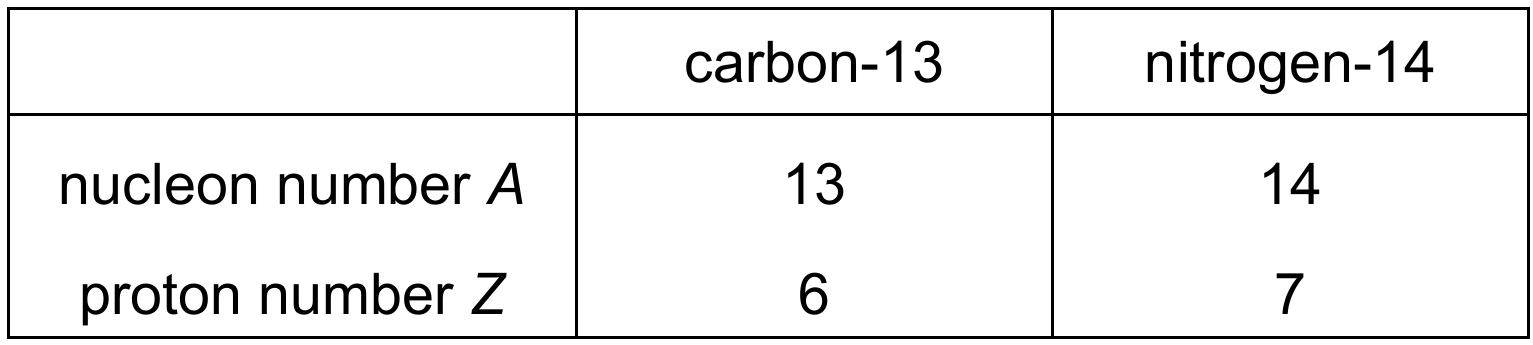
The table compares an atom of carbon-13 and an atom of nitrogen-14.

What do the neutral atom of carbon-13 and the neutral atom of nitrogen-14 have the same number of?

A. electrons
B. ions
C. neutrons
D. protons

▶️ Answer/Explanation
Number of neutrons is found using \( \text{neutrons} = A – Z \).
For carbon-13: \( 13 – 6 = 7 \) neutrons.
For nitrogen-14: \( 14 – 7 = 7 \) neutrons, so both atoms have the same number of neutrons.
Answer: (C)
Scroll to Top