
CIE iGCSE Co-Ordinated Science P6.1 The Solar System Exam Style Questions Paper 3
Question
Topic codes (Cambridge IGCSE Co-ordinated Sciences 0654):
• Topic P6.1 — The Solar System
• Topic P6.2.1 — The Sun as a star
• Topic P6.2.2 — Life cycle of stars
• Topic P3.2.3 — Thin converging lens
▶️ Answer/Explanation
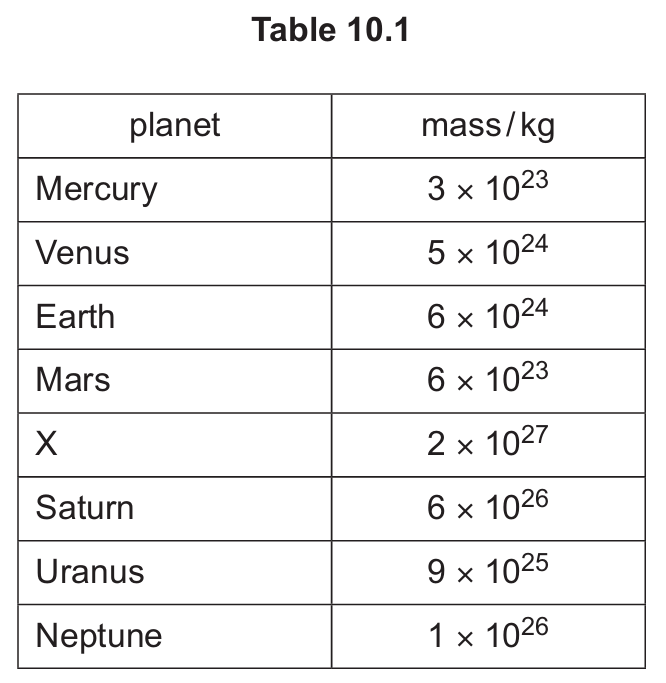
(a)(i) Planet X is Jupiter.
From Table 10.1, planet X has a mass of \(2 \times 10^{27}\,\text{kg}\), which closely matches Jupiter’s known mass of approximately \(1.9 \times 10^{27}\,\text{kg}\). Jupiter is the most massive planet in the Solar System, making it the only candidate consistent with the table data.
(a)(ii) The Sun is 1000 times the mass of planet X — the student is incorrect.
\(\dfrac{2 \times 10^{30}}{2 \times 10^{27}} = 10^3 = 1000\). Since the ratio is 1000 and not 100, the student has made an error, likely a mistake with powers of 10. The Sun is therefore ten times more massive relative to planet X than the student claimed.
(b)(i) The two materials are gas and dust.
Protostars form when vast interstellar clouds of gas (mainly hydrogen and helium) and dust are drawn together by gravity. As the cloud collapses, temperature and pressure at the centre rise steadily until nuclear fusion ignites, marking the birth of a stable star.
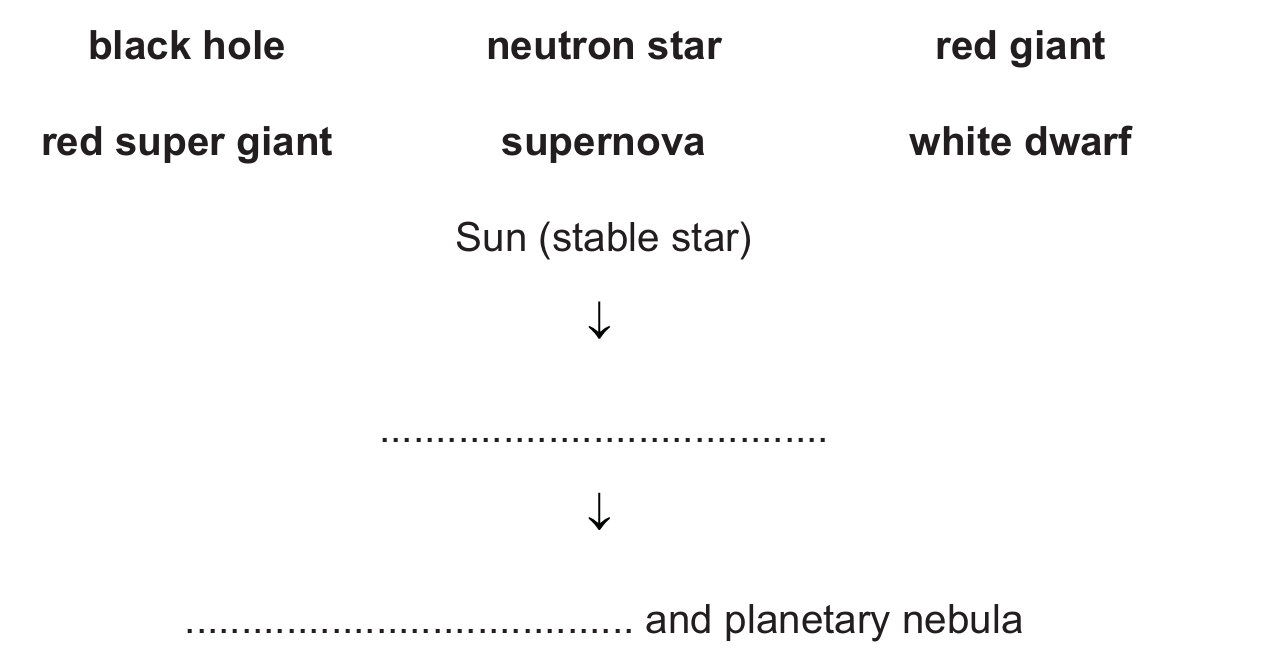
(b)(ii) Stable star → red giant → planetary nebula + white dwarf.
When the hydrogen fuel in the Sun’s core is exhausted, it will expand and cool into a red giant. The outer layers will then be expelled as a planetary nebula, leaving behind the hot, dense core as a white dwarf that gradually cools over billions of years.
(c) Calculation:
\(\text{time} = \dfrac{\text{distance}}{\text{speed}} = \dfrac{1.5 \times 10^{11}}{3.0 \times 10^{8}} = 500\,\text{s}\)
\(500\,\text{s} \div 60 = 8.3\,\text{minutes} \approx 8\,\text{minutes}\)
Therefore, the time is approximately 8 minutes.
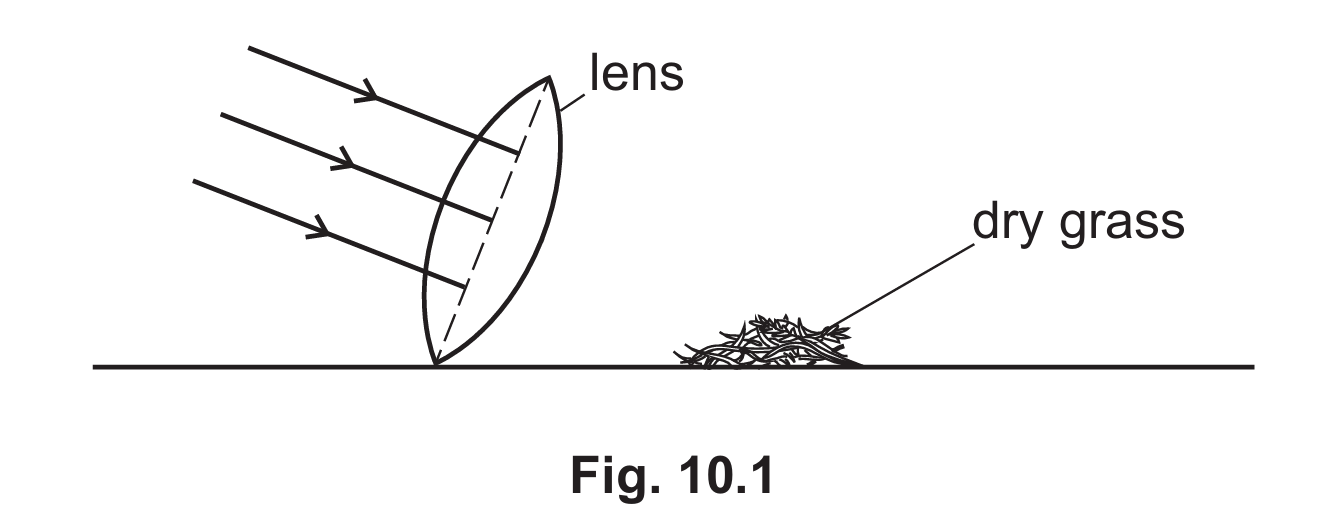
(d) Parallel rays from the Sun enter the converging lens and refract to meet at the principal focus on the dry grass.
Since the Sun is effectively at infinity, light rays arriving at the lens are parallel to the principal axis. The converging lens bends these rays inward so they all meet at a single focal point, concentrating light energy enough to raise the temperature of the grass and ignite it.
Question
Topic codes:
• Topic P6.1 — The Solar System (Part (a))
• Topic P5.2.3 — Radioactive decay (Part (b))
• Topic P1.4 — Density (Part (c)(i), (c)(iii) & (d))
• Topic P1.3 — Mass and weight (Part (c)(ii))
• Topic P1.5.1 — Effects of forces (Part (d))
▶️ Answer/Explanation
(a) Planets in order from closest to the Sun:
Mercury, Venus, Earth, Mars, Jupiter, Saturn, Uranus, Neptune
The eight planets of our Solar System in order of increasing distance from the Sun are: Mercury, Venus, Earth, Mars, Jupiter, Saturn, Uranus, Neptune. Pluto is classified as a dwarf planet and is not included.
(b) neutron → proton + electron (β⁻ particle)
During β⁻ emission, a neutron in the nucleus of an atom decays into a proton and an electron (β⁻ particle). The electron is emitted from the nucleus, and the proton remains in the nucleus, increasing the atomic number by 1.
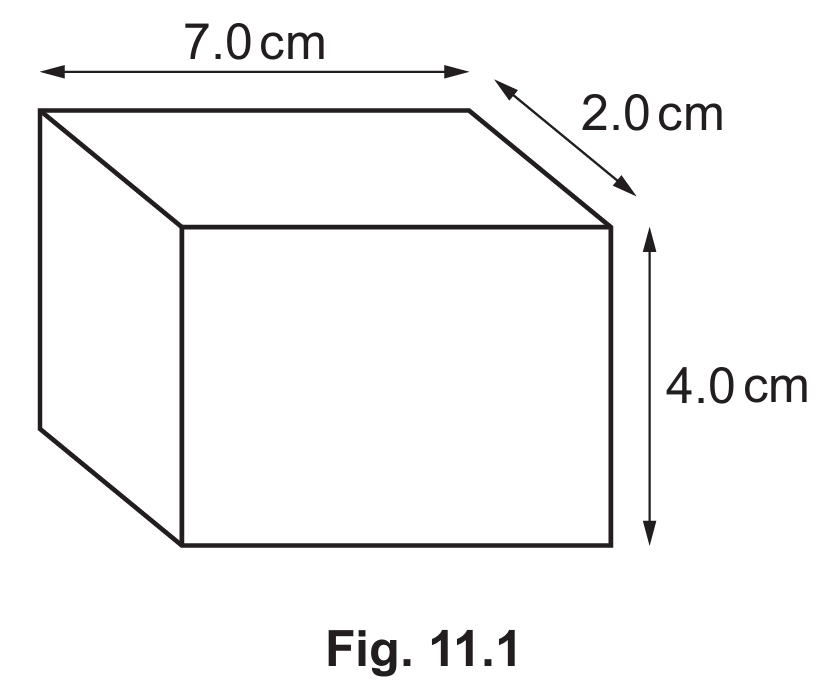
(c)(i) Volume = 56 cm³
Volume = length × width × height = 7.0 × 4.0 × 2.0 = 56 cm³
(c)(ii) Mass calculation:
Weight = mass × gravitational field strength
\(W = m \times g\)
\(m = \frac{W}{g} = \frac{1.47}{9.8} = 0.15\) kg
Converting from kg to g: 0.15 × 1000 = 150 g
(c)(iii) Density = 2.7 g/cm³
Density = mass ÷ volume
\(\rho = \frac{150}{56} = 2.68 \approx 2.7\) g/cm³
(d) The density of granite is greater than the density of water.
An object will sink in a fluid if its density is greater than the density of the fluid. The granite block has a density of 2.7 g/cm³, which is greater than the density of water (1.0 g/cm³). Therefore, the upward buoyant force from the water is less than the weight of the block, causing it to sink.