
CIE iGCSE Co-Ordinated Science P6.1 The Solar System Exam Style Questions Paper 4
Question
Topic codes:
• Topic P6.2.1 — The Sun as a star (Part (a))
• Topic P6.1 — The Solar System / Orbital speed (Part (b))
• Topic P6.2.2 — Life cycle of stars (Part (c))
• Topic P5.1 — The nucleus / Nuclear processes (Part (d))
▶️ Answer/Explanation
(a)(i) The two most common elements found in the Sun are hydrogen and helium.
(a)(ii) As the distance from the Sun increases:
- The strength of the Sun’s gravitational field decreases
- The orbital speed of the planets decreases
(b) Orbital speed = \(2\pi r \div T\)
1 year = 60 × 60 × 24 × 365 = 31,536,000 s
\(v = 2 \times \pi \times 1.5 \times 10^{11} \div 31,536,000\)
\(v = 9.42 \times 10^{11} \div 31,536,000\)
\(v = 29,900\) m/s ≈ 30,000 m/s
(c) After leaving the stable main sequence stage, a very large mass star goes through:
1. Red supergiant
2. Supernova
3. Black hole
(d) Nuclear fusion is the process of joining small nuclei together to form a larger nucleus (releasing energy).
Nuclear fission is the process of splitting a large nucleus into smaller nuclei (releasing energy).
Question

Most-appropriate topic codes (Cambridge IGCSE Co-ordinated Sciences 0654):
• Topic P6.2.2 — Life cycle of stars (Parts (a) & (b))
• Topic P6.1 — The Solar System (Part (c)(i) & (c)(ii))
• Topic P5.2.2 — The three types of nuclear emission (Part (d))
▶️ Answer/Explanation
(a) The Big Bang Theory describes the beginning of the Universe as an expansion from a single point of very high density and very high temperature.
According to this theory, the Universe began approximately 13.8 billion years ago and has been expanding ever since.
(b) Very large mass stable star → red supergiant → supernova → black hole.
• A very large mass star becomes a red supergiant as it expands.
• It then undergoes a supernova explosion.
• The core collapses to form a black hole (if sufficiently massive).
(c)(i) Most of the mass of the Solar System is located in the Sun.
The Sun contains approximately 99.8% of the total mass of the Solar System.
(c)(ii) As orbital radius increases, orbital speed decreases.
The strength of the Sun’s gravitational field decreases with distance, so planets further from the Sun travel more slowly in their orbits.
(d) First type of radiation: Alpha (α) radiation.
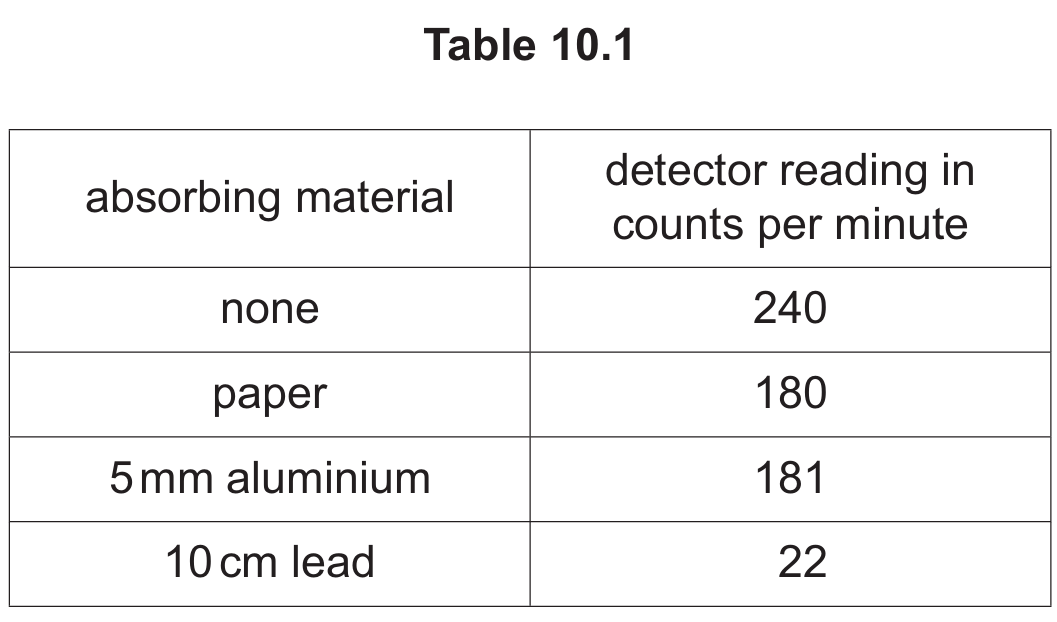
Explanation: The count rate decreases from 240 to 180 when paper is placed between the source and detector. Alpha radiation is stopped by paper, so this reduction indicates the presence of alpha particles.
Second type of radiation: Gamma (γ) radiation.
Explanation: After passing through paper and 5 mm aluminium, the count rate remains above background (181 counts/min compared to background 14 counts/min). Gamma radiation is highly penetrating and is only significantly reduced by thick lead (10 cm lead reduces the count to 22, which is close to background). This confirms the presence of gamma radiation.