
CIE iGCSE Co-Ordinated Science P6.2.1 The Sun as a star Exam Style Questions Paper 3
Question
Another student wears a white T-shirt in the Sun and does not become as hot.
Explain why.
Most-appropriate topic codes (Cambridge IGCSE Coordinated Sciences 0654):
• Topic P1.2 — Motion (Part (a)(i))
• Topic P1.6.4 — Power (Part (a)(ii))
• Topic P2.2.2 — Melting, boiling and evaporation (Part (b)(i))
• Topic P2.3.3 — Radiation (Part (b)(ii))
• Topic P6.2.1 — The Sun as a star (Part (b)(iii), (b)(iv))
▶️ Answer/Explanation
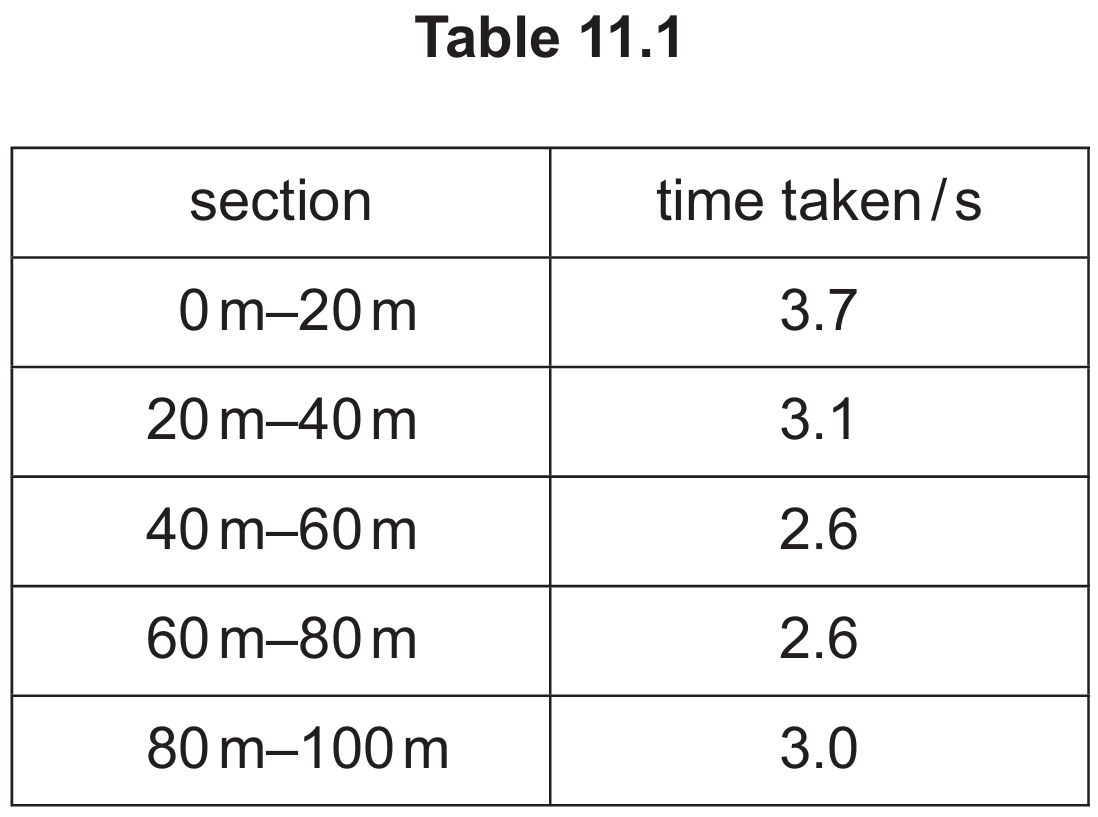
(a)(i) evidence of total time = 15 (s); v = s/t (in any form) OR (average speed =) 100/15; 6.7 (m/s)
Total time = 3.7 + 3.1 + 2.6 + 2.6 + 3.0 = 15.0 s. Average speed = 100/15 = 6.7 m/s.
(a)(ii) P = W/t (in any form) OR (work done =) 600 × 3.0; 1800; J
Work done = power × time = 600 × 3.0 = 1800 J. The unit for work is the joule (J).
(b)(i) evaporation
Sweating cools the body because the most energetic water particles evaporate from the skin surface, taking thermal energy with them and lowering the skin temperature.
(b)(ii) white absorbs less (thermal) radiation / white reflects more (thermal) radiation
White surfaces reflect most incident radiation, so less thermal energy is absorbed. Black surfaces absorb more radiation, leading to greater heating.
(b)(iii) helium or hydrogen
The Sun is composed mainly of hydrogen (about 75%) and helium (about 25%), with small amounts of other elements.
(b)(iv) infrared; (visible) light; ultraviolet
The Sun emits energy across the electromagnetic spectrum, but most is in the infrared, visible, and ultraviolet regions.
Question
Topic codes (Cambridge IGCSE Co-ordinated Sciences 0654):
• Topic P6.1 — The Solar System
• Topic P6.2.1 — The Sun as a star
• Topic P6.2.2 — Life cycle of stars
• Topic P3.2.3 — Thin converging lens
▶️ Answer/Explanation
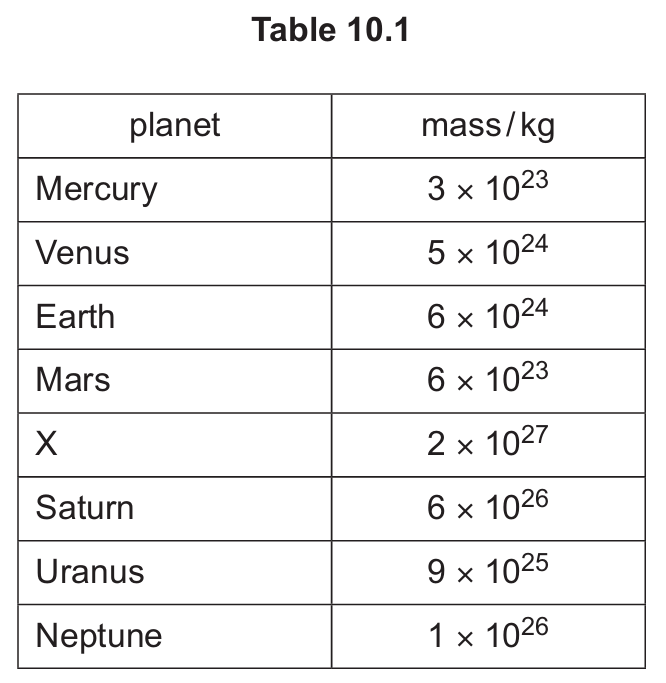
(a)(i) Planet X is Jupiter.
From Table 10.1, planet X has a mass of \(2 \times 10^{27}\,\text{kg}\), which closely matches Jupiter’s known mass of approximately \(1.9 \times 10^{27}\,\text{kg}\). Jupiter is the most massive planet in the Solar System, making it the only candidate consistent with the table data.
(a)(ii) The Sun is 1000 times the mass of planet X — the student is incorrect.
\(\dfrac{2 \times 10^{30}}{2 \times 10^{27}} = 10^3 = 1000\). Since the ratio is 1000 and not 100, the student has made an error, likely a mistake with powers of 10. The Sun is therefore ten times more massive relative to planet X than the student claimed.
(b)(i) The two materials are gas and dust.
Protostars form when vast interstellar clouds of gas (mainly hydrogen and helium) and dust are drawn together by gravity. As the cloud collapses, temperature and pressure at the centre rise steadily until nuclear fusion ignites, marking the birth of a stable star.
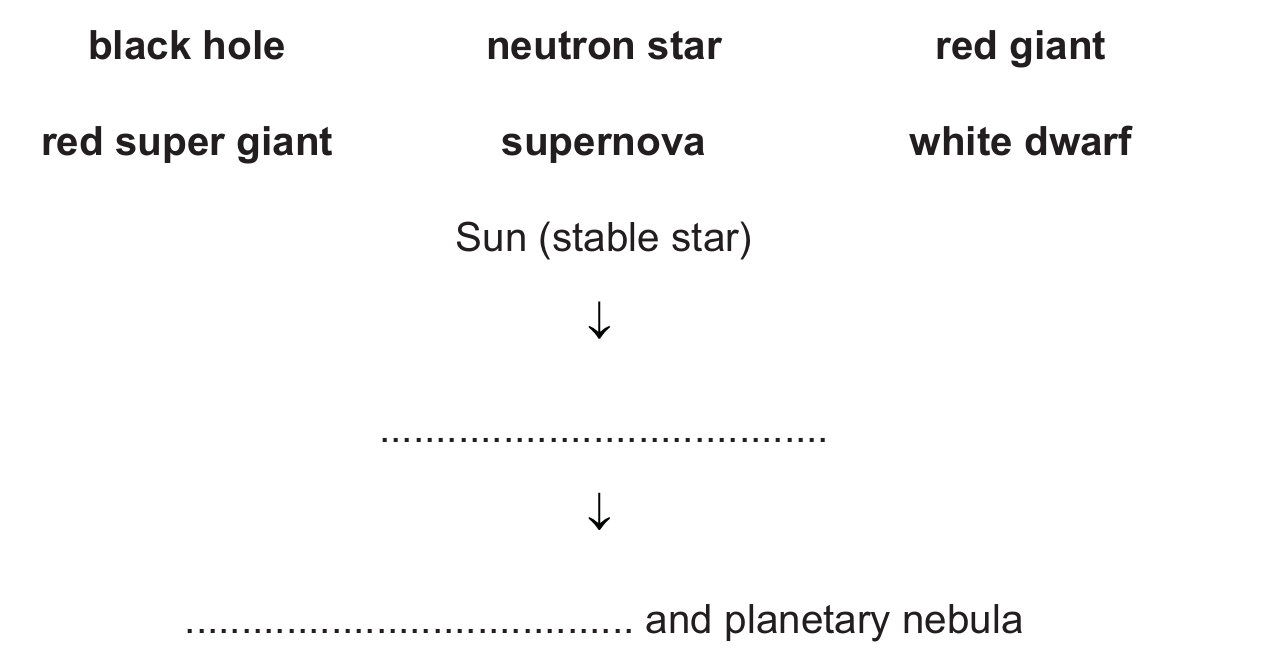
(b)(ii) Stable star → red giant → planetary nebula + white dwarf.
When the hydrogen fuel in the Sun’s core is exhausted, it will expand and cool into a red giant. The outer layers will then be expelled as a planetary nebula, leaving behind the hot, dense core as a white dwarf that gradually cools over billions of years.
(c) Calculation:
\(\text{time} = \dfrac{\text{distance}}{\text{speed}} = \dfrac{1.5 \times 10^{11}}{3.0 \times 10^{8}} = 500\,\text{s}\)
\(500\,\text{s} \div 60 = 8.3\,\text{minutes} \approx 8\,\text{minutes}\)
Therefore, the time is approximately 8 minutes.
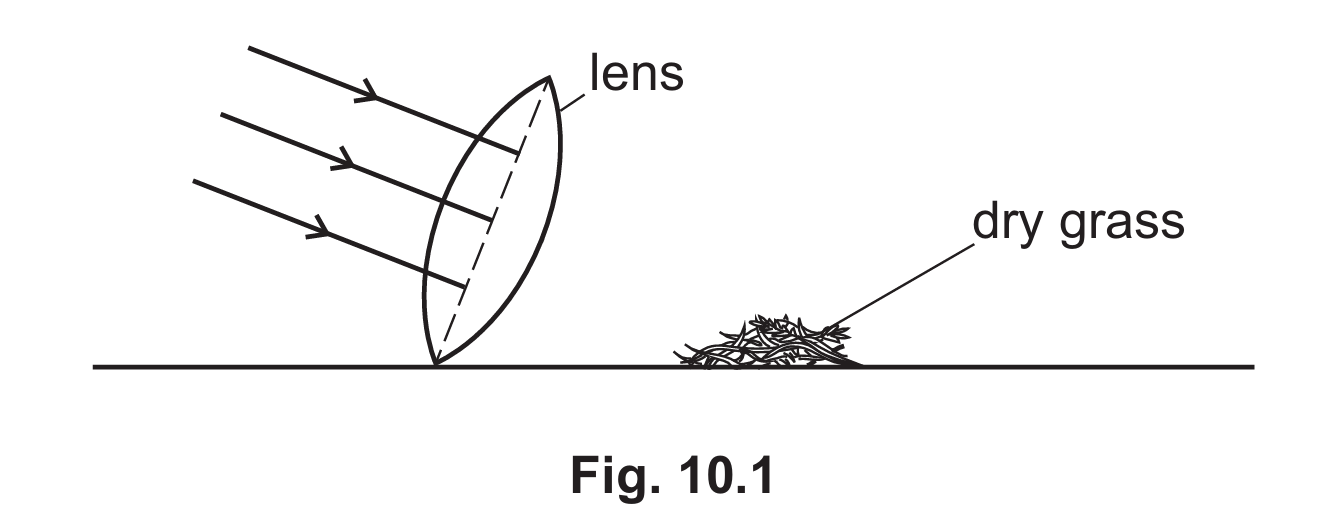
(d) Parallel rays from the Sun enter the converging lens and refract to meet at the principal focus on the dry grass.
Since the Sun is effectively at infinity, light rays arriving at the lens are parallel to the principal axis. The converging lens bends these rays inward so they all meet at a single focal point, concentrating light energy enough to raise the temperature of the grass and ignite it.