Home / iGCSE / Coordinated Sciences / P6.2.2 Life cycle of stars Paper 1 |IITIAN ACADEMY

CIE iGCSE Co-Ordinated Science P6.2.2 Life cycle of stars Exam Style Questions Paper 1

Question

The life cycle of a star depends on whether it has a small mass, a large mass or a very large mass.

What is the final stage of the life cycle of a large mass star?

A. black hole
B. planetary nebula
C. neutron star
D. supernova

▶️ Answer/Explanation

The life cycle of a star depends on its mass:

  • Small mass star (about the same mass as the Sun): red giant → white dwarf + planetary nebula
  • Large mass star: red supergiant → supernova → neutron star
  • Very large mass star: red supergiant → supernova → black hole

Therefore, for a large mass star, the final stage is a neutron star. A supernova is an event that occurs before the final stage (the explosion that leaves behind a neutron star or black hole). A planetary nebula is the final stage for a small mass star (like the Sun), and a black hole is the final stage for a very large mass star.

Answer: (C)

Question

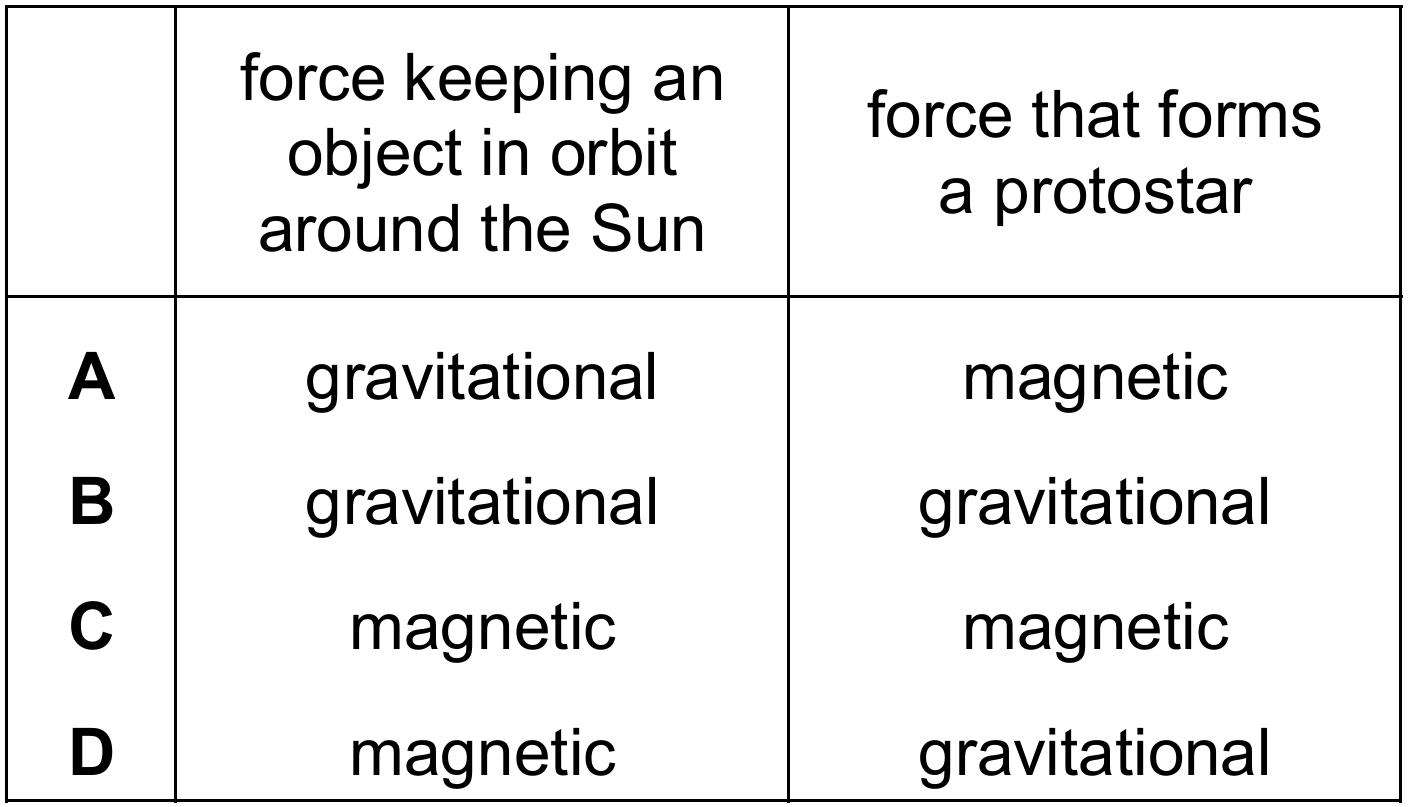
Which type of force keeps an object in orbit around the Sun and which type of force forms a protostar?

▶️ Answer/Explanation
Gravitational force is the universal force of attraction between objects with mass. It keeps planets in orbit around the Sun by providing the centripetal force needed for circular motion. Additionally, gravitational attraction between particles in interstellar clouds causes them to collapse and form protostars. Therefore, both phenomena are caused by gravitational force.
Answer: (B)
Scroll to Top