
Translocation in Plants
📌 Key Definition
Translocation = the movement of sucrose and amino acids in the phloem from sources (where they are made) → to sinks (where they are stored or used).
🔎 Main Features of Translocation
- Substances moved: mainly sucrose + amino acids (plus other nutrients).
- Medium: transported in phloem sap (can contain up to 25% dissolved solids).
- Direction: upwards or downwards (depends on source–sink relation).
- Energy-dependent: requires living cells → poisons/high temperature stop translocation.
🌱 Source and Sink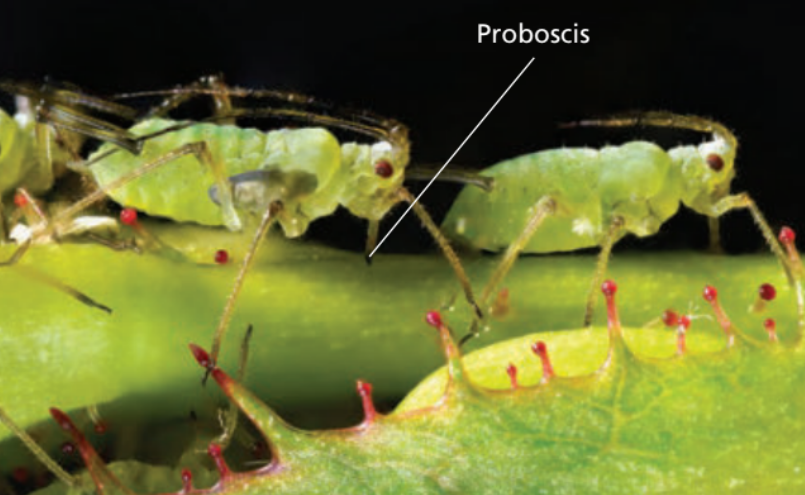
- Source: region of production of sugars/amino acids (e.g. leaves during photosynthesis).
- Sink: region of storage or use (e.g. roots, buds, fruits, tubers).
Some organs can act as both:
- Potato tuber → sink while growing (stores starch).
- Same tuber → source when buds sprout, sending sucrose to shoots.
- New buds → sink (need nutrients), but later become sources once leaves photosynthesise.
🔄 Comparison with Xylem Transport
| Feature | Xylem | Phloem (Translocation) |
|---|---|---|
| Substances carried | Water + mineral salts | Sucrose + amino acids |
| Direction | Only upwards | Both up and down |
| Mechanism | Passive (transpiration pull) | Active (living processes involved) |
🐜 Evidence for Translocation
- Aphid experiments: Aphids insert stylets (proboscis) into phloem → sugary sap exudes due to pressure, proving phloem carries sucrose solution.
⚡ Quick Recap
Translocation = movement of sucrose + amino acids in phloem.
From sources → sinks.
Transport can be upwards or downwards.
Requires living cells + energy.
Examples: Leaf → fruit (growth), Leaf → root (storage), Tuber → source when sprouting.
Sources and Sinks in Plants (Phloem Transport)
📌 Introduction
In translocation, sucrose and amino acids move through the phloem.
Where they come from = source
Where they go = sink
(a) 🌿 Sources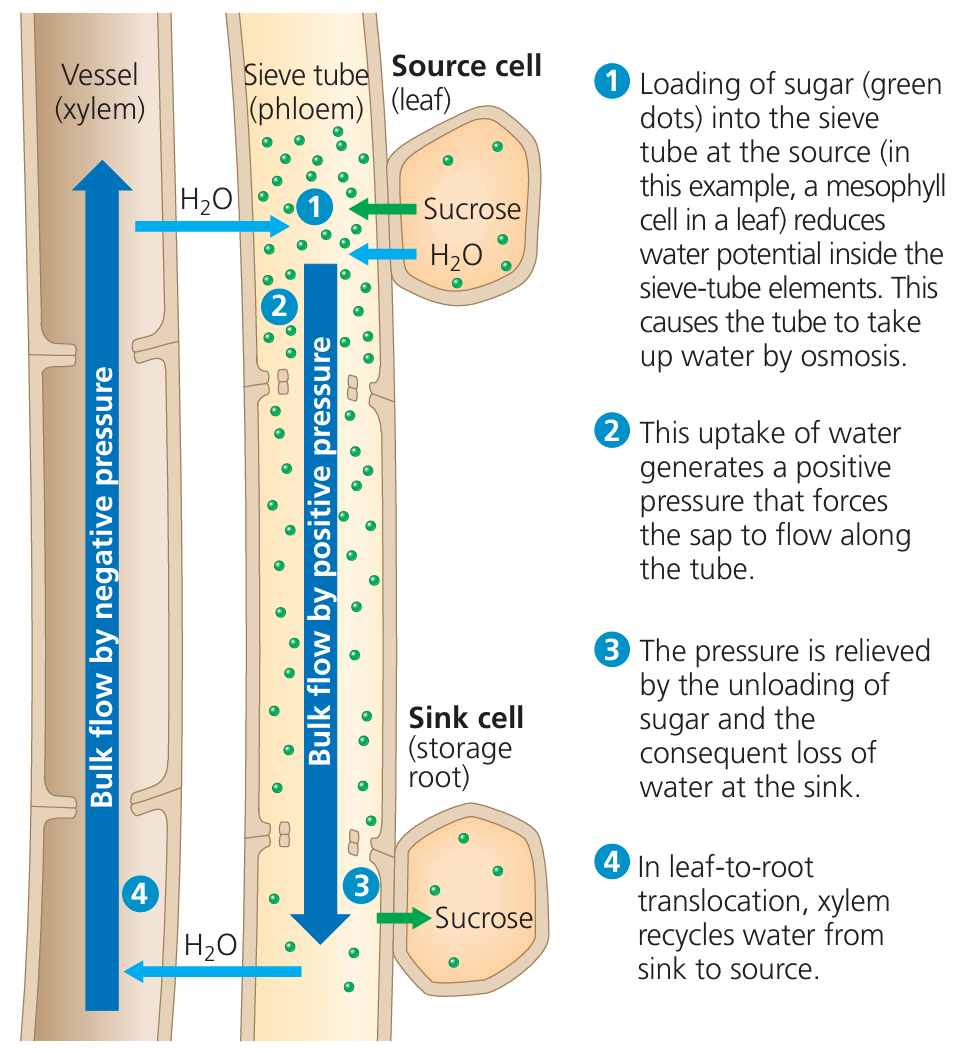
Definition → Parts of the plant that produce or release sucrose/amino acids into the phloem.
Main examples:
- Leaves → during photosynthesis, produce glucose → converted to sucrose → loaded into phloem.
- Storage organs (e.g. potato tubers, bulbs) → when sprouting, stored starch is converted to sucrose → acts as a source.
Function → provide nutrients for growth, storage, or respiration elsewhere in the plant.
Trick: Sources = Suppliers (make/release food).
(b) 🍎 Sinks
Definition → Parts of the plant that use or store sucrose/amino acids.
Main examples:
- Roots → store sugars as starch.
- Developing fruits → need sucrose for growth.
- Young leaves/buds → cannot photosynthesise yet, so act as sinks.
- Growing stems/flowers → use nutrients for building tissues.
Function → allow growth, energy release, and long-term food storage.
Trick: Sinks = Storage/Users (consume or keep food).
🔄 Changing Roles
- A potato tuber → sink while starch is being stored, but becomes a source when sprouting.
- A bud → sink while developing, then a source once leaves photosynthesise.
📝 Summary Table
| Term | Meaning | Examples |
|---|---|---|
| Source | Produces/releases sucrose & amino acids into phloem | Leaves, sprouting tubers, bulbs |
| Sink | Uses or stores sucrose & amino acids | Roots, fruits, buds, growing stems |
⚡ Quick Recap
Source = supplier (makes/releases sucrose & amino acids).
Sink = consumer/storage (uses/stores sucrose & amino acids).
Transport is via phloem, in both directions.
Some organs switch roles depending on plant stage.