
Set Language, Notation, and Venn Diagrams
Definition of a Set
A set is a collection of distinct objects or elements. These elements can be numbers, letters, or any well-defined items.
Sets are usually denoted by capital letters like \( A, B, C \), and elements are listed within curly brackets.
Example: \( A = \{2, 4, 6, 8\} \)
Set Notation and Symbols
| Symbol | Meaning |
|---|---|
| \( n(A) \) | Number of elements in set \( A \) |
| \( A’ \) or \( A^c \) | Complement of set \( A \) (elements not in \( A \)) |
| \( A \cup B \) | Union — all elements in \( A \) or \( B \) or both |
| \( A \cap B \) | Intersection — elements common to both \( A \) and \( B \) |
| \( A \setminus B \) | Difference — elements in \( A \) but not in \( B \) |
| \( \xi \) | Universal set — the set containing all elements under consideration |
| \( \subseteq \) | Subset — all elements of one set are contained in another |
| \( \emptyset \) | Empty set — a set with no elements |
| \( \in \) | “is an element of” (e.g., \( 3 \in A \)) |
| \( \notin \) | “is not an element of” (e.g., \( 7 \notin A \)) |
Describing Sets
Sets can be described in two main ways:
- List form: \( B = \{1, 3, 5, 7\} \)
- Set-builder form: \( B = \{x : x \text{ is an odd number less than } 10\} \)
Special Sets
These commonly used sets have specific symbols:
- \( \mathbb{N} \): Natural numbers
- \( \mathbb{Z} \): Integers
- \( \mathbb{Q} \): Rational numbers
- \( \mathbb{R} \): Real numbers
- \( \mathbb{P} \): Prime numbers
Venn Diagrams
Venn diagrams are visual representations of sets using overlapping circles. Each set is shown as a circle, and the universal set \( \xi \) is usually shown as a rectangle containing all relevant elements.
| Image | Set Notation | Description |
|---|---|---|
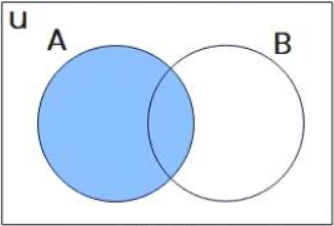 | \( A \) | Only elements in set A |
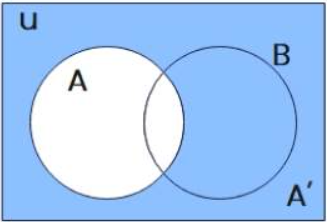 | \( A’ \) or \( A^c \) | Complement of A (everything not in A) |
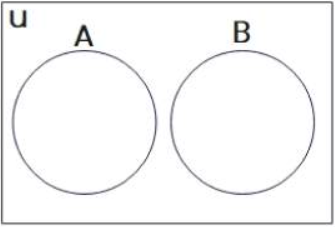 | \( A \cap B = \emptyset \) | Disjoint sets (no common elements) |
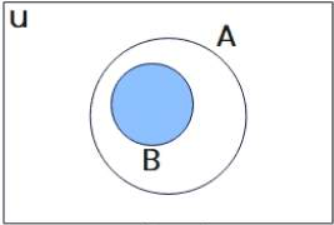 | \( B \subset A \) | B is a proper subset of A |
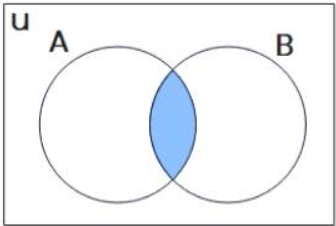 | \( A \cap B \) | Elements common to both A and B |
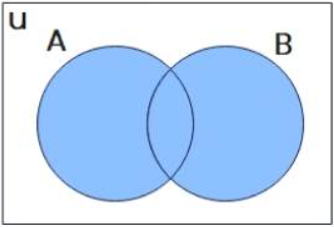 | \( A \cup B \) | Union of A and B (all elements in A or B or both) |
Set Relationships and Vocabulary
- Equal Sets: Two sets are equal if they have exactly the same elements.
- Subsets: \( A \subseteq B \) means every element of \( A \) is also in \( B \)
- Disjoint Sets: Sets with no elements in common (i.e., \( A \cap B = \emptyset \))
Example:
Let the universal set be \( \xi = \{1, 2, 3, 4, 5, 6, 7, 8, 9, 10\} \), and \( A = \{2, 4, 6, 8\} \).
List the elements of \( A’ \), the complement of set \( A \).
▶️ Answer/Explanation
Step 1: Identify all elements in the universal set \( \xi \).
\( \xi = \{1, 2, 3, 4, 5, 6, 7, 8, 9, 10\} \)
Step 2: Identify elements in set \( A \).
\( A = \{2, 4, 6, 8\} \)
Step 3: The complement \( A’ \) is everything in \( \xi \) that is not in \( A \).
\( A’ = \{1, 3, 5, 7, 9, 10\} \)
Example:
Let \( A = \{2, 4, 6\} \), \( B = \{4, 5, 6, 7\} \).
Find \( A \cup B \) and \( A \cap B \).
▶️ Answer/Explanation
Union: Combine all elements from both sets (no repetition).
\( A \cup B = \{2, 4, 5, 6, 7\} \)
Intersection: Elements common to both sets.
\( A \cap B = \{4, 6\} \)
Example:
In a class of 40 students:
- 18 study Mathematics
- 20 study Physics
- 7 study both Mathematics and Physics
How many study neither subject?
▶️ Answer/Explanation
Step 1: Use a Venn diagram (or formula):
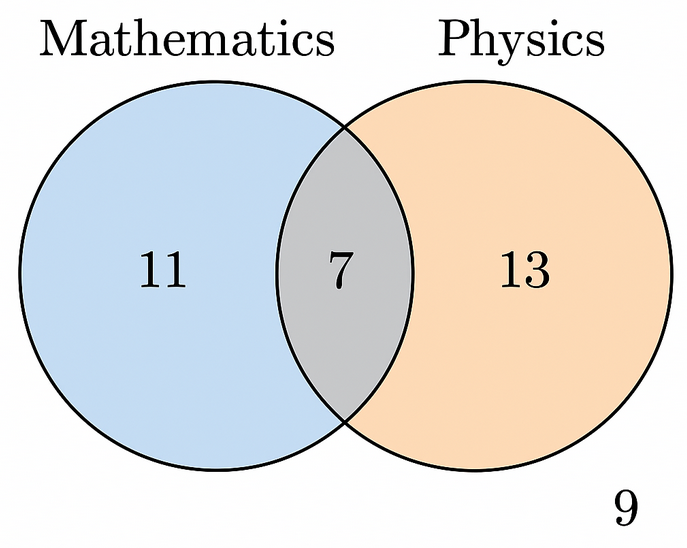
\( n(A \cup B) = n(A) + n(B) – n(A \cap B) \) \( = 18 + 20 – 7 = 31 \)
Step 2: Total students = 40
So, number who study neither = \( 40 – 31 = 9 \)
Example:
In a Venn diagram with two sets \( A \) and \( B \), describe and shade the region representing \( A \cup B’ \).
▶️ Answer/Explanation
Step 1: Understand the expression.
\( B’ \) is everything outside set \( B \).
\( A \cup B’ \) includes everything in set \( A \), or outside set \( B \), or both.
Step 2: Region includes:
- All of set \( A \)
- Everything outside \( B \) (including parts not in \( A \))
- Only the overlapping part that lies in both \( A \) and outside \( B \)
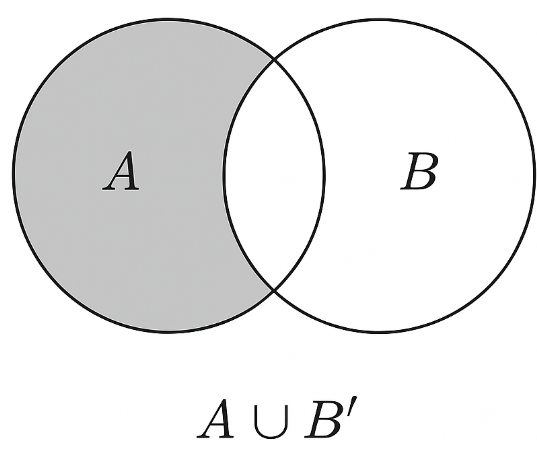
This region includes everything except the part that is only in \( B \) and not in \( A \).