Home / iGCSE / CIE iGCSE Biology

IGCSE Biology Mock – Set 1 Paper 2-Updated 2026

IGCSE Biology Mock – Set 1 Paper 2 – Updated 2026

Preparing for your CIE IGCSE Biology exam can be daunting, but with the right approach, you can achieve your goals with CIE iGCSE Biology Mock test.

Ace your CIE iGCSE Biology exam! Find exam-style questions, detailed notes, and helpful resources to boost your understanding.

iGCSE Practice Questions, Past Papers, Flashcards and notes available for iGCSE Students at IITian Academy.

CIE iGCSE Biology Mock test – All Sets

Question 

What is a characteristic of all living organisms?

(A) breathing
(B) photosynthesis
(C) reproduction
(D) transpiration
▶️ Answer/Explanation
All living things share certain life processes, commonly summarized by the acronym MRS GREN (Movement, Respiration, Sensitivity, Growth, Reproduction, Excretion, and Nutrition). Reproduction is essential for the survival of a species. Other options are specific to certain groups: breathing is a physical mechanism used by some animals but not plants or single-celled organisms; photosynthesis is unique to autotrophs like plants; and transpiration is a process specifically related to water movement in plants.
Answer: (C)

Question 

A palisade cell and a neurone are observed under a light microscope.

Which cell component is found only in the palisade cell?

(A) cell membrane
(B) cell wall
(C) cytoplasm
(D) nucleus
▶️ Answer/Explanation
To solve this, we must distinguish between plant and animal cell structures. A palisade cell is a specialized plant cell found in leaves, whereas a neurone (nerve cell) is an animal cell. Both cells are eukaryotic, meaning they both possess a cell membrane, cytoplasm, and a nucleus (Options A, C, and D). However, plant cells are characterized by a rigid cell wall made of cellulose for structural support, a feature entirely absent in animal cells like the neurone.
Answer: (B)

Question 

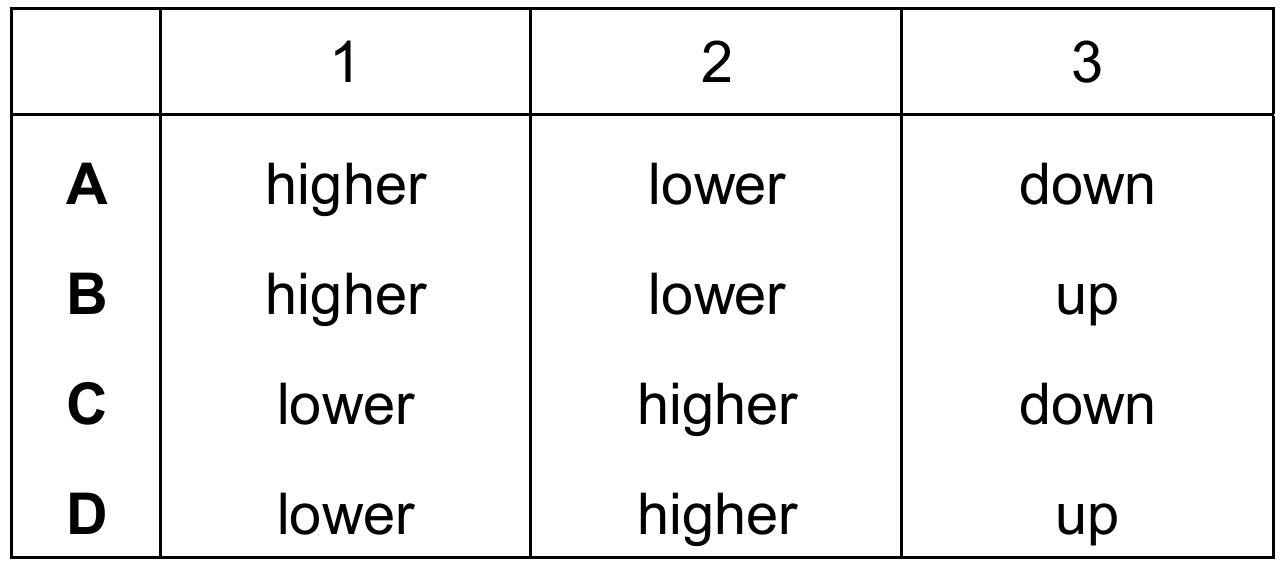
Diffusion may be defined as the net movement of particles from a region of their ……$1$…… concentration, to a region of their ……$2$…… concentration, where movement is ……$3$…… a concentration gradient.

Which words complete gaps $1$, $2$ and $3$?

▶️ Answer/Explanation
Diffusion is a passive process where particles move from an area where they are more crowded to an area where they are less crowded. This means they move from a higher concentration ($1$) to a lower concentration ($2$). Since the particles are following the natural slope of concentration, the movement is described as going down ($3$) the concentration gradient. This process does not require energy input because it relies on the random kinetic energy of the particles. Therefore, the sequence that correctly fills the gaps is higher, lower, and down.
Answer: (A)
Scroll to Top