Home / iGCSE / CIE iGCSE Biology

IGCSE Biology Mock – Set 2 Paper 1-Updated 2026

IGCSE Biology Mock – Set 2 Paper 1 – Updated 2026

Preparing for your CIE IGCSE Biology exam can be daunting, but with the right approach, you can achieve your goals with CIE iGCSE Biology Mock test.

Ace your CIE iGCSE Biology exam! Find exam-style questions, detailed notes, and helpful resources to boost your understanding.

iGCSE Practice Questions, Past Papers, Flashcards and notes available for iGCSE Students at IITian Academy.

CIE iGCSE Biology Mock test – All Sets

Question 

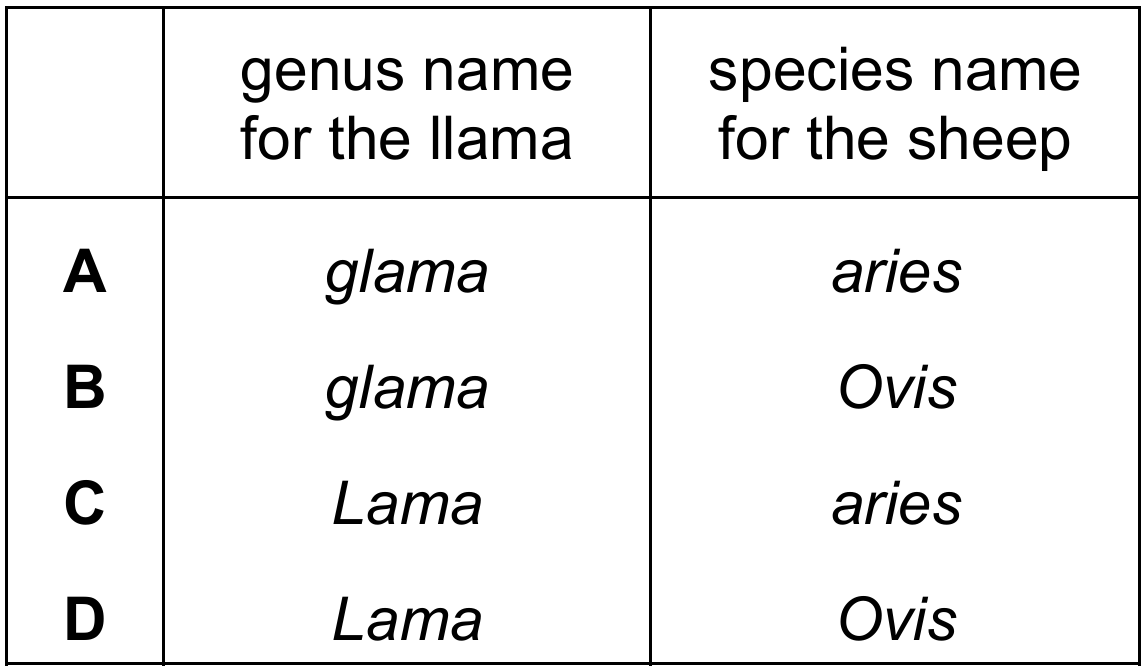
The scientific name for a domesticated llama is Lama glama.
The scientific name for a domesticated sheep is Ovis aries.
What is the genus name for the llama and the species name for the sheep?
▶️ Answer/Explanation
Correct Answer: C

In biological classification, the binomial nomenclature system developed by Carl Linnaeus uses two parts to name every species:

  • The First Name: This is the Genus. It is always capitalized and written in italics (or underlined if handwritten).
  • The Second Name: This is the Specific Epithet (often referred to simply as the species name). It is always lowercase and also written in italics.
Question 

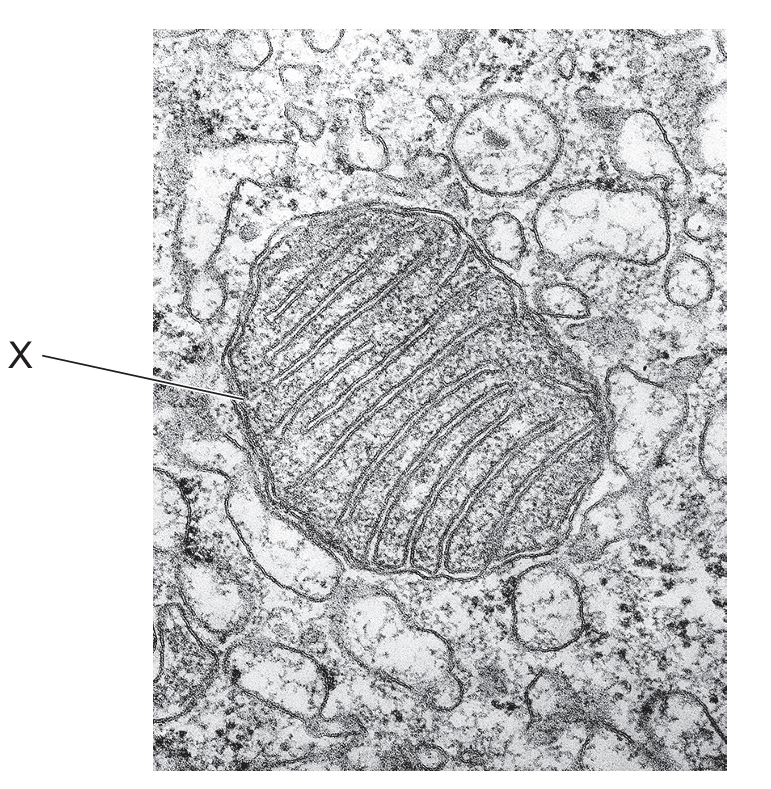
The photomicrograph shows part of an animal cell.
What is the structure labelled \(X\)?
  • A chloroplast
  • B mitochondrion
  • C ribosome
  • D vacuole
▶️ Answer/Explanation
Detailed solution

The correct answer is B.

Identification:
The image displays a transmission electron micrograph (TEM) of an organelle with a distinct double membrane structure. The label \(X\) points to the inner membrane, which is folded inwards to form finger-like projections called cristae. This folded structure is the hallmark characteristic of a mitochondrion. The cristae serve to increase the surface area available for the electron transport chain and ATP synthesis during aerobic respiration.

Question 

What is the formula for calculating the magnification of specimens?
A   actual size \(\div\) image size
B   actual size \(\times\) image size
C   image size \(-\) actual size
D   image size \(\div\) actual size
▶️ Answer/Explanation
Detailed solution

The correct answer is D.

Magnification is a measure of how much larger a specimen appears compared to its real size. The general formula for calculating magnification is:

$$ \text{Magnification} = \frac{\text{Image size}}{\text{Actual size}} $$

This can also be written as image size \(\div\) actual size.

Scroll to Top