IGCSE Biology Mock – Set 2 Paper 2-Updated 2026
IGCSE Biology Mock – Set 2 Paper 2 – Updated 2026
Preparing for your CIE IGCSE Biology exam can be daunting, but with the right approach, you can achieve your goals with CIE iGCSE Biology Mock test.
Ace your CIE iGCSE Biology exam! Find exam-style questions, detailed notes, and helpful resources to boost your understanding.
iGCSE Practice Questions, Past Papers, Flashcards and notes available for iGCSE Students at IITian Academy.
Question
Events that occur at a synapse are listed.
They are not in the correct order.
$1$ An impulse is stimulated in the next neurone.
$2$ An impulse stimulates the release of neurotransmitter molecules from vesicles into the synaptic gap.
$3$ Neurotransmitter molecules bind with receptor proteins on the next neurone.
$4$ The neurotransmitter molecules diffuse across the gap.
$2$ An impulse stimulates the release of neurotransmitter molecules from vesicles into the synaptic gap.
$3$ Neurotransmitter molecules bind with receptor proteins on the next neurone.
$4$ The neurotransmitter molecules diffuse across the gap.
What is the actual sequence of events?
(A) $2 \rightarrow 4 \rightarrow 1 \rightarrow 3$
(B) $2 \rightarrow 4 \rightarrow 3 \rightarrow 1$
(C) $4 \rightarrow 2 \rightarrow 1 \rightarrow 3$
(D) $4 \rightarrow 2 \rightarrow 3 \rightarrow 1$
(B) $2 \rightarrow 4 \rightarrow 3 \rightarrow 1$
(C) $4 \rightarrow 2 \rightarrow 1 \rightarrow 3$
(D) $4 \rightarrow 2 \rightarrow 3 \rightarrow 1$
▶️ Answer/Explanation
The process begins when an electrical impulse reaches the presynaptic terminal, triggering the release of neurotransmitters from vesicles ($2$). These chemical messengers then travel by diffusion across the narrow synaptic gap ($4$). Once they reach the postsynaptic membrane, the molecules bind to specific receptor proteins ($3$). This binding causes a change in the membrane potential, which ultimately stimulates a new electrical impulse in the next neurone ($1$). Following this logical flow, the correct sequence is $2 \rightarrow 4 \rightarrow 3 \rightarrow 1$.
✅ Answer: (B)
✅ Answer: (B)
Question
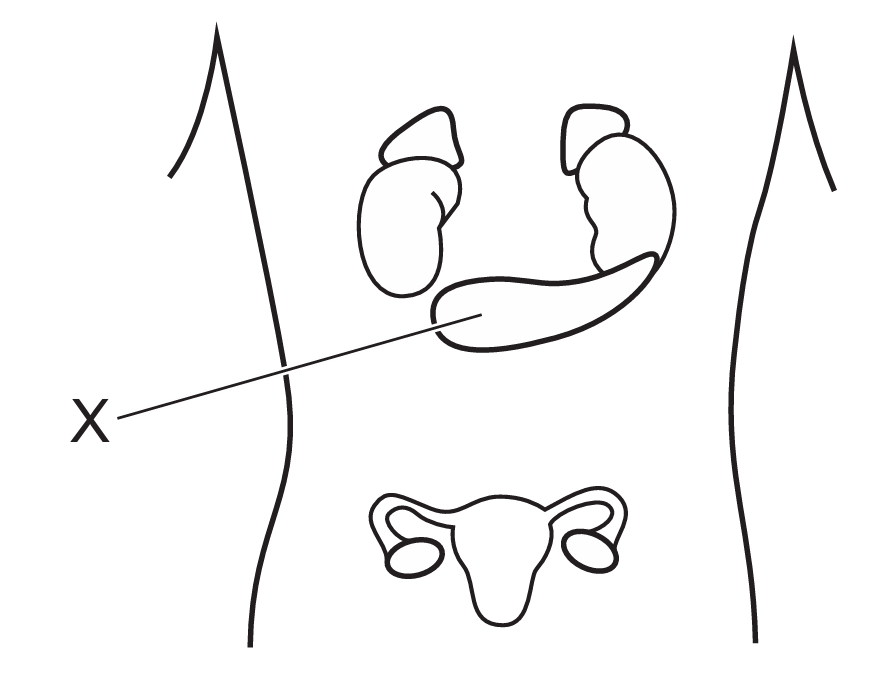
The diagram shows the position of some of the human endocrine glands.

Which hormone is secreted by $X$?
(A) adrenaline
(B) insulin
(C) oestrogen
(D) testosterone
(B) insulin
(C) oestrogen
(D) testosterone
▶️ Answer/Explanation
The label $X$ points to the pancreas, a leaf-shaped gland located behind the stomach. The pancreas plays a vital role in regulating blood glucose levels by secreting the hormone insulin from its beta cells. While the diagram also shows the adrenal glands (above the kidneys) which secrete adrenaline, and the ovaries which secrete oestrogen, $X$ specifically identifies the pancreatic structure. Therefore, among the given options, insulin is the correct hormone produced by this specific gland.
✅ Answer: (B)
✅ Answer: (B)
Question
A student writes four statements about auxin.
1. Auxin becomes more concentrated on the lower side of a horizontal stem.
2. Auxin becomes more concentrated on the side of the shoot that has more light.
3. Auxin is made in the shoot tip.
4. Auxin prevents cell elongation in the shoot.
2. Auxin becomes more concentrated on the side of the shoot that has more light.
3. Auxin is made in the shoot tip.
4. Auxin prevents cell elongation in the shoot.
Which statements describe what happens during chemical control of plant growth?
(A) $1$, $2$ and $4$
(B) $1$ and $2$ only
(C) $1$ and $3$
(D) $2$, $3$ and $4$
(B) $1$ and $2$ only
(C) $1$ and $3$
(D) $2$, $3$ and $4$
▶️ Answer/Explanation
Statement $1$ is correct because gravity causes auxin to accumulate on the lower side of a horizontal stem (gravitropism). Statement $3$ is also correct as auxin is synthesized in the apical meristem of the shoot tip. Statement $2$ is false; auxin actually moves away from light to the shaded side. Statement $4$ is incorrect because auxin stimulates cell elongation in shoots, though it inhibits it in roots. Therefore, only statements $1$ and $3$ are accurate descriptions of auxin’s role in shoot growth.
✅ Answer: (C)
✅ Answer: (C)
