Home / iGCSE / CIE iGCSE Biology

IGCSE Biology Mock – Set 3 Paper 1-Updated 2026

IGCSE Biology Mock – Set 3 Paper 1 – Updated 2026

Preparing for your CIE IGCSE Biology exam can be daunting, but with the right approach, you can achieve your goals with CIE iGCSE Biology Mock test.

Ace your CIE iGCSE Biology exam! Find exam-style questions, detailed notes, and helpful resources to boost your understanding.

iGCSE Practice Questions, Past Papers, Flashcards and notes available for iGCSE Students at IITian Academy.

CIE iGCSE Biology Mock test – All Sets

Question 

A rat has the scientific name Rattus rattus.

What do the two parts of this name refer to?

(A) genus and species
(B) kingdom and genus
(C) kingdom and species
(D) species and group
▶️ Answer/Explanation
Scientific names follow the system of binomial nomenclature, which assigns a unique two-part name to every organism. The first part of the name represents the genus and is always capitalized (e.g., Rattus). The second part identifies the specific species within that genus and is written in lowercase (e.g., rattus). Therefore, the name Rattus rattus corresponds to the genus and species of the rat.
Answer: (A)

Question 

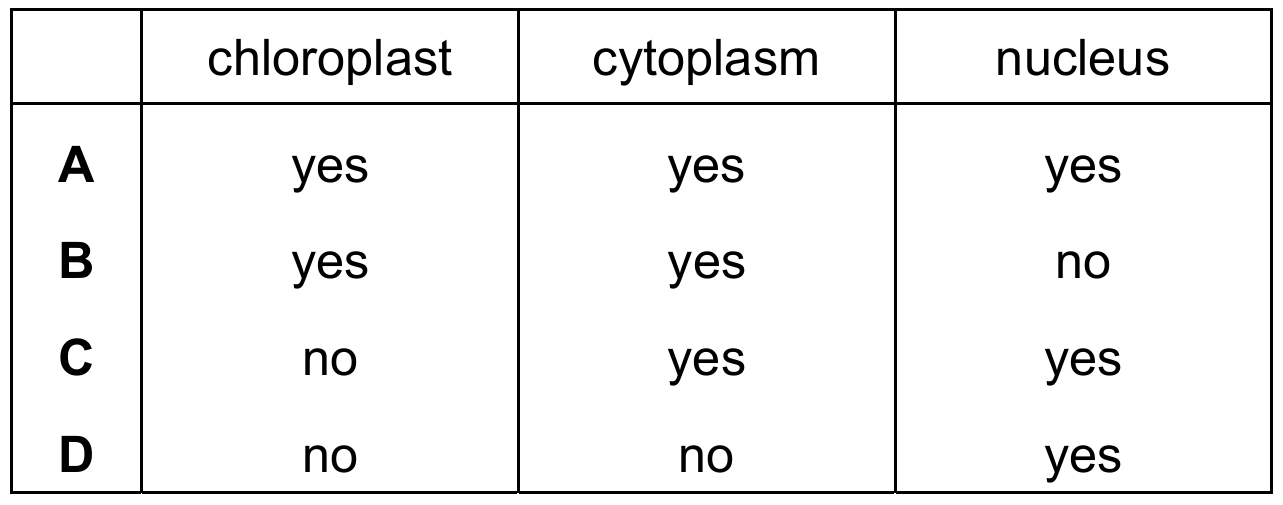
Which features do animal cells share with plant cells?

▶️ Answer/Explanation
To solve this, we must identify which organelles are present in animal cells. Both animal and plant cells are eukaryotic, meaning they both contain a nucleus to house genetic material and cytoplasm where metabolic reactions occur. However, chloroplasts are specialized organelles used for photosynthesis; these are found in plant cells but are not present in animal cells. Therefore, an animal cell has cytoplasm and a nucleus, but no chloroplasts.
Answer: (C)

Question 

Some pieces of potato plant tissue are placed in a very concentrated sugar solution. Other pieces of potato plant tissue are placed in distilled water.

What happens to the mass of the potato pieces in the two liquids?

▶️ Answer/Explanation

This question tests the concept of osmosis, which is the net movement of water molecules from a region of higher water potential to a region of lower water potential through a partially permeable membrane.

In the concentrated sugar solution (hypertonic), the water potential outside the potato cells is lower than inside. Consequently, water leaves the potato cells by osmosis, causing the mass to decrease.

In distilled water (hypotonic), the water potential outside is higher than inside the potato cells. Water enters the cells by osmosis, causing the cells to become turgid and the overall mass to increase.

Answer: (B)

Scroll to Top