
Questions 2
(a) Topic – 8.b
(b) Topic-8.b
(c)Topic-8.b
(d)Topic-8.b
(e)Topic-8.a
This question is about radioactivity.
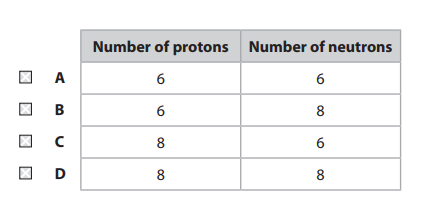
(a) The nucleus of an atom of carbon has 6 protons and 8 neutrons. Which row of the table shows the nucleus of an atom that is a different isotope of carbon?
(b) Which type of radiation is a high-energy electron?
A alpha
B beta
C gamma
D neutron
(c) A nucleus emits radiation. This causes the mass number to decrease by one. The atomic number stays the same. Which type of radiation does the nucleus emit?
A alpha
B beta
C gamma
D neutron
(d) The nucleus of an isotope of uranium can be represented using this symbol.
\(^{238}_{92}U\)
The nucleus forms part of a positively charged ion. How many electrons could be in this ion?
A 90
B 92
C 146
D 238
(e) A radioactive isotope has an initial activity of 400Bq. The half-life of the isotope is 8 hours. What is the activity of the isotope after 16 hours?
A 25Bq
B 50Bq
C 100Bq
D 200Bq
▶️Answer/Explanation
Ans
(a) A (6 protons, 6 neutrons);
B is not the answer because it is the same isotope
C is not the answer because it is a different element
D is not the answer because it is a different element
(b) B (beta);
A is not the answer because alpha is a helium nucleus
C is not the answer because gamma is a high frequency EM wave
D is not the answer because it is not an electron
(c) D (neutron);
A is not the answer because this would decrease the atomic number and
decrease the mass number
B is not the answer because this would increase the atomic number and
keep the mass number the same
C is not the answer because this would keep the atomic number and mass
number the same
(d) A (90);
B is not the answer because this is a neutral atom
C is not the answer because it is a negatively charged ion
D is not the answer because it is a negatively charged ion
(e) C (100 Bq);
A is not the answer because this is 4 half-lives
B is not the answer because this is 3 half-lives
D is not the answer because this is 1 half-life
Questions 3
(a) Topic – 5.c
(b) Topic-5.c
(c)Topic-5.b
(d)Topic-5.c
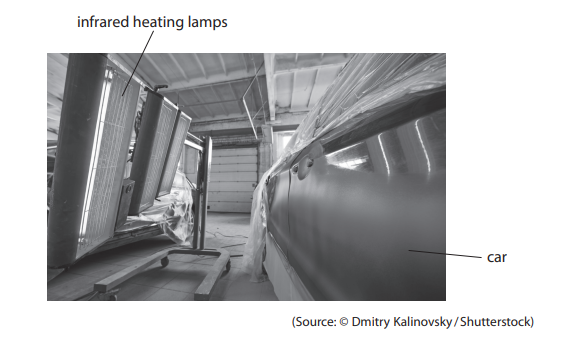
The photograph shows infrared heating lamps being used to harden fresh paint on a car.
(a) Give a harmful effect of infrared waves.
(b) The heating lamps produce visible light waves in addition to infrared waves.
(i) Give two similar properties of visible light waves and infrared waves.
(ii) Give two differences between the properties of visible light waves and infrared waves.
(c) The infrared heating lamps are placed 1.5 m from the car. Calculate the time taken for infrared waves emitted from a lamp to reach the car. [for infrared waves, speed = \(3.0 \times 10^8m/s\)]
(d) Paint takes less time to harden when it absorbs more energy from infrared radiation. A technician observes that white paint takes more time to harden than black paint. Explain this observation.
▶️Answer/Explanation
Ans
(a) {skin / eye / tissue} burns;
(b) (i) any two from:
• both electromagnetic waves;
• both transfer energy;
• both transverse waves;
• both are non-ionising;
• both can travel through vacuum;
• both have same speed (in a vacuum);
(ii) • infrared has longer/higher wavelength;
• infrared has lower frequency;
(c) substitution into speed = distance / time;
rearrangement;
evaluation;
e.g.
\(3.0 × 10^8 = 1.5 / time\)
\(time = 1.5 / 3.0 × 10^8\)
\((time =) 5.0 × 10^{−9} (s)\)
(d) black is a better/good absorber (of infrared radiation);
idea that more energy/heat transferred to black car (in the same time);
Questions 4
(a) Topic – 9.c
(b) Topic-9.c
(c) Topic-9.c
This question is about the evolution of a star.
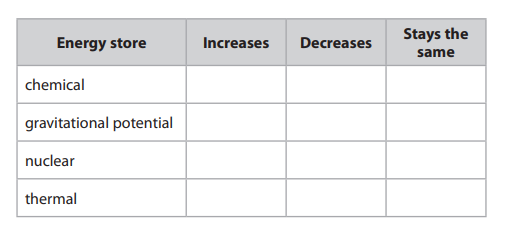
(a) A main sequence star is created in a collapsing region of a nebula. The table gives different energy stores for the gases in the collapsing nebula, from when the nebula starts to collapse to just before the main sequence star is created. Complete the table by placing ticks (ü) to show whether each energy store increases, decreases or stays the same.
(b) At the end of the main sequence stage of a star’s evolution, the star can become a red giant or a red supergiant. Give the property of a star that determines whether it becomes a red giant or a red supergiant.
(c) A red giant star eventually becomes a white dwarf star. Discuss the differences between a red giant star and a white dwarf star.
▶️Answer/Explanation
Ans
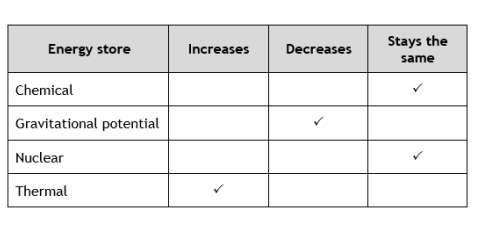
(a) one mark for each correct row;;;;
(b) mass;
(c) any four from:
MP1. red giant has greater brightness than white dwarf;
MP2. (nuclear) fusion takes place in red giant (core) but not in white dwarf (core);
MP3. red giant is larger than white dwarf;
MP4. red giant has lower (surface) temperature than white dwarf;
MP5. white dwarf is denser than a red giant;
MP6. white dwarf has a planetary nebula but a red giant does not;
Questions 5
(a) Topic – 1.c
(b) Topic-1.b
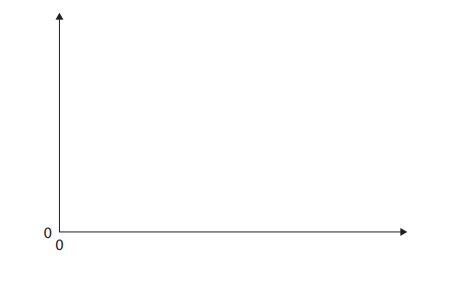
(a) A metal spring obeys Hooke’s law. Sketch a graph to show that the spring obeys Hooke’s law as it is stretched. You should label both axes with appropriate physical quantities
(b) Diagram 1 shows an object suspended from a support using a metal spring. The object is initially at rest.
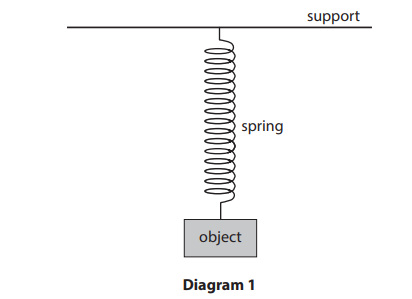
(i) The object is pulled down and then released. Diagram 2 shows the forces acting on the object at the instant it is released. 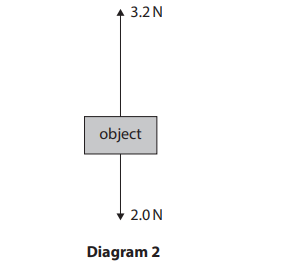
Determine the magnitude and direction of the resultant force acting on the object.
(ii) The object has a mass of 0.20kg. Calculate the acceleration of the object at the instant it is released
(iii) Explain how the magnitude of the acceleration of the object changes, from the instant the object is released until the first time the object returns to its initial resting position. You should refer to the forces acting on the object in your answer.
▶️Answer/Explanation
Ans
(a) axes labelled “extension”/“elongation” and “load”/“force”/”weight”;
straight line of positive gradient drawn throughout;
line passes through origin;
(b) (i) magnitude = 1.2 (N);
direction = up(wards);
(ii) substitution into F = m × a;
rearrangement;
evaluation;
e.g.
1.2 = 0.20 × a
a = 1.2 / 0.20
(a =) 6.0 \((m/s^2)\)
(iii) acceleration decreases (to zero);
with any two from:
• spring extension decreases;
• force from spring / elastic force / upwards force decreases;
• weight (of object) stays the same;
• resultant force decreases (to zero);
Questions 6
(a) Topic – 7.b
(b) Topic-7.b
(c) Topic-7.c
(c) Topic-7.c
Diagram 1 shows the magnetic field lines near the south pole of a bar magnet.
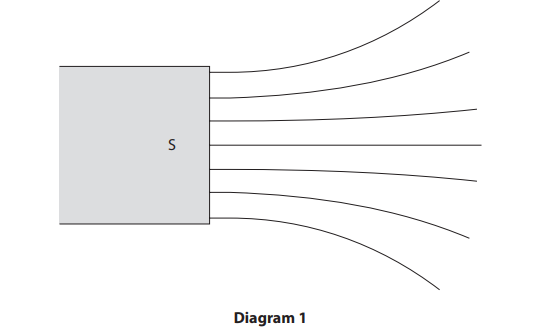
(a) Draw two arrows on the field lines in diagram 1 to show the direction of the magnetic field lines.
(b) Which of these is attracted to the bar magnet if placed in the magnetic field?
A copper
B nickel
C plastic
D zinc
(c) The strength of the magnetic field changes as the distance from the south pole increases. Explain how the magnetic field lines show this.
(d) Diagram 2 shows a small piece of iron that has been placed in the magnetic field.
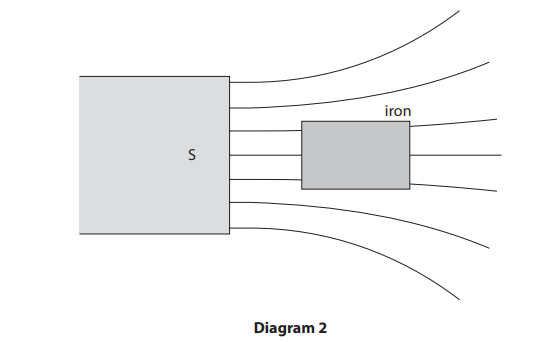
The piece of iron becomes magnetised when placed in the magnetic field.
(i) Explain why the piece of iron experiences a force towards the south pole of the bar magnet. You may add to diagram 2 to help your answer.
(ii) A student suggests that the piece of iron is now a permanent magnet. Explain why the student is incorrect.
▶️Answer/Explanation
Ans
(a) arrows drawn on at least two field lines pointing towards the south pole;
(b) B (nickel);
A is incorrect because copper is not a magnetic material
C is incorrect because plastic is not a magnetic material
D is incorrect because zinc is not a magnetic material
(c) field line spacing/density changes (with distance from south pole);
further apart field lines shows weaker field strength;
(d) (i) idea that a north pole is induced on the side of the iron nearest the bar magnet;
idea that opposite poles attract;
(ii) iron is a soft magnetic material;
iron loses its magnetism (when it is removed from the magnetic field);
Questions 7
(a) Topic – 2.c
(b) Topic-2.b
(c)Topic – 2.c
The diagram shows a domestic lighting circuit.
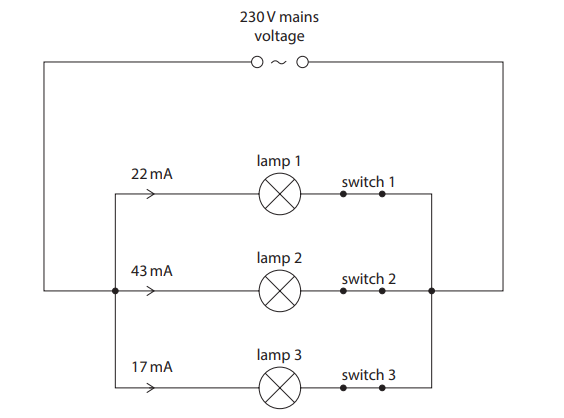
(a) Explain an advantage of using this circuit for domestic lighting.
(b) When switch 1 is closed, the current in lamp 1 is 22mA.
(i) Give the name of the charged particle that moves in an electric current.
(ii) Show that lamp 1 has a power of about 5W.
(iii) Calculate the energy transferred by lamp 1 when it is on for 30 seconds.
(c) The circuit is connected to the mains supply. Mains voltage is 230V.
(i) State what is meant by the term voltage.
(ii) Switches 1 and 3 are closed, which turn on lamps 1 and 3. Switch 2 is open. Calculate the current in the mains supply
▶️Answer/Explanation
Ans
(a) idea that lamps can be controlled independently;
(because) circuit is a parallel circuit;
(b) (i) electron(s);
(ii) substitution into formula;
conversion from mA to A;
evaluation to 2 or more s.f.;
e.g.
power = \(230 × 22(×10^{-3})\)
power = 230 × 0.022
power = 5.1 (W)
(iii) substitution into P = E/t;
rearrangement;
evaluation;
e.g.
5 = E / 30
E = 5 × 30
E = 150 (J)
(c) (i) energy (transferred) per unit charge (passed);
(ii) any attempt to add any currents together;
(current =) 39 (mA);
Questions 8
Topic – 5.d
The diagram shows two rays of light, A and B, incident on the boundary between air and water.
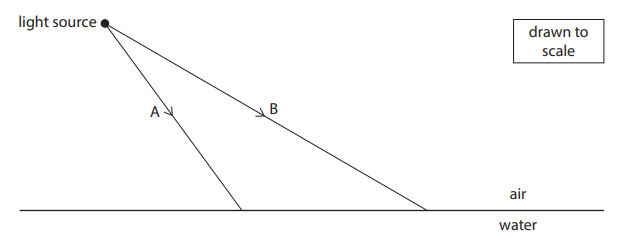
The refractive index of water is 1.33 Explain the paths of the two rays of light after they strike the boundary between air and water. Include calculations in your answer and draw on the diagram to support your answer.
▶️Answer/Explanation
Ans
any six from:
MP1. ray A is refracted and changes direction;
MP2. ray B is refracted and changes direction;
MP3. correctly measured angle of incidence for either ray;
MP4. correctly calculated angle of refraction for either ray A or ray B;
MP5. water and air have different (optical) densities;
MP6. light travels slower in water than air;
MP7. TIR does not happen because water is more (optically) dense than air;
Questions 9
(a) Topic – 6.d
(b) Topic-6.d
(c) Topic-6.d
This question is about air pressure.
(a) During an aeroplane flight, a passenger drinks some water from a plastic bottle. The passenger then replaces the top to seal the bottle, as shown in diagram 1.
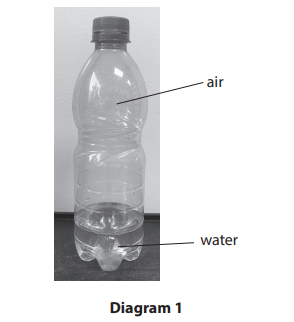
The air pressure outside the bottle is 80kPa. State the air pressure inside the bottle just after the bottle has been sealed.
(b) As the aeroplane descends, the air pressure inside the aeroplane changes. When the aeroplane lands, the passenger notices that the plastic bottle has collapsed, as shown in diagram 2.
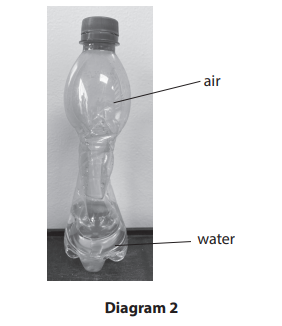
Explain why the bottle has collapsed.
(c) Explain how gas molecules in the air exert a pressure on the surface of the bottle.
▶️Answer/Explanation
Ans
(a) 80 (kPa);
(b) any two from:
MP1. pressure (in aeroplane) increases;
MP2. (resultant) force (inwards) on bottle;
MP3. idea that decreasing volume (in bottle) increases pressure (in bottle);
(c) any three from:
MP1. (direction of) movement of molecules is random;
MP2. molecules collide with the (bottle) surface;
MP3. exert a force (on the surface);
MP4. pressure is force on an area;
Questions 10
(a) Topic – 1.c
(b) Topic-1.c
(c) Topic-1.c
Diagram 1 shows the apparatus a student uses to investigate the bending of a wooden strip. Part of the wooden strip is clamped to a table. A load is fixed to the free end of the wooden strip, causing it to bend.
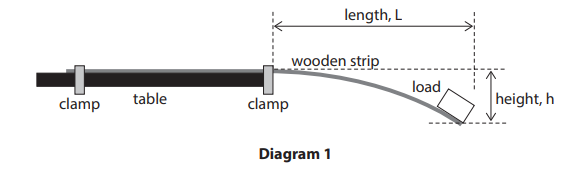
The free end of the wooden strip is positioned a length, L, beyond the edge of the table, as shown in diagram 1. The weight of the load causes the end of the wooden strip to move down through a height, h. A student investigates how the length, L, affects the height, h.
(a) The load has a mass of 250g. Calculate the weight of the load. Use the formula
weight = mass × gravitational field strength, g
(b) This is the student’s method for the investigation.
• clamp the wooden strip so that L = 20cm
• fix the load to the end of the wooden strip, as shown in diagram 1
• measure the height, h
The student repeats this method for different values of L.
(i) Give the independent and dependent variables in the investigation.
(ii) Give two control variables in the investigation.
(iii) Suggest how the student could accurately measure the height, h.
(c) The table shows the results of the investigation.
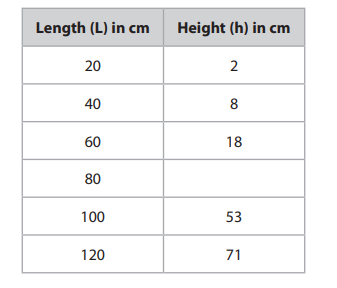
(i) Diagram 2 shows the wooden strip when L = 80 cm. 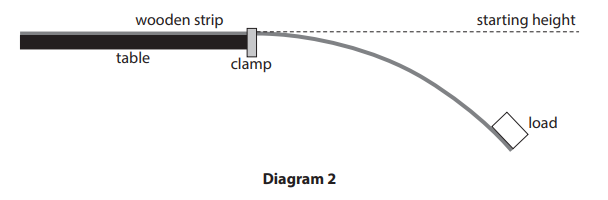
Using diagram 2, determine the height, h, in the laboratory.
[1cm on the diagram = 10cm in the laboratory]
(ii) Plot a graph of the student’s results.
(iii) Draw the curve of best fit.
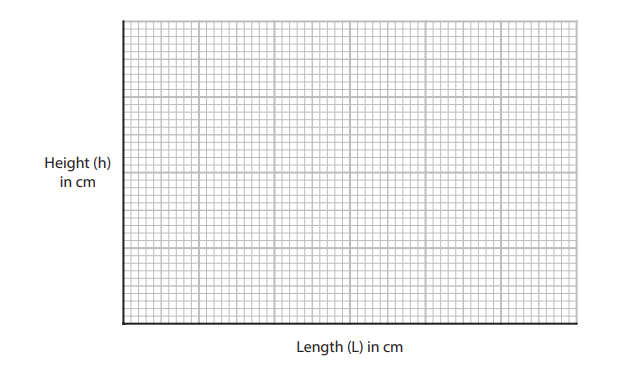
(iv) The student concludes that h is directly proportional to L. Evaluate the student’s conclusion.
▶️Answer/Explanation
Ans
(a) substitution into formula;
e.g.
weight = 250 (÷1000) × 10
(weight =) 2.5 (N)
(b) (i) independent variable = length (extending beyond table);
dependent variable = height;
(ii) any two from: 2
• mass/weight of load;
• position of load (on wooden strip);
• thickness of wood(en strip);
• material/type of wood(en strip);
(iii) any two from: 2
MP1. use of (metre) rule;
MP2. fixed in place at end of wooden strip;
MP3. 0 on rule placed at original height of wooden strip;
MP4. method to ensure measurement is vertical e.g. using a plumb line, set square etc.;
MP5. measure at eye level;
(c) (i) correct measurement from diagram = 3.1 (cm);
use of scale factor gives 31 (cm);
(ii) suitable linear scale chosen (>50% of grid used);
plotting correct to nearest half square;
(iii) acceptable curve of best fit drawn for data between 20cm and 120cm;
(iv) idea that proportionality requires a straight line (through the origin);
(graph does not show this so)
conclusion/student is incorrect;
Questions 11
(a) Topic – 2.b
(b) Topic-2.c
(c) Topic-2.c
The photograph shows a power bank used to recharge the battery in an electronic device.
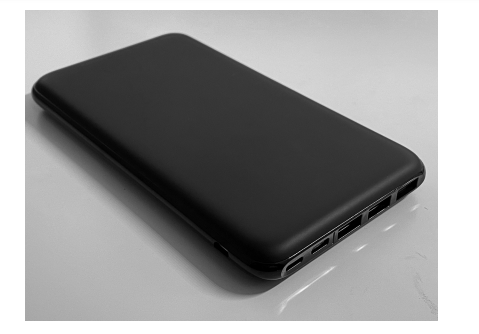
(a) The power bank stores charge. The charge stored can be measured in amp-hours (Ah). 1Ah is the amount of charge transferred by a current of 1A in a time of 1 hour. Calculate the charge stored in coulombs when the charge stored is 1Ah. Use the formula
charge stored = current × time taken
(b) An electronic device is connected to the power bank. Whilst recharging, the electronic device receives a constant current of 2.4A and \(3.8 × 10^3C\) of charge is transferred.
(i) Calculate the time taken to recharge the electronic device. Give your answer in minutes.
(ii) The electronic device is connected to the power bank using a long cable. Suggest how using a long cable affects the time taken to recharge the electronic device when compared with a short cable.
(c) A student owns three electronic devices. Each electronic device stores a different amount of charge. The table gives some information about the charge stored by the electronic devices and how often they need to be recharged.
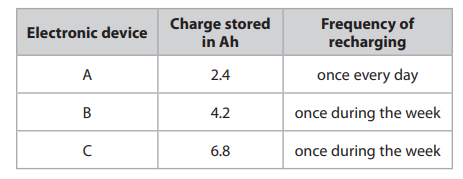
The power bank stores a maximum charge of 26.8Ah. The student needs to take these three electronic devices on a school trip for one week. Determine whether the maximum charge of the power bank is enough to recharge the batteries of the three electronic devices during the school trip
▶️Answer/Explanation
Ans
(a) conversion of hours into seconds;
evaluation;
e.g.
1 hour = (60 × 60 =) 3600 (s)
(charge = 1 × 3600 =) 3600 (C)
(b) (i) substitution OR rearrangement;
evaluation in seconds;
conversion to minutes;
e.g.
\(3.8 × 10^3 = 2.4 × t\) OR t = Q/I
(t =) 1600 (s)
(t =) 26 (minutes)
(ii) idea that longer cable has more resistance;
(so) charging current will be less AND time taken
will increase;
(c) any four from:
MP1. determination of total charge needed for the week;
MP2. quantitative comparison to power bank charge;
MP3. idea that power bank cannot recharge all devices (from completely flat);
MP4. idea that devices will not always be completely empty when recharged;
MP5. idea that devices could be used less (which would make them last longer before recharging);
MP6. idea that other charging facilities might be available;
Questions 12
(a) Topic – 1.b
(b) Topic-1.b
(c) Topic-1.b
A car accelerates with a constant driving force along a horizontal road and reaches its maximum speed. This is the velocity-time graph for the car’s journey.
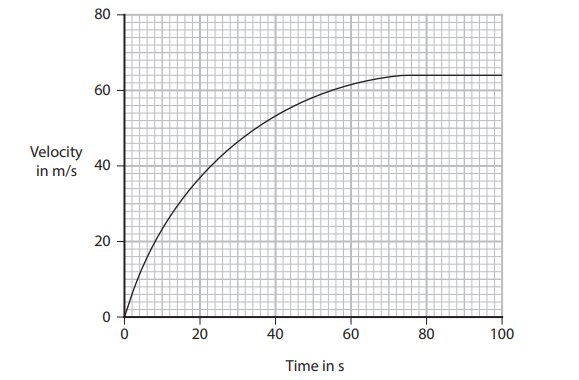
(a) By drawing a tangent to the curve, determine the acceleration of the car at a time of 20s.
(b) Determine the distance travelled by the car during the first 80s of its journey.
(c) Explain the motion of the car after 80s.
▶️Answer/Explanation
Ans
(a) appropriate attempt to draw tangent at 20s on the graph;
acceleration = gradient;
acceleration in the range 1.00-1.20 \((m/s^2)\);
acceleration in the range 1.05-1.15 \((m/s^2)\);
(b) distance = area under line;
suitable method used;
distance in the range = 3200-4200 (m);
distance in the range = 3500-4000 (m);
distance in the range = 3700-3800 (m);
(c) speed/velocity is constant;
idea that driving force of car = air resistance;
resultant force is zero;