
iGCSE Physics (0625) 1.2 Motion - Exam Style Questions Paper 1 -New Syllabus
Question
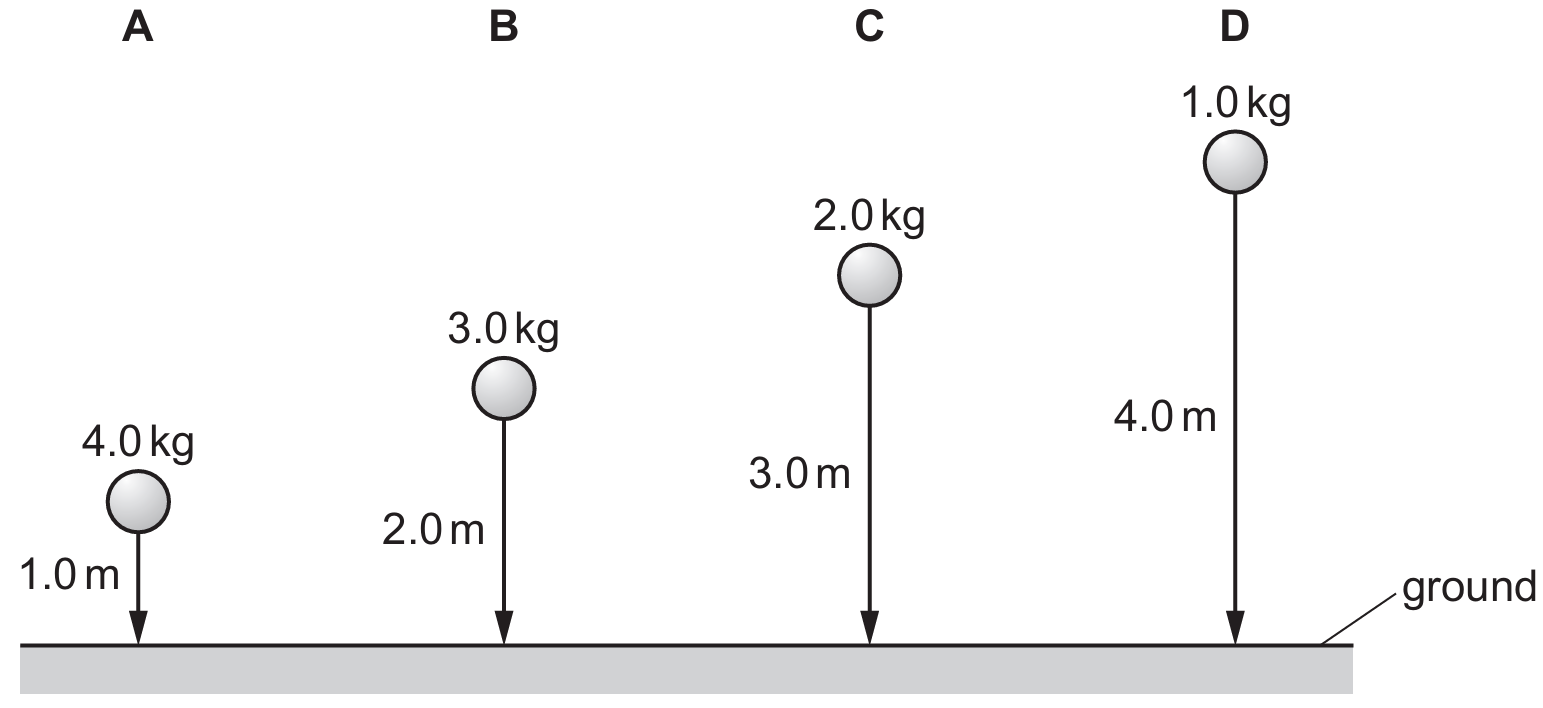
Four balls with different masses are dropped from the heights shown.
Air resistance can be ignored.
Which ball has the greatest average speed?
▶️ Answer/Explanation
Correct Answer: \( \boxed{\mathrm{D}} \)
When air resistance is ignored, all objects fall with the same acceleration due to gravity:
\( g \approx 9.8\,\mathrm{m\,s^{-2}} \)
The final speed of a ball dropped from rest is given by:
\( v=\sqrt{2gh} \)
The average speed during the fall is:
\( v_{\mathrm{avg}}=\frac{0+v}{2}=\frac{v}{2} \)
Therefore, the average speed is proportional to \( \sqrt{h} \).
The heights are: \(1.0\,\mathrm{m}\), \(2.0\,\mathrm{m}\), \(3.0\,\mathrm{m}\), and \(4.0\,\mathrm{m}\).
Since Ball D is dropped from the greatest height, \(4.0\,\mathrm{m}\), it reaches the greatest final speed and therefore has the greatest average speed.
The masses do not affect the motion because all balls experience the same gravitational acceleration.
Hence, the correct answer is (D).
Question
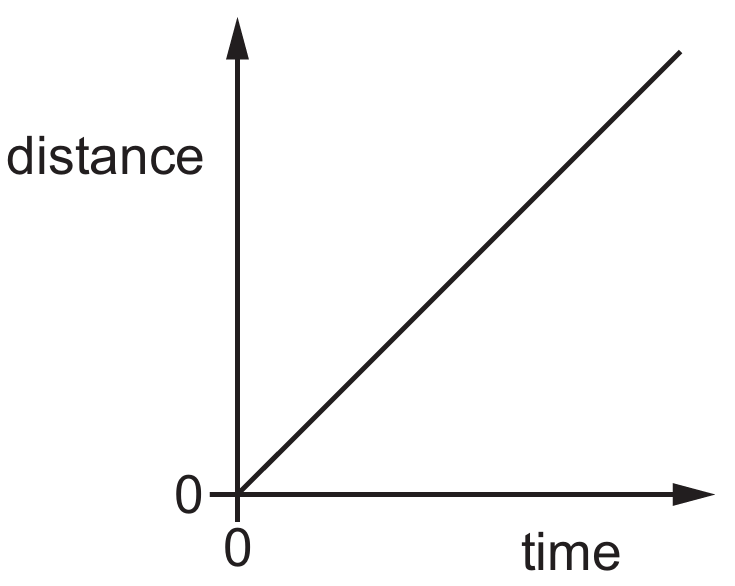
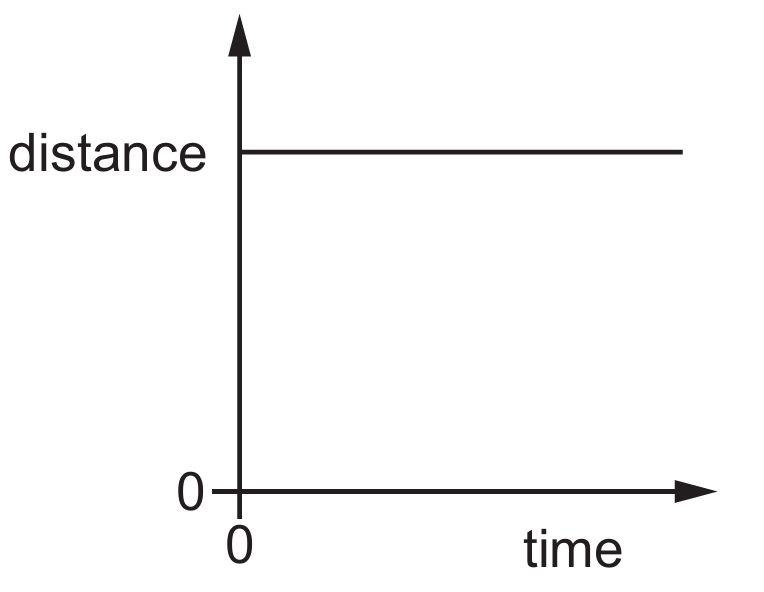
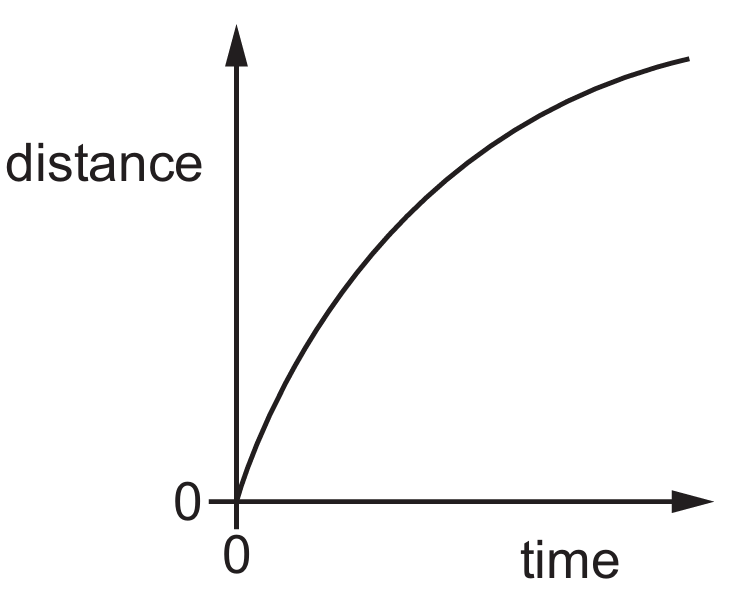
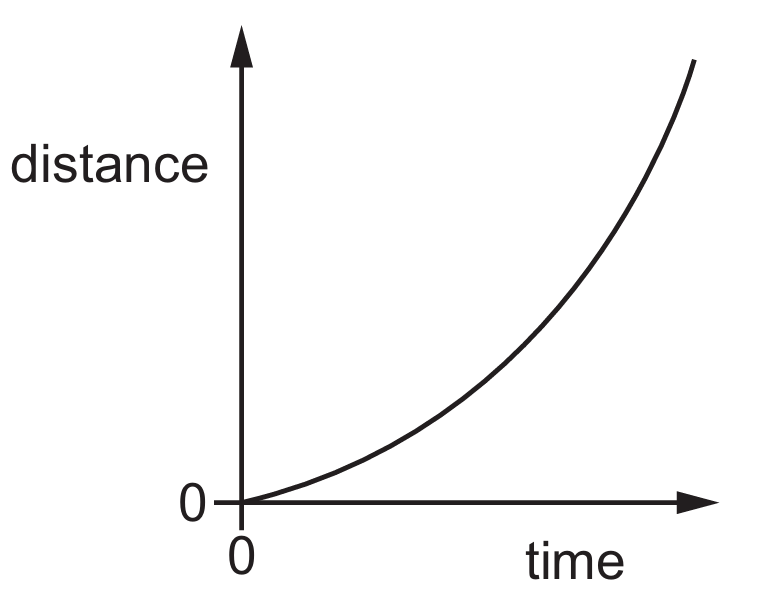
The diagrams show distance–time graphs for four objects. Which object is moving with increasing speed?
(B)
(C)
(D)
▶️ Answer/Explanation
Correct Answer: \( \boxed{\mathrm{D}} \)
On a distance–time graph, the speed of an object is represented by the gradient (slope) of the graph.
\( \mathrm{Speed} = \frac{\mathrm{Distance}}{\mathrm{Time}} \)
Graph A has a constant gradient, so the object moves with constant speed.
Graph B is horizontal, so the distance does not change with time. The object is stationary.
Graph C becomes less steep with time, meaning the gradient decreases and the speed is decreasing.
Graph D becomes steeper with time, meaning the gradient increases continuously.
An increasing gradient indicates an increasing speed, so the object is accelerating.
Therefore, Graph D represents an object moving with increasing speed.
Hence, the correct answer is (D).
Question
Which statement about acceleration is correct?
(B) It is the distance an object travels in one second.
(C) It is the force acting on an object divided by the distance it travels in one second.
(D) It is the force acting on an object when it is near to the Earth.
▶️ Answer/Explanation
Correct Answer: \( \boxed{\mathrm{A}} \)
Acceleration is the rate of change of velocity with time.
\( a = \frac{\Delta v}{\Delta t} \)
Since velocity depends on both speed and direction, any change in speed or direction causes acceleration.
Option (B) describes speed, which is distance travelled per unit time.
Option (C) is not a valid physical definition. Although \(F = ma\), acceleration is not equal to force divided by distance travelled in one second.
Option (D) describes weight, the gravitational force acting on an object near Earth: \( W = mg \).
Therefore, the correct statement is that acceleration is related to the changing speed (or velocity) of an object.
Hence, the correct answer is (A).