
iGCSE Physics (0625) 1.3 Mass and weights Exam Style Questions Paper 1 - New Syllabus
Question
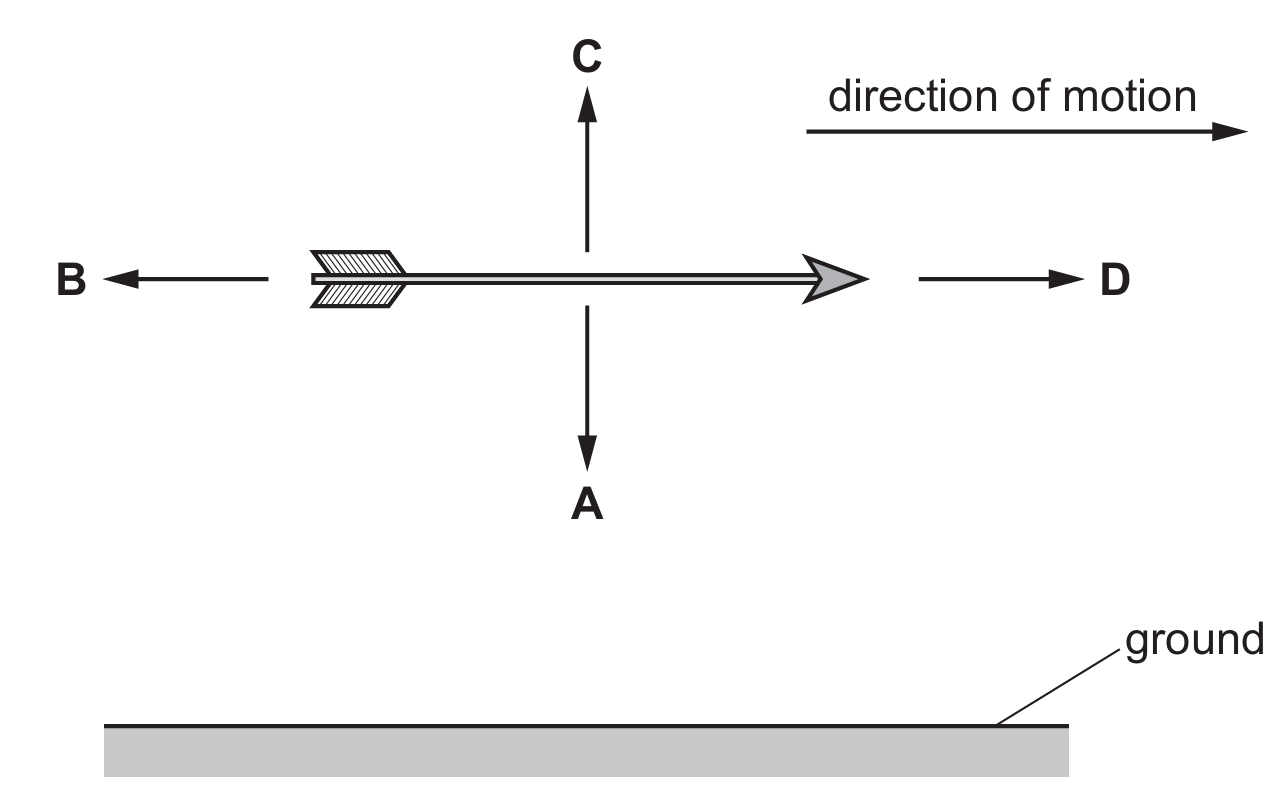
An arrow travels horizontally in a straight line at constant speed.
In which direction does the weight of the arrow act?
▶️ Answer/Explanation
Correct Answer: \( \boxed{\mathrm{A}} \)
Weight is the gravitational force acting on an object.
It is given by:
\( W = mg \)
where \(m\) is the mass of the object and \(g\) is the gravitational field strength.
The weight of an object always acts vertically downward towards the centre of the Earth, regardless of the object’s motion.
Even though the arrow is moving horizontally at constant speed, gravity still acts downward.
In the diagram, direction A points vertically downward toward the ground.
Therefore, the weight of the arrow acts in direction A.
Hence, the correct answer is (A).
Question
An object with a mass of \(6.0\,\mathrm{kg}\) rests on the surface of a planet.
On this planet, \(g = 20\,\mathrm{N/kg}\).
What is the weight of the object on this planet?
(B) \(0.60\,\mathrm{N}\)
(C) \(60\,\mathrm{N}\)
(D) \(120\,\mathrm{N}\)
▶️ Answer/Explanation
Correct Answer: \( \boxed{\mathrm{D}} \)
Weight is the gravitational force acting on an object and is given by:
\( W = mg \)
Given:
\( m = 6.0\,\mathrm{kg} \)
\( g = 20\,\mathrm{N/kg} \)
Substituting into the formula:
\( W = 6.0 \times 20 \)
\( W = 120\,\mathrm{N} \)
Therefore, the object experiences a gravitational force of \(120\,\mathrm{N}\) on the planet.
Hence, the correct answer is (D).
Question
Which property of an object never changes when a force acts on the object?
(B) shape
(C) size
(D) speed
▶️ Answer/Explanation
Correct Answer: \( \boxed{\mathrm{A}} \)
A force can change the motion of an object or deform it.
According to Newton’s Second Law:
\( F = ma \)
A resultant force can produce an acceleration, causing the object’s speed or direction to change.
Forces can also change an object’s shape or size, such as stretching, compressing, or bending it.
However, applying a force does not change the amount of matter contained in the object.
Therefore, the mass of the object remains constant even when a force acts on it.
Hence, the correct answer is (A).