
iGCSE Physics (0625) 1.4 Density -Exam Style Questions Paper 1 - New Syllabus
Question
A student is asked to find the volume of a small irregularly shaped piece of rock. The student has a balance, a measuring cylinder containing water, and a ruler available.
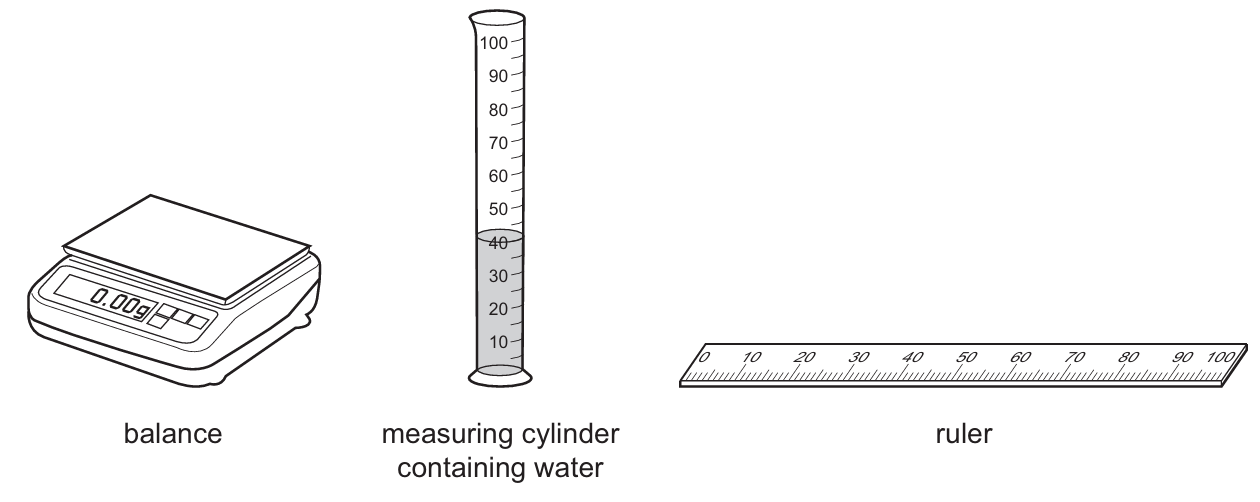
Which apparatus must the student use to find the volume of the small piece of rock?
(B) ruler only
(C) balance and measuring cylinder
(D) measuring cylinder only
▶️ Answer/Explanation
Correct Answer: \( \boxed{\mathrm{D}} \)
The volume of an irregularly shaped object is measured using the water displacement method.
A ruler cannot be used because the rock does not have regular dimensions from which a volume formula can be applied.
A balance measures mass, not volume, so it is not required for this measurement.
First, record the initial water level \(V_1\) in the measuring cylinder.
Then immerse the rock completely and record the new water level \(V_2\).
The volume of the rock is:
\( V_{\mathrm{rock}} = V_2 – V_1 \)
Therefore, only the measuring cylinder is needed to determine the volume of the irregularly shaped rock.
Hence, the correct answer is (D).
Question
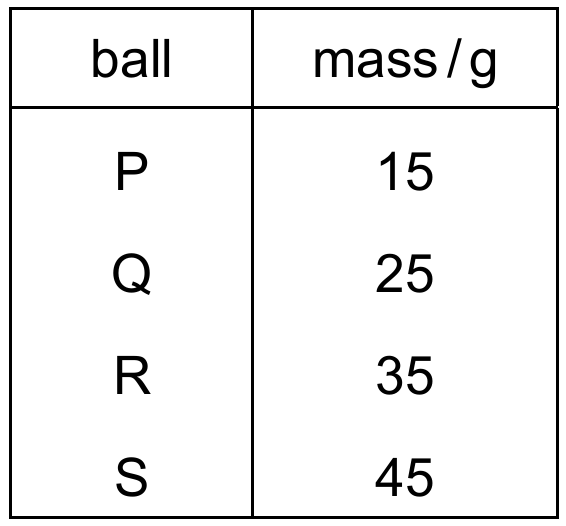
Four hollow glass balls, P, Q, R and S, each have a volume of \(30\,\mathrm{cm^3}\).
The mass of each ball is shown in the table.
Which balls will float in a liquid of density \(0.95\,\mathrm{g/cm^3}\)?
(B) P only
(C) R and S
(D) S only
▶️ Answer/Explanation
Correct Answer: \( \boxed{\mathrm{A}} \)
An object floats if its density is less than the density of the liquid.
Density is calculated using:
\( \rho=\frac{m}{V} \)
For ball P: \( \rho_P=\frac{15}{30}=0.50\,\mathrm{g/cm^3} \)
For ball Q: \( \rho_Q=\frac{25}{30}\approx0.83\,\mathrm{g/cm^3} \)
For ball R: \( \rho_R=\frac{35}{30}\approx1.17\,\mathrm{g/cm^3} \)
For ball S: \( \rho_S=\frac{45}{30}=1.50\,\mathrm{g/cm^3} \)
The liquid density is \(0.95\,\mathrm{g/cm^3}\).
Since \(0.50 < 0.95\) and \(0.83 < 0.95\), balls P and Q float.
Balls R and S have densities greater than the liquid density, so they sink.
Therefore, the balls that will float are P and Q.
Hence, the correct answer is (A).
Question
Which piece of equipment is useful in determining the density of an irregularly-shaped stone?
(B) metre ruler
(C) measuring cylinder
(D) voltmeter
▶️ Answer/Explanation
Correct Answer: \( \boxed{\mathrm{C}} \)
Density is defined as:
\( \rho = \frac{m}{V} \)
To determine the density of an irregularly-shaped stone, both its mass and volume must be known.
The volume of an irregular object cannot be measured accurately using a metre ruler. Instead, the displacement method is used.
The stone is submerged in water, and the increase in water level gives the volume of the stone.
A measuring cylinder is required to measure this change in volume accurately.
A stop-watch measures time, and a voltmeter measures potential difference, so neither is useful for finding density.
Therefore, the correct equipment is the measuring cylinder.
Hence, the correct answer is (C).