
iGCSE Physics (0625) 1.7.3 Energy resources -Exam Style Questions Paper 1- New Syllabus
Question
Different energy resources are used to produce electricity on a small island.
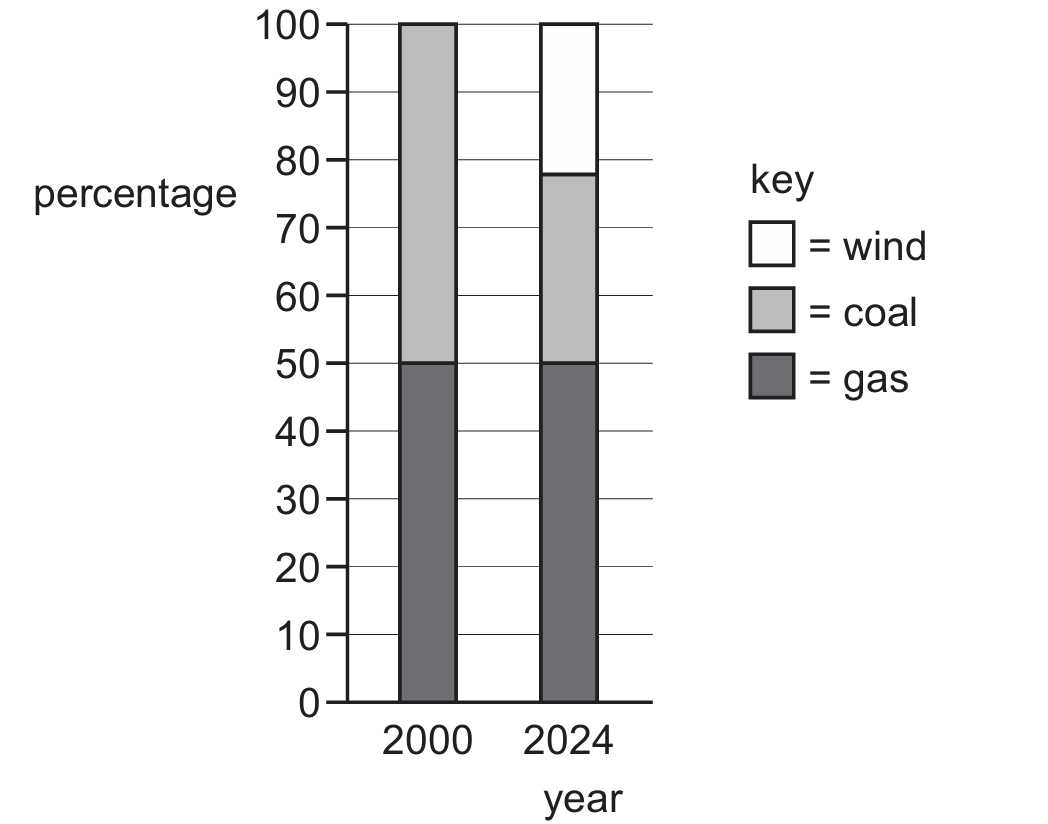
The chart shows the percentages of each energy resource used in \(2000\) and in \(2024\).
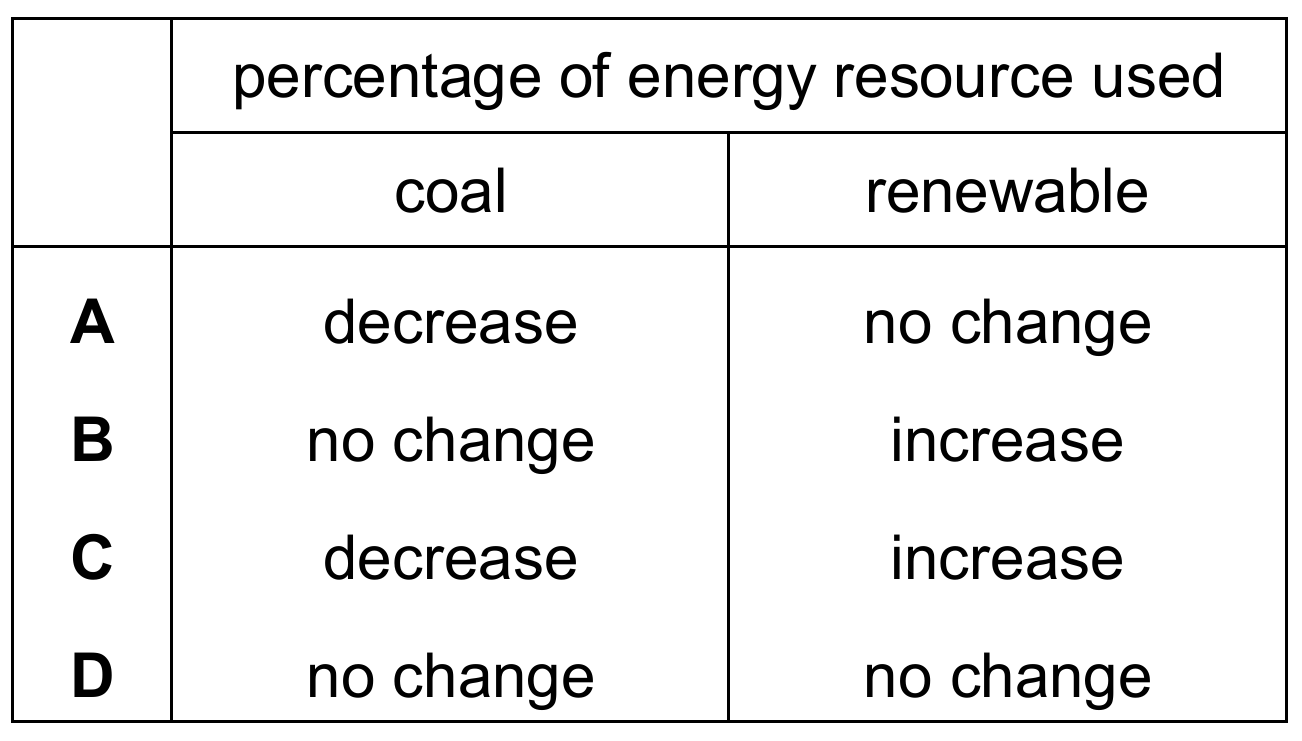
Which row correctly describes any changes in the percentage for \(2024\) compared with \(2000\)?
▶️ Answer/Explanation
Correct Answer: \( \boxed{\mathrm{C}} \)
From the chart for \(2000\):
Gas \(=50\%\), Coal \(=50\%\), Wind \(=0\%\).
From the chart for \(2024\):
Gas \(=50\%\), Coal \(=28\%\), Wind \(=22\%\).
Coal decreases from \(50\%\) to \(28\%\).
Wind energy is the renewable resource shown, and it increases from \(0\%\) to \(22\%\).
Gas remains unchanged at \(50\%\), but the question asks about coal and renewable energy.
Therefore:
Coal \(\rightarrow\) decrease
Renewable energy \(\rightarrow\) increase
Hence, the correct row is (C).
Question
Which energy resource requires a power station with a boiler to produce steam when generating electricity?
(B) tides
(C) water behind a dam
(D) wind
▶️ Answer/Explanation
Correct Answer: \( \boxed{\mathrm{A}} \)
In a coal-fired power station, coal is burned to release thermal energy.
This thermal energy heats water in a boiler to produce high-pressure steam.
The steam drives a turbine, which turns a generator to produce electricity.
Tidal, hydroelectric, and wind power stations do not require boilers because they use the kinetic or gravitational potential energy of moving water or air directly.
Therefore, only coal requires a boiler to generate steam as part of the electricity-generation process.
Hence, the correct answer is (A).
Question
Which energy resource does not contain a store of chemical energy?
(B) coal
(C) nuclear fuel
(D) oil
▶️ Answer/Explanation
Correct Answer: \( \boxed{\mathrm{C}} \)
Chemical energy is stored in the chemical bonds of substances and is released during chemical reactions such as combustion.
Biofuels, coal, and oil all release energy by burning, so they contain stores of chemical energy.
Nuclear fuel releases energy through nuclear reactions, such as fission, rather than through chemical reactions.
The energy in nuclear fuel is stored in the nucleus of atoms and is known as nuclear energy.
Therefore, nuclear fuel is the only resource listed that does not contain a chemical energy store.
Hence, the correct answer is (C).