iGCSE Physics (0625) 2.1.3 Gases and the absolute scale of temperature-Exam Style Questions- New Syllabus

Question

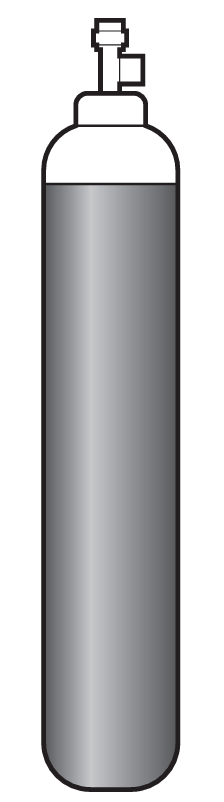
The diagram shows a cylinder containing oxygen under high pressure.
The temperature of the cylinder and the oxygen decreases.
Which statement describes what happens to the pressure in the cylinder and gives the reason why the pressure changes?
A. The pressure decreases because the oxygen particles move faster.
B. The pressure decreases because the oxygen particles move more slowly.
C. The pressure increases because the oxygen particles move faster.
D. The pressure increases because the oxygen particles move more slowly.
▶️ Answer/Explanation
Correct Option: B

Detailed solution:

Temperature is a measure of the average kinetic energy of particles, where $E_{k} = \frac{1}{2}mv^{2}$.
As the temperature decreases, the oxygen particles lose kinetic energy and move more slowly ($v$ decreases).
Pressure in a gas is caused by particles colliding with the cylinder walls, exerting a force per unit area ($p = \frac{F}{A}$).
Slower particles collide with the walls less frequently and with less force, leading to a reduction in total pressure.
According to Gay-Lussac’s Law, for a fixed volume, pressure is directly proportional to absolute temperature ($P \propto T$).
Therefore, a decrease in temperature results in a decrease in pressure because the particles move more slowly.
Question

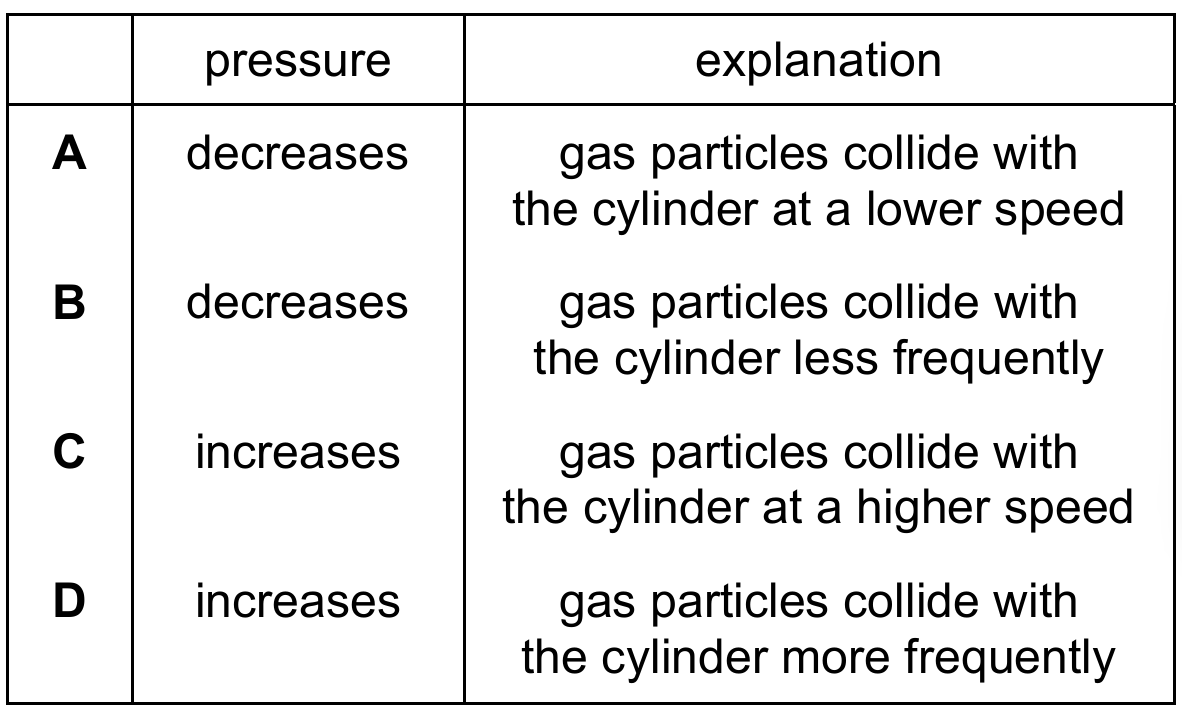
A fixed mass of gas at a constant temperature is trapped in a cylinder which has a movable piston.
Which row states and explains what happens to the pressure of the gas in the cylinder when the volume of the gas increases?
▶️ Answer/Explanation
Correct Option: B

Detailed solution:

At a constant temperature, the average kinetic energy and speed of gas particles remain unchanged. According to Boyle’s Law, $pV = \text{constant}$, so increasing the volume $V$ results in a decrease in pressure $p$. Microscopically, as the volume increases, the particles are spread over a larger space, leading to an increase in the average distance between them. This results in the gas particles colliding with the cylinder walls less frequently per unit area. Consequently, the total force exerted on the walls decreases, which explains why the pressure decreases. Therefore, Row B provides the correct state and explanation.

Question

The temperature of an object is 37 ∘ C.
What is the temperature of the object in kelvin?
A. −236 K
B. 7.4 K
C. 236 K
D. 310 K
▶️ Answer/Explanation
Correct Option: D

Detailed solution:

To convert a temperature from the Celsius scale to the Kelvin scale, we use the standard relation: T(in K)=θ(in ∘ C)+273.
Given that the temperature of the object is θ=37 ∘ C, we substitute this value into the conversion formula.
The calculation becomes T=37+273, which equals 310.
Therefore, the temperature in kelvin is 310 K.
This corresponds to option D, which correctly identifies the absolute temperature value.
Note that the kelvin scale starts at absolute zero, which is equivalent to −273 ∘ C.

Scroll to Top