iGCSE Physics (0625) 3.1 General properties of waves-Exam Style Questions- New Syllabus

Question

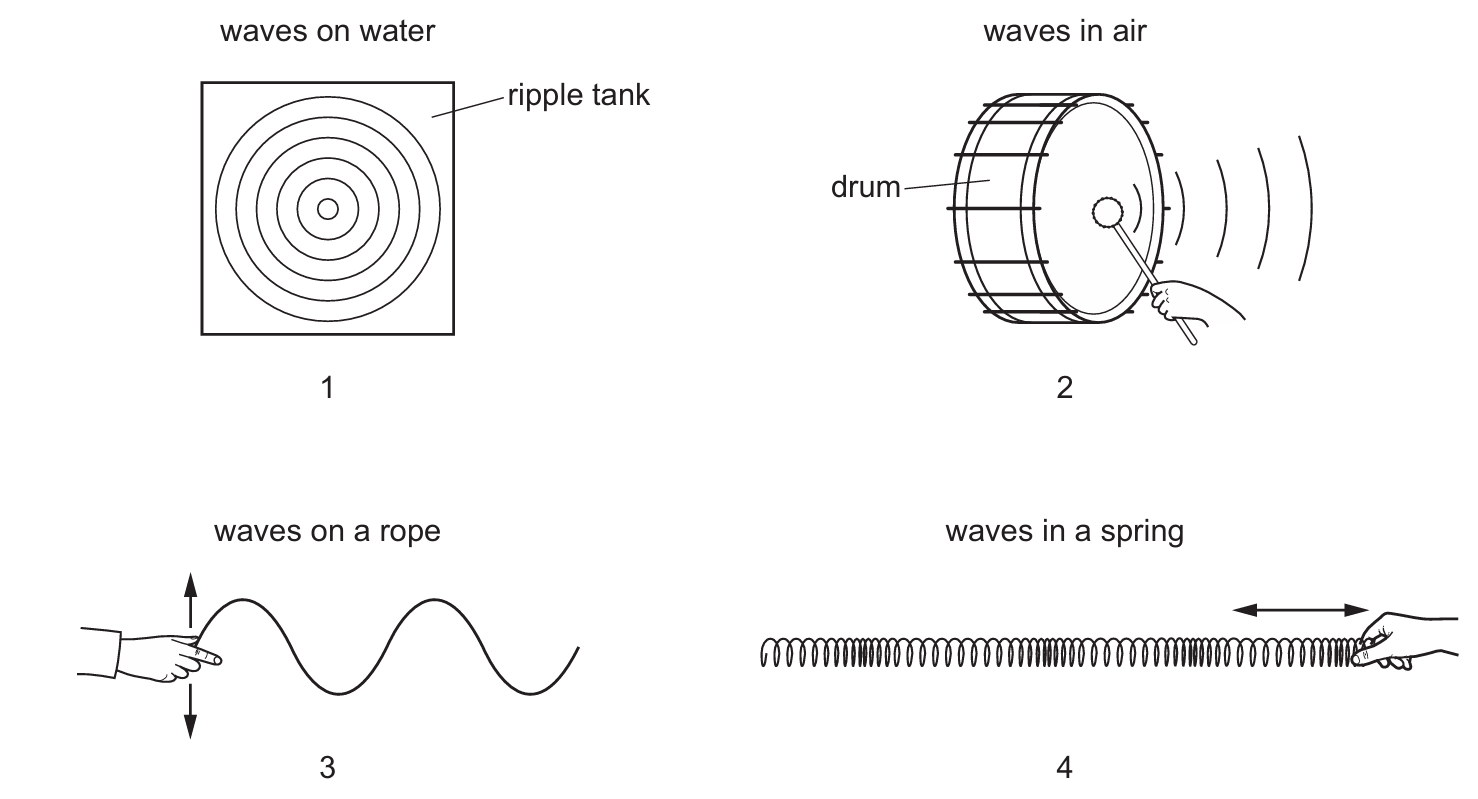
The diagrams show examples of wave motion.
Which waves are longitudinal?
A. 1 only
B. 2, 3 and 4
C. 2 and 3 only
D. 2 and 4 only
▶️ Answer/Explanation
Correct Option: D

Detailed solution:

In longitudinal waves, particles vibrate parallel to the direction of wave travel. Diagram 2 represents sound waves in air, which are always longitudinal as they consist of compressions and rarefactions. Diagram 4 shows a spring being pushed and pulled horizontally, creating vibrations parallel to the energy transfer. Conversely, water waves (Diagram 1) and waves on a rope (Diagram 3) are transverse, where vibrations occur at $90^\circ$ to the direction of propagation. Therefore, only examples 2 and 4 describe longitudinal motion.

Question

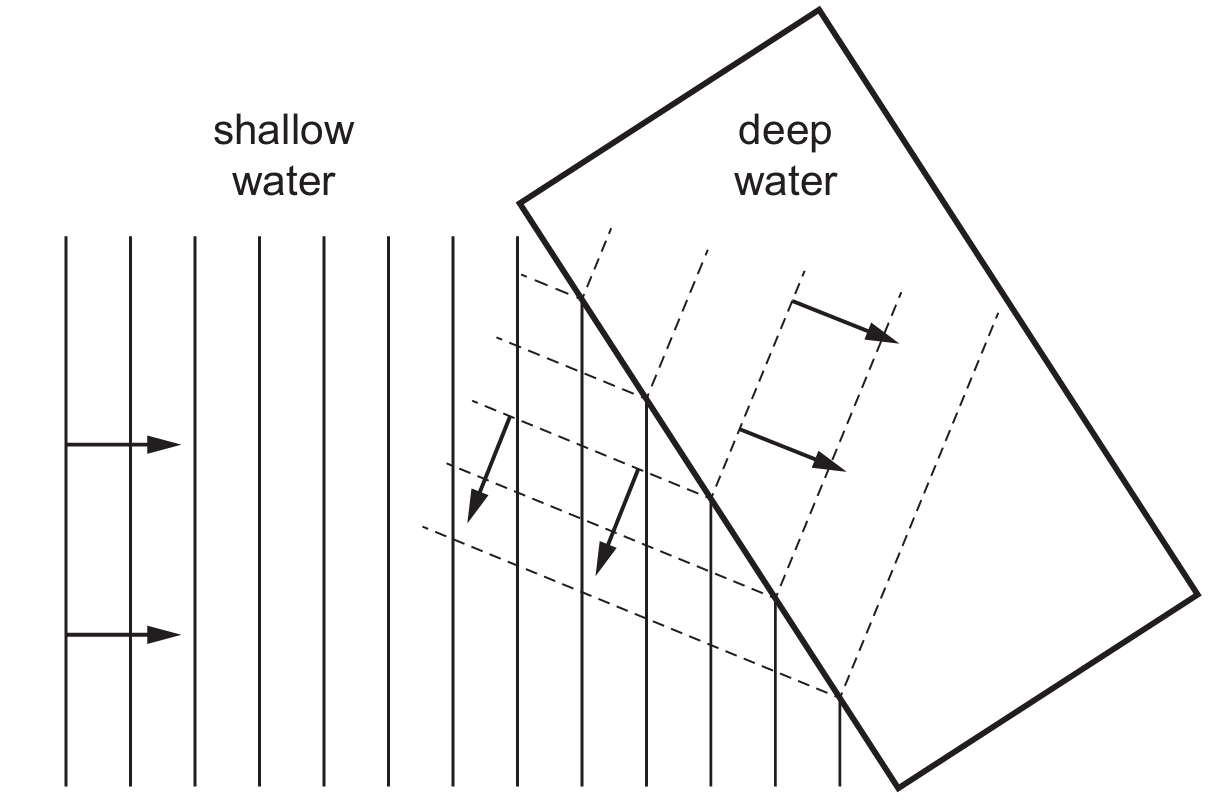
A student draws a diagram to show two different properties of a water wave. The arrows show the wave directions.
Which two wave properties does the diagram show?
A. refraction and diffraction
B. reflection and dispersion
C. reflection and diffraction
D. reflection and refraction
▶️ Answer/Explanation
Correct Option: D

Detailed solution:

The diagram illustrates two distinct wave behaviors. First, reflection is shown by the arrows bouncing off the boundary back into the shallow water, where the angle of incidence equals the angle of reflection. Second, refraction is evident as the wave crosses the boundary from shallow to deep water. This transition causes a change in wave speed $v$ and wavelength $\lambda$, resulting in the wave changing direction as it enters the new medium. Since no spreading through gaps (diffraction) or splitting into colors (dispersion) is shown, option D is the correct choice.

Question

P-waves and S-waves are produced in the ground during an earthquake.
Which statement about these waves is correct?
A. Only P-waves are transverse waves.
B. Only P-waves are longitudinal waves.
C. Both P-waves and S-waves are longitudinal waves.
D. Both P-waves and S-waves are transverse waves.
▶️ Answer/Explanation
Correct Option: B

Detailed solution:

Seismic waves are categorized based on their direction of vibration relative to propagation.
P-waves (primary waves) are longitudinal, meaning vibrations are parallel to the wave’s direction.
S-waves (secondary waves) are transverse, meaning vibrations are at $90^{\circ}$ to the wave’s direction.
Since P-waves are longitudinal and S-waves are transverse, statement B is the only correct choice.
Options A, C, and D incorrectly classify the fundamental nature of one or both wave types.
Therefore, only P-waves are longitudinal waves in this comparison.

Scroll to Top